



Nylon Wheel Brush: Gentle Finishing for Fragile Workpieces
A nylon wheel brush finishes fragile workpieces by spreading contact across hundreds of flexible filament tips instead of cutting with stiff wire ends. That difference decides the outcome on a thin aluminium panel, a brass fitting, an anodised cover or a painted housing, where one deep scratch turns a finished part into scrap. The mechanism behind the gentleness is simple, but it has limits, and those limits are where most scratched parts come from. This article explains how the filament behaves, where a nylon wheel stops being gentle, and how to set a process and accept a finish that holds in production.
Why a Nylon Wheel Brush Bends Instead of Cutting
A wheel brush works only where filaments touch the part. In a wire wheel, each bristle is a stiff steel cantilever with a small, hard end. When it meets a raised burr or a proud grain of a casting, the load concentrates at that point and the end behaves like a tiny cutting tool, leaving a groove whose depth is set by how far the bristle can bite. Across thousands of bristles the surface ends up with a pattern of short, deep scratches.
A nylon filament of comparable diameter has far lower stiffness, so it deflects at the first resistance. Load spreads to neighbouring filaments instead of concentrating on the first point of contact, and the tip slides over a high spot rather than digging into it. The outcome is a shallower, more even scratch pattern and a much lower chance of one deep score that survives every later polishing step. This is professional reasoning from filament behaviour, not a measured comparison, and a trial on the real workpiece settles the question faster than any data sheet.
Contact pressure decides whether the filament wipes or cuts
The same nylon filament can clean a surface or cut into it, depending on pressure and speed. At light deflection the tips sweep dust, release agent and light oxidation without changing the substrate. Press harder, or run the wheel fast enough that centrifugal force stiffens the filaments, and the tips stop yielding. That transition is the most useful thing an operator can learn to feel: the brush should sound steady, the part should stay cool, and the filaments should spring back after the pass.
Abrasive nylon and unfilled nylon do different jobs
Wheel brushes sold as nylon fall into two groups. Unfilled nylon filaments carry no grain, so they clean, wipe and de-dust without abrading. Abrasive nylon filaments have aluminium oxide or silicon carbide grain bonded through the filament, which exposes fresh cutting points as the filament wears and holds a more consistent finish over the life of the brush. Choosing between the two is the first selection decision, because a gentle-abrasion claim applies to the abrasive group only when the grit is fine enough for the substrate.
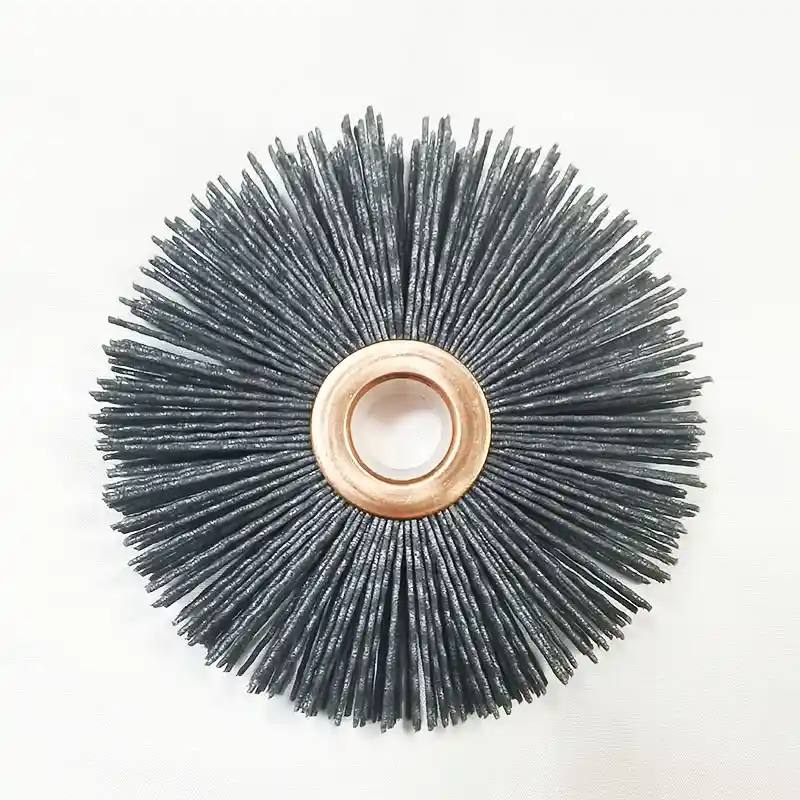
Trim length and filament length also shape how a wheel conforms. A longer trim gives more deflection and reaches into radii, thread roots and shallow recesses. A shorter trim stiffens the brush and makes it more aggressive. Two wheels with the same diameter and the same grit can therefore behave very differently on one part, which is why the trim dimension belongs in the enquiry alongside the abrasive specification.
Where Gentle Finishing Works and Where It Stops
Nylon wheels suit work where the surface is the product, or where a scratch becomes a functional failure. Typical parts include aluminium and brass components before anodising or plating, thin sheet that would distort under a stiff brush, painted and powder-coated housings that need cleaning rather than stripping, plastic and composite mouldings with flash at the parting line, wood and veneer edges where wire tears the grain, and machined edges with light burrs on threads, seal seats or bearing fits.
The same flexibility sets the limit. Heavy weld spatter, thick mill scale, deep machining burrs and pitted corrosion need a stiffer tool, because a filament that deflects cannot transfer enough force to remove a hard, thick deposit. Work an abrasive nylon wheel on that kind of deposit for long enough and it polishes the top of the contamination without removing it, which is one of the more common reasons a “gentle” brush gets blamed for poor results.
| Workpiece condition | Nylon wheel brush fit | Reason |
|---|---|---|
| Light burr on aluminium extrusion | Yes, with fine abrasive nylon | Filament deflects before it can gouge the soft alloy |
| Anodised or painted panel | Cleaning only, unfilled nylon | Abrasive nylon cuts through the coating |
| Plastic moulding flash at parting line | Yes, at light pressure | Heat softens the plastic if the wheel dwells |
| Wood edge fuzz and raised grain | Yes | Wire tears the grain, nylon lifts and cuts the fuzz |
| Weld spatter on mild steel | No | Spatter is harder than the filament can cut |
| Heavy mill scale or rust pitting | No | Needs a wire wheel or a different removal method |

The same decision appears on automated lines, where a brush runs at a fixed height over every part and the setting cannot be adjusted per workpiece. Choosing between gentle and aggressive abrasive action there depends on the tolerance of the most sensitive part in the batch, not the average one.
A fixed brush height leaves no room to ease off on a delicate part, so the abrasive grade has to carry the whole margin. <abrasive disc brush an excellent industrial surface treatment tool> covers abrasive disc brushes as industrial surface treatment tools.
Nylon Wheel Brush vs Wire Wheel Brush on Scratch-Sensitive Parts
The choice is not between gentle and rough in general. It is between two ways of delivering force to the same surface, and the differences that matter on fragile work are mechanical rather than cosmetic.
| Property | Nylon wheel brush | Crimped wire wheel brush | Effect on fragile workpieces |
|---|---|---|---|
| Filament action | Bends and wipes, shares load with neighbours | Stiff bristle ends act as small cutting edges | Nylon leaves shallower scratches |
| Soft alloys | Workable with fine grit and light pressure | Can groove aluminium and brass at normal pressure | Deep scores survive later polishing |
| Heat at contact | Less friction heat, but nylon softens as the part warms | Tolerates higher temperature | Heat-sensitive parts favour nylon at reduced speed |
| Contamination | No ferrous fragments from the filament | Bristle fragments and ferrous particles can embed | Matters before coating, welding or food-contact work |
| Contours and radii | Conforms to radii and thread roots | Reaches tight recesses but rounds edges | Edge break is easier to control with nylon |
| Removal rate | Low, suited to finishing work | High, suited to heavy removal | Wire first for heavy work, nylon last for finish |
This comparison follows filament mechanics and the working behaviour of both media. It is not a measured test series on one material, and the boundary is worth stating plainly. A crimped wire wheel with fine bristles at light pressure can leave a surface close to a coarse abrasive nylon wheel, and a coarse abrasive nylon wheel at high pressure will scratch aluminium. Nylon is gentler because of how the filament delivers force, not because the material is safe on every part.
Three conditions still produce scratches with a nylon wheel. The grit may be coarser than the substrate and the finish requirement allow. Speed and pressure may build enough heat that the filament smears material or the abrasive loads and drags. Swarf may be trapped in the brush or on the part, acting as loose abrasive. Each has a different correction: step to a finer grade, reduce speed and pressure and keep the wheel moving, or clean the part and the brush between passes.
Aggressiveness is a construction decision as much as a material decision, and wire wheels show it most clearly. <the differences between knotted wire wheel brush and crimped wire wheel brush> covers how knotted and crimped wire wheel brushes differ in construction and working behaviour.
Choosing Filament Diameter, Grit and Density for a Target Finish
Three variables do most of the work: filament diameter, abrasive grit, and filament density with trim length. They interact, so changing one alone rarely produces the result an operator expects.
Filament diameter sets the contact footprint
A thicker filament is stiffer and carries more abrasive at each tip, so it cuts faster and leaves a coarser pattern. A thinner filament deflects more, reaches into small features and produces a finer, more forgiving finish. On thin sheet, thinner filament also reduces the risk of the brush pushing the part out of position or deflecting it into the fixture.
Grit size should match the scratch you need to remove
Start no coarser than the deepest existing scratch or burr you have to remove, then use each step to erase the pattern left by the previous one. A coarse grade chosen “to be safe” creates scratches the next step must remove, and on soft alloys those scratches can be deeper than the original defect. Grit designations differ between systems and suppliers, so ask for the designation, the abrasive type and the bond rather than a number on its own.

Density and trim length change the pressure at the part
More filaments per unit width means more contact points, which spreads load and gives a more even finish at the same machine setting. A sparse brush concentrates load and behaves more aggressively. Longer trim adds flexibility, shorter trim stiffens the wheel. When a part is fragile, gain gentleness from trim length and pressure first, before stepping to a finer grit, because a fine grit on a stiff, overloaded brush still scratches.
A vague request wastes a sample round: “a soft nylon wheel for aluminium” says nothing about the defect or the acceptance standard. Replace it with the substrate and temper, the burr or scratch to remove and its approximate depth, the finish and how it is judged, the brush diameter, filament diameter, grit and abrasive type, trim length, mounting and spindle speed, whether the process runs wet or dry, and an accepted sample for comparison.
Burr size and location usually decide which brush geometry is workable before filament choice matters at all. <how do you know about deburring brushes> covers deburring brush selection for different burr and edge conditions.
Setting Speed, Pressure and Contact Angle for a Consistent Result
- Check the rated speed. Every wheel brush carries a maximum safe speed, and the spindle should run below it. Overspeed stiffens nylon filaments and raises contact temperature, so the brush behaves like a coarser tool than the one specified.
- Set light deflection. Bring the wheel to the part until filaments deflect slightly and spring back after the pass. Filaments that flatten and stay bent mean too much pressure, not a worn brush.
- Keep the wheel moving. Dwelling in one spot loads the filaments, traps swarf and builds heat. A steady pass with overlap gives a more even result than a slow scrub over the same area.
- Match contact to shape. Use the face of the wheel on flat areas and the edge on radii and inside corners at reduced pressure. Forcing the edge into a corner rounds it, and on a visible edge that rounding is not recoverable.
- Control heat. Abrasive nylon generates less friction heat than wire, but nylon softens as temperature rises, and a softened filament smears material instead of cutting it. Interrupted passes, an air blast or a wet process keep the part cool where heat accumulates.
- Clean between steps. Rinse or blow off the part and clean the brush when you change grade. Swarf carried from a coarse step into a fine step leaves scratches that look like a brush fault.
- Keep pass direction consistent. On visible surfaces, one direction of travel avoids a cross-hatch that shows up after coating or anodising.

Hand-held work with a drill-mounted brush follows the same rules with less control. Watch the spindle speed, keep the brush angle shallow, and resist the habit of pressing harder as the brush wears. Pressure that increases through a shift is one of the quiet causes of a finish that passes in the morning and fails in the afternoon.
How to Run a Trial and Accept the Finish
- Record the incoming condition. Measure the burr height or scratch depth where you can, and keep an untouched area of the same part as a reference. Scratch visibility also depends on gloss and lighting, so record both.
- Run a ladder rather than a single setting. Test the same part or matched coupons at increasing grit or pressure while keeping the pass count constant, otherwise the comparison tells you nothing.
- Inspect under the lighting the customer will use. Low-angle light reveals scratches that diffuse workshop light hides, and a finish accepted at the machine can be rejected at goods-in for that reason alone.
- Check the next process, not just the appearance. If the part is coated, plated, sealed or printed afterwards, test adhesion and coverage on the finished area. A surface that looks uniform can still fail if the brush has burnished the substrate or left residue.
- Write down what passed. Record the brush identity (filament, abrasive, grit, trim length, batch), spindle speed, pressure or deflection, pass count, direction, wet or dry operation, and the inspection result.
- Limit what the trial proves. One accepted part from one brush batch on one alloy does not authorise the whole production run. A change of temper, coating supplier, brush batch or machine setting needs a re-check, because the sensitivity of the surface changes with each.

A photograph of the finished part helps orientation but is not an acceptance standard. Define the criterion so it survives a change of inspector: a roughness value, a comparison sample kept under the same lighting, an adhesion result, or a written visual limit with the defects named.
Send the Part Details and We Will Match the Brush
Gentle finishing comes down to matching filament, grit and pressure to one specific part, and that match is quicker to reach with the workpiece details in hand. Tell us the material and temper, the burr or scratch to be removed, the finish and how it is judged, the brush dimensions you use now, the spindle speed, and whether the process runs wet or dry. Huixi Brush can propose a filament, abrasive and trim length for a trial, or review a sample part you send. Email [email protected] or call +86 1580 0932 713 to start.
FAQ
Can a nylon wheel brush remove rust?
Light surface rust and flash rust can be removed with abrasive nylon, particularly on painted steel where a wire wheel would strip the coating around the affected area. Pitted corrosion and laminated scale are a different job, because the filament deflects before it can lift a thick, hard layer. Test on a hidden area first, since rust layers vary in thickness and adhesion across one component.
Will abrasive nylon scratch aluminium?
It can. Scratches with abrasive nylon usually come from a grit coarser than the finish requires, too much pressure, a spindle speed that builds heat, or swarf trapped in the brush. Start with a fine grade at light deflection, keep the wheel moving, and compare the result with an accepted sample under low-angle light before running a batch.
What grit should I start with?
Choose a grade that removes the deepest scratch or burr you actually have, not the coarsest grade available. Each following step should erase the pattern of the previous one. Because grit designations differ between systems, specify the designation and the abrasive type together, and confirm the range your supplier can actually produce.
Can I use a nylon wheel brush on painted or anodised parts?
Only where the coating is meant to survive. Unfilled nylon filaments can clean a coated surface without cutting it. Abrasive nylon will cut through paint, powder coat and anodising wherever the filaments contact the surface, so restrict it to areas being reworked, or mask and control the contact zone.
Does higher spindle speed give a better finish?
Usually the opposite. Higher speed stiffens flexible filaments and raises contact temperature, so the brush cuts more aggressively and nylon can soften and smear. Finish improves with the correct grit, light deflection, steady movement and a cool part. Stay below the rated speed of the brush and treat speed as a variable to reduce when scratches appear.
If you’re interested, check out these related articles:
main features and applications of hx nylon cylindrical brush
brass brushes work perfectly for pipe cleaning


 Whatsapp
 Email