


Knotted Wire Wheel Brush: Removing Weld Slag, Rust and Paint
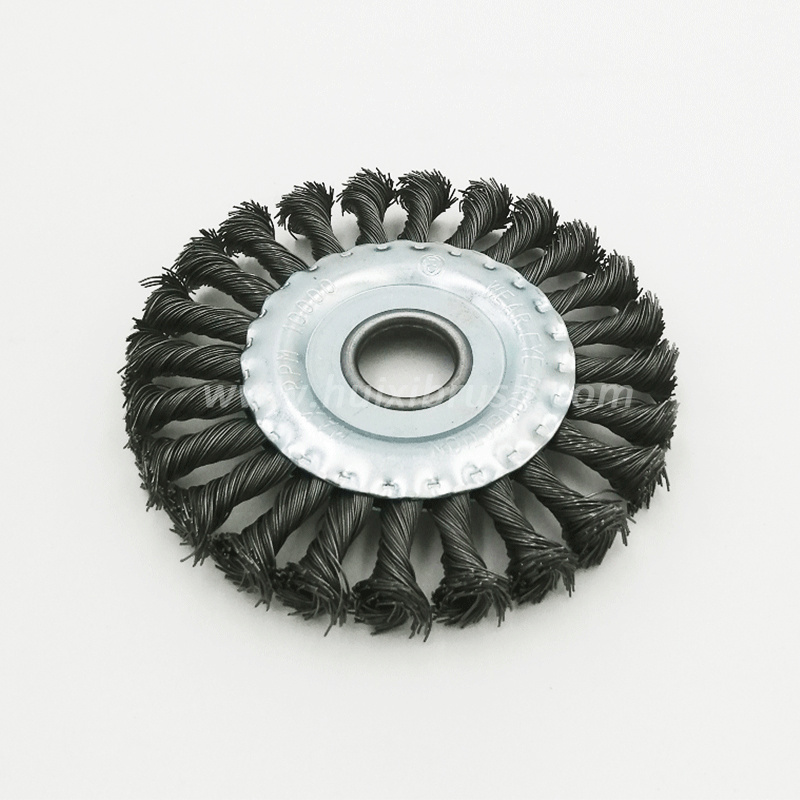
A knotted wire wheel brush removes weld slag, heavy rust and thick paint by striking the surface with dense, stiff wire knots instead of sweeping across it. Each knot is a bundle of wire twisted tight at the root, so the tips reach the contaminant in rapid impacts and break its grip on the steel. That is why the same diameter clears a weld seam faster in knotted form than in crimped form, and why a careless pass can also mark the base metal underneath. What decides the outcome is not how hard you lean on the tool but knot density, wire stiffness, running speed and the order in which you attack the layers.
Why Knotted Wire Wheel Brushes Bite Into Weld Slag
A knotted wheel is built from tufts of wire folded into a bundle and twisted at the root. The twist locks the strands together, so each tuft behaves as one stiff block rather than a set of independent wires. When the wheel turns, that block meets the weld bead as a run of hard impacts. Slag is brittle and sits on top of the weld, so the impacts chip it at the edges and then work underneath it, which lets the deposit lift instead of being worn away slowly.
Crimped wheels work on a different principle. Their wire is waved and held loosely, which lets each strand flex and follow the contour of the part. That flexibility is useful on thin sheet and curved surfaces, and it is the reason a crimped wheel is the gentler option. The same flexibility also absorbs energy. On a thick slag ridge, much of the force goes into bending wire rather than breaking deposit.
Knot design sets how aggressively the brush behaves. Fewer, heavier knots present a more solid striking face, while a denser arrangement of finer knots spreads the work across more tips. Face width acts the same way. A narrow face puts the available force into a small contact band, and a wide face spreads that force across the whole surface. Matching the configuration to the job is the difference between a wheel that cuts and a wheel that skates.

Matching the Brush to Weld Slag, Heavy Rust and Thick Paint
The three contaminants do not behave alike under the same wheel. Slag is hard and brittle, rust is granular and often layered, and paint is soft and softens further with heat. Each needs a different balance of impact and dwell, which is why a single wheel specification rarely suits a whole workshop.
| Condition | Wheel configuration | How to run it | What to avoid |
|---|---|---|---|
| Weld slag on a fillet or butt weld | Heavier knots, coarser wire, narrow face | Work along the weld toe first, then across the bead | Laying the full face flat so the wheel rides the slag instead of chipping it |
| Heavy rust and mill scale | Medium knots, coarse wire, medium face | Overlapping passes at a shallow angle | Polishing one spot to a shine while the surrounding scale stays |
| Thick paint or powder coat | Medium knots, medium wire, medium to wide face | Move continuously and let the coating soften and lift | Holding still until the coating smears and loads the wheel |
| Rust pitting inside seams and corners | Small diameter, narrow face, coarse wire | Short passes with only the edge of the wheel in contact | Forcing a wide wheel into a gap it cannot reach |
Two things sit outside the table. Old paint can be harder and more brittle than recent coating, so a wheel that suits a fresh film may skate on a cured one. Rust under a paint film also releases only as the film breaks, which means the pass that removes the coating often exposes a second layer of work underneath.
Descaling and rust removal on steel wire and steel parts follow the same logic, where the deposit has to be broken before the surface can be finished. <brushes for steel wire industries cleaning descaling derusting polishing> covers brush selection for cleaning, descaling, derusting and polishing work in steel wire production.
Flat plate and continuous profiles often suit a different body shape. A disc brush presents a flat face to a flat surface, which keeps contact even across a wide area instead of concentrating it on one band.

A cylindrical brush works a moving strip, roller or conveyor line, so cleaning happens as the material passes rather than as an operator tracks a hand tool along it. The knot principle does not change in either format. Only the way the brush meets the workpiece changes.
Setting Up the Tool Before the First Pass
Most wire wheel failures start before the wheel touches metal. Five checks take a few minutes and remove most of the avoidable risk.
-
Match wheel speed to tool speed. Every wheel carries a marked maximum operating speed and every tool carries a free speed. The marked maximum on the wheel governs; if the tool can spin faster than that figure, the tool is the wrong one for that wheel. Imbalance, wire fatigue and burst risk all climb above that mark.
-
Fit the guard that matches the wheel. The guard contains broken wire. A wheel run without one throws strands along the line of the spindle, and the operator’s face usually sits in that line. A face shield worn over safety glasses covers the cheeks and chin that glasses leave open.
-
Check mounting and rotation. Flanges should be flat and clean, the arbor bore should match without play, and the nut should be tight enough that the wheel does not slip. Spin the tool in free air before contact and read the direction arrow. A wheel run against its designed direction tends to pull the workpiece toward the tool instead of throwing debris away from it.
-
Hold the work. A part that moves takes control away from the operator and feeds the wheel into the surface at an angle nobody chose. Clamping, a fixture, or a brush table that presents the part at a consistent height keeps contact repeatable from one piece to the next.

- Protect the operator for the material actually being removed. Coating dust is a different hazard from steel dust, so the extraction and respiratory protection chosen for one job may not suit the next. Loose sleeves and gauntlet gloves near a spinning wheel are a catch risk on their own.
Running the Removal Pass Step by Step
Once the tool is set up, the sequence matters as much as the equipment. Steps marked required affect whether the contaminant comes off at all; the optional step improves the finish but does not change the removal.
-
Remove the heaviest layer first, working along the weld toe before crossing the bead (required). Breaking the edge of the deposit gives the wheel a start point, and the rest of the layer lifts from there.
-
Use part of the face rather than the full width, held at a shallow angle to the surface (required). Full-face contact spreads force and makes the wheel ride over the deposit instead of striking it. Partial contact concentrates the impacts where you aim them.
-
Keep pressure light and the wheel moving (required). Pressure does not increase cutting depth in the way operators expect; it bends wire, heats the surface and flattens the knot. Tip speed does the cutting, and travel keeps fresh wire over fresh metal.
-
Work in one direction and overlap each pass (required). Crossing your own passes produces a patchwork of scratch directions that is harder to blend later, and it hides whether a section has actually been cleaned.
-
Watch heat and coating behaviour (required). When paint begins to smear rather than lift, the surface is hot enough to soften the film instead of breaking it. Back off, let the part cool and resume with a shorter dwell.
-
Blend edges and transition zones with a lighter pass (optional). It does not remove more contaminant, but it removes the sharp step between cleaned and uncleaned areas before the next operation.
-
Clean and inspect before any coating or welding (required). Loose wire fragments, dust and loosened scale left on the surface contaminate the next process, and the inspection is also the moment to confirm that pits and seams are actually clean rather than shadowed.
Reading the Surface When the Pass Goes Wrong
The marks left on the part are diagnostic. A wheel that is cutting correctly leaves a uniform, dull, matte track with the deposit gone. A wheel that is skidding, overheating or digging in leaves a pattern that points to a specific setup error.
| What you see | Likely cause | First thing to check |
|---|---|---|
| Coating smears into streaks | Surface heat too high, wheel held in one place | Travel speed and dwell, then reduce pressure |
| Wheel bounces or chatters | Too much contact area, or the part is not rigid | Contact angle and how the workpiece is held |
| Surface polished instead of cut | Wire too fine, or knots worn round | Whether the wire still has a cutting edge or has been flattened |
| Deep parallel gouges | Wheel edge dug in at a steep angle, or a knot has lost wires | Contact angle and wheel condition |
| Wires shedding quickly | Running above the marked maximum, or wire already fatigued | Speed rating and the age of the wheel |
A polished patch beside a rough one is the most common version of this problem. It usually means the operator found a spot where the wheel bit easily, stayed there, and polished the area until it gleamed while the surrounding scale was untouched.
The same wheel that removes slag can also condition a surface, and the difference sits in how the final passes are run. <wire wheel brush the right assistant for industrial cleaning and polishing> covers where a wire wheel fits between cleaning work and polishing work.
When a Knotted Wire Wheel Brush Is the Wrong Tool
Aggression is not universally useful. Thin sheet distorts under a stiff knotted wheel before the contaminant releases, and aluminium or soft alloys can gall, smear and pick up wire fragments in the surface. Carbon steel wire used on stainless steel can transfer iron particles that later show up as corrosion points, which is a reason to specify stainless wire for that work rather than to press harder. Precision sealing faces and cosmetic panels usually need a gentler construction or a different process entirely.
The alternatives are practical rather than inferior. A crimped wheel suits light rust, contours and thin material. Abrasive nylon handles deburring and gentle finishing without the same impact. A flap disc blends flat surfaces faster than any wire wheel. Blasting reaches complex geometry that a hand-held wheel cannot follow.
Knot and crimp are constructions rather than grades, so neither is the better brush in every case. <the differences between knotted wire wheel brush and crimped wire wheel brush> covers how the two constructions behave differently during rust removal and surface preparation.
Tool power also decides the outcome. A drill-mounted brush turns slower and with less torque, so on heavy slag it stalls and the operator tends to lean harder to compensate, which loads the wire instead of the deposit. Small-diameter knotted wheels on a die grinder are the better match for tight cavities and small weld clusters where a full-size wheel cannot reach.

Send the Base Metal, Contaminant and Tool Speed
A useful wheel recommendation starts with the job, not the catalogue. Tell us the base metal and its thickness, the contaminant you are removing and what it sits on, the tool type with its free speed, the wheel diameter, face width and arbor size you can mount, the finish the next operation needs, and the production rate you have to hit. With those details, Shanghai Huixi Trading Co., Ltd. can confirm a knot style, wire type and face width that match the work rather than the nearest stock item, without treating one sample result as the specification for the whole line. Email [email protected] or call +86 1580 0932 713.
FAQ
How does a knotted wire wheel brush remove weld slag?
The twisted knot acts as a stiff, dense block of wire. As the wheel turns, the tips deliver repeated impacts that chip the brittle slag at its edges and then work underneath the layer. Once the edge lifts, the rest of the deposit follows. A crimped wheel flexes on the same impact and loses much of that effect, which is why the knotted construction is chosen for heavy weld cleaning.
Can it strip thick paint without a chemical stripper?
Yes, in most cases, but the pass has to be run as a cutting operation rather than a sanding operation. Keep the wheel moving, use partial face contact and let the coating soften and break away. If the paint smears, the surface is too hot and the coating is being spread rather than removed. Very thick or elastomeric coatings may still need a scraper or stripper first.
Will the brush damage the base steel?
It can mark it. A knotted wheel removes metal along with the contaminant, and a steep angle, a stationary wheel or a coarse wire on thin material will leave gouges and a distorted profile. On structural steel that is usually acceptable. On thin sheet, stainless with a corrosion-sensitive finish, or machined surfaces, choose a gentler construction and check the result on an offcut first.
When should I choose crimped instead of knotted?
Choose crimped when the deposit is light, the surface is curved or thin, or the priority is a controlled finish rather than fast removal. Light rust, paint scuffing and contour work on sheet metal sit in that range. Choose knotted when the deposit is thick, brittle or welded on, and when the part can take the impact without distortion.
If you’re interested, check out these related articles:
abrasive disc brush an excellent industrial surface treatment tool
honing brush a magic tool for flexible burr removal
where stainless wire spiral brush can be used
the differences between knotted wire wheel brush and crimped wire wheel brush
abrasive disc brush an efficient tool for many applications


 Whatsapp
 Email