



How to Use a Crimped Wire Wheel Brush for Metal Finishing
A crimped wire wheel brush is a finishing tool, not a stripping tool. Its filaments are waved along their length, so they bend when they touch the work and let thousands of small wire tips do the cutting instead of a rigid block of wire. That is why the wheel can lift oxide and knock off a light burr without carving a groove, and why it will not clear heavy scale or weld slag. Getting light deburring, oxide removal and surface texturing from the same wheel comes down to matching the brush to the job, controlling tip speed, and holding pressure low enough that the filaments keep working.
What a crimped wire wheel actually does to metal
A crimped wheel carries wire that has been waved along its length. Each filament acts like a small spring: it bends on contact, stores the deflection, and releases it as the wheel turns. Because the tips meet the surface at an angle and the contact is intermittent, the energy delivered at any point is small compared with a knotted wheel or a coated abrasive disc. The brush removes material by fatigue, breaking the oxide layer or the root of the burr with repeated light impacts rather than cutting a continuous chip.

Two practical consequences follow. The brush follows the contour instead of flattening it, which is why it can be run along a machined edge without turning the corner into a chamfer. Stock removal is also not controllable: a crimped wheel will not bring a surface to a dimension, close a deep scratch, or level a weld toe. When the job needs metal moved, the tool is wrong for it.
The filament tips do the work, so pressing harder does not make them cut faster. Heavy pressure flattens the fan of filaments against the surface, closes the gaps between them, and turns the brush into a fast-moving pad that generates heat and burnishes whatever it touches. A light, steady touch removes more oxide than a heavy one.
What the wheel cannot do is worth stating at the start. It does not break thick scale, cut through slag, take off an old paint film in a single pass, or flatten a weld. Those jobs belong to a knotted wheel, a coated abrasive, or a grinder, and using the wrong tool on them wears out consumables while pushing heat into the part.
Selecting wire, diameter and face width for the job
Wire material comes first because it decides what the brush leaves behind. Carbon steel wire is the general-purpose choice for carbon steel work. It should not touch stainless steel, aluminium, or any part that will sit in a corrosive environment after brushing, because tips break off and embed, and the embedded iron becomes a rust point. Stainless wire is used on stainless and wherever contamination is unacceptable. Brass wire is softer and suits gentler work and non-ferrous parts.
Wire diameter sets how aggressive the wheel is. Stiffness rises far faster than the diameter itself, roughly with the fourth power of the wire diameter, so a small step up in wire size changes the finish much more than a small step in wheel diameter. Crimped wheels are generally built for flexibility, which means finer wire, longer free length, and lower contact pressure at the work.
Face width controls contact area. A wide face spreads the load, softens the action, and suits blending across a flat panel. A narrow face puts the filaments on the edge, which is what you want when the edge is the target and the face is not.
Diameter has two roles, reach and tip speed. A small wheel on a fast tool can reach a tip speed close to a large wheel on a slow one, which is why the same part can be finished on a bench motor or a die grinder with different wheel sizes and the same result, provided the tip speed is held.
| Job condition | Suitable choice | Avoid | Reason |
|---|---|---|---|
| Light burr with a tight radius tolerance | Narrow crimped wheel, finer wire | Wide face with thick wire | Keeps contact on the edge and limits rounding |
| Heat tint on stainless after welding | Stainless wire, dedicated wheel | Carbon steel wire used elsewhere in the shop | Prevents iron transfer that rusts later |
| Visible directional blend on a flat panel | Wide crimped wheel, uniform wire diameter | Mixed refills from different lots | A uniform scratch needs a uniform filament |
| Heavy scale, slag, thick coating | Knotted wire wheel or coated abrasive | Crimped wheel at any pressure | Flexible filaments cannot break thick deposits |
| Soft aluminium or brass parts | Crimped wheel at low pressure, or abrasive nylon | Stainless wire at high pressure | Wire tips can embed and start corrosion |
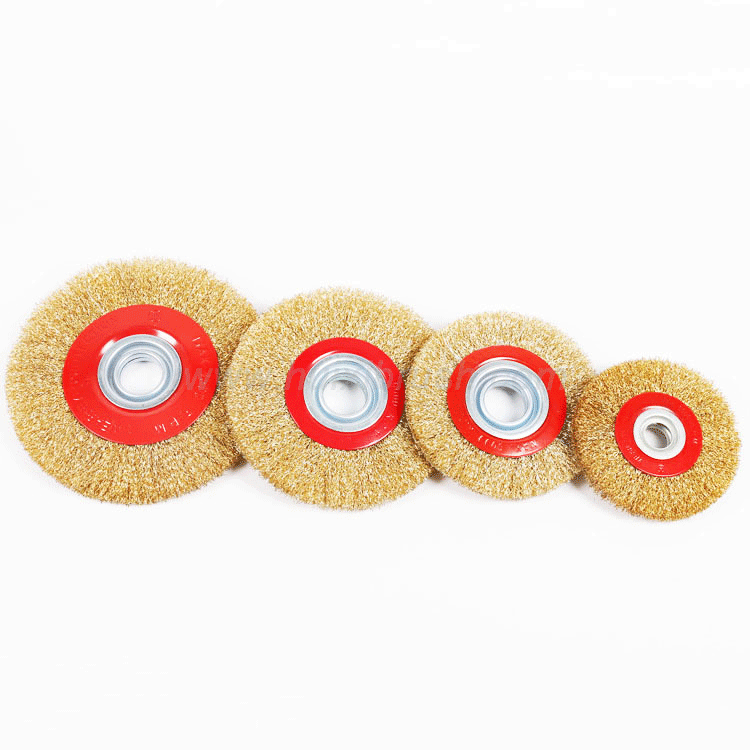
When a wheel is specified rather than picked from a catalogue, these four values are the ones to write down: wire material, wire diameter, face width and outside diameter. Huixi Brush builds crimped wheels to that kind of specification, including bore size and marked maximum speed, so the same part can be reordered instead of re-identified by eye.
Mounting, guarding and speed before the first pass
The bore and the flanges decide whether the wheel runs true. A brush sitting on mismatched or damaged flanges runs out of balance, hammers the work, and sheds filaments. Match the bore to the spindle, use flat flanges of equal diameter, and retire a brush whose bore has been opened up by a loose fit.
Keep the tool guard fitted and between you and the wheel. Wire brushes shed filaments, especially when new, and the guard that came with the tool still catches most of them. Wear a face shield over safety glasses rather than instead of them, and add hearing protection and dust extraction for oxide dust on high-speed work.
Speed is the setting most often taken for granted. Tip speed is what reaches the work: surface speed equals pi times the diameter times the revolutions per minute. A 150 mm brush turning at 3,000 rpm moves roughly 1,410 metres of wire past the part every minute; at half the speed it is about 710. The arithmetic matters, but the hard limit is the maximum speed marked on the brush, which caps whatever the tool can be set to.

Before the first production part, run a new wheel briefly inside the guarded zone, pointed away from anyone standing nearby, then check the mounting and the guard for loose filaments. Small parts belong in a vise or soft jaws, not in the hand. Present the work so the wheel turns off the edge rather than into it, because a wheel running into an edge can catch and kick.
Light deburring without rolling the edge over
Deburring with a crimped wheel is a sequence, not a matter of brushing until it looks right.
- Define the edge condition first. If the drawing allows no radius, the brush can only touch the burr. If a small radius is acceptable, the wheel can be worked along the corner. Without that decision, two operators will produce two different edges from the same wheel.
- Present the wheel so it turns off the burr. A wheel running into the edge can fold the burr back over the corner instead of removing it, and a folded burr may break away later in service.
- Use light contact at the lowest speed that removes the burr, and count the passes. One steady pass with the tips working beats several heavy ones, because heavy contact flattens the filaments and polishes the burr down rather than breaking it off.
- Check the edge against a radius gauge or a comparator sample after the first part, not by eye. Workshop light hides a rounded corner until the part fails a fit check.
- Keep the same pass direction and pass count for every part in the batch. A brushed edge is a finish, and finishes drift when each operator works to feel.
- Clean and inspect for loose wire. Soft materials can hold a broken filament, and one left in a bore or a thread will be found later by someone else.
Edge condition is easier to control when the brush is chosen for the burr rather than for the machine it happens to fit. <how do you know about deburring brushes> covers how deburring brush types differ and where each one fits.
The most common failure at this step is not the wheel but the specification. A burr removed to an undefined edge will pass inspection and still fail assembly, because the corner that was knocked off no longer holds the tolerance the part was designed around.
Removing oxide and heat tint without smearing it
Heat tint from welding, and the light oxide that forms on hot rolled or annealed steel, is a thin brittle layer sitting on the metal. The crimped wheel removes it by breaking the layer and lifting it away with the filament tips. The same layer can also be burnished into the surface: once the pressure is high enough to flatten the brush, the oxide is compressed and polished rather than removed, and the part looks bright while the metal underneath is still contaminated.
The consequences show up later. On stainless, a smeared oxide layer interferes with the passive layer and becomes a site for pitting. Under a coating, it is a weak boundary that fails an adhesion test even though the part looked clean at dispatch.
Three conditions make tint removal reliable. Degrease before brushing, because oil mixed with oxide dust forms a paste that gets pushed into pits and scratches. Use a stainless wire wheel kept for stainless work only, stored away from carbon steel dust and swarf. Keep the contact light enough that the filaments stay in motion, and work along the weld rather than across it so the oxide is lifted in one direction.
Then check the result. A water-break test is quick: a clean, freshly brushed surface holds a continuous film of water, while an oily or smeared surface breaks it into droplets. Raking light at a low angle shows remaining tint better than direct light. Brushing removes the tint, but it does not restore the chromium oxide passive layer on its own, so the part still needs the passivation step the shop procedure calls for.
Texturing and blending to a repeatable direction
A brushed texture is a controlled scratch pattern, and its consistency depends on three things: wire diameter, tip speed, and the direction and overlap of each pass.
Wire diameter sets the depth of the individual scratch. Change to another wire size and the panel will not match the previous batch, even when the wheel looks the same and the operator works the same way. Tip speed sets how many impacts land per second and how much heat reaches the surface. Direction sets what the eye sees: a panel brushed one way with even overlap has a readable grain, while a panel brushed in several directions has none.
Run a new wheel against scrap before it goes anywhere near a visible part. A brush with filaments at full length behaves differently from the same brush after the tips have worn back, and a wheel that has been in service long enough to shorten its filaments will cut harder at the same setting. Break in the wheel, record the setting that produced the reference finish, and replace it once its outside diameter falls below the point where the finish was approved.

Thin sheet is the case that catches people out. Texturing at high speed puts heat into a panel faster than it can dissipate, and the result is warping or a colour change that no amount of re-brushing will remove. If the panel discolours, the speed or the pressure is already too high for the section thickness.
A textured finish still depends on a clean surface underneath it, and cleaning and polishing often run on the same wheel. <wire wheel brush the right assistant for industrial cleaning and polishing> covers how wire wheel brushes are used across cleaning and polishing work.
When crimped wire is the wrong wheel
A crimped wheel is a light-impact tool, and it stops being the right choice as soon as the deposit has to be broken rather than lifted, or the surface has to be brought to a dimension.
Knotted wire is the alternative when the contamination is thick: weld slag, heavy rust, mill scale, or several coats of paint. The knots hold the filaments rigid, so each tip strikes harder and the wheel cuts rather than blends. The trade-off is edge damage, which is exactly what the crimped wheel avoids.
Abrasive nylon is the alternative when ferrous contamination cannot be tolerated or the scratch has to be uniform. Nylon filaments filled with abrasive cut a consistent pattern and leave no wire to embed, which matters on aluminium, on stainless that will be pickled or passivated, and on parts that will be anodised.
Coated abrasives and flap discs are the alternative when metal has to come off to reach a dimension, close a deep scratch, or level a surface. No brush does that job, and trying to make one do it produces heat, rounded edges, and a stack of worn-out wheels.
| Wheel type | Action on the surface | Edge radius risk | Typical use |
|---|---|---|---|
| Crimped wire | Light repeated impact, blends and lifts | Moderate if pressure is high | Deburring, tint removal, satin blending |
| Knotted wire | Heavy impact, breaks and cuts deposits | High at edges and corners | Scale, slag, thick rust, weld preparation |
| Abrasive nylon | Uniform scratch, no ferrous contamination | Low to moderate | Aluminium, stainless finishing, coating prep |
| Coated abrasive flap | Controlled stock removal on flat areas | High on edges | Dimension correction, scratch removal |
The two wire wheel families are often sold from the same shelf, but they are not interchangeable. <the differences between knotted wire wheel brush and crimped wire wheel brush> covers how knot pattern and wire stiffness change what the wheel does to an edge.
Checking the finish and recording the setup
Four checks cover most brushed work, and each answers a different question.
Raking light answers whether the oxide is gone or only polished. Hold a light at a low angle across the surface and the remaining tint shows as a dull patch against brighter metal.
A radius gauge or comparator sample answers whether the edge is still within tolerance. Comparing parts against a physical reference is faster and more consistent than judging by eye.
A water-break test answers whether the surface is clean enough for the next process. A continuous water film is a pass, droplets mean oil or smeared contamination is still there.
A cross-hatch tape test answers whether a coating will hold, and it belongs after coating rather than before. If the coating lifts over the brushed area and holds elsewhere, the brushing step is the suspect.
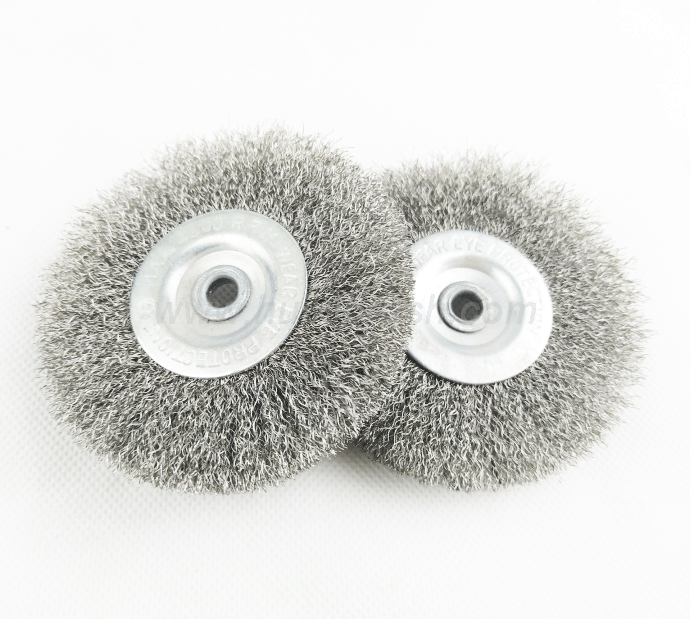
Record the setup that produced the approved finish: brush outside diameter, wire material and wire diameter, face width, marked maximum speed, tool and speed setting, pass count and pass direction, plus supplier and lot. Two of those values drift quietly. Brush diameter falls with use, which stiffens the wheel and changes the finish at the same setting. Wire diameter can change between lots when a brush is bought to a description rather than a specification. Measuring the brush at fixed intervals and re-qualifying the finish after a lot change keeps a brushed part reproducible months after the first sample was approved.
Send the job details before you choose a wheel
A crimped wheel that suits one part will round the edge on another, and the difference sits in the specification rather than the label. Send the workpiece material and its condition, the operation you need to complete, the tool you plan to mount the wheel on and its rated speed, the brush outside diameter and bore you can use, the wire material and wire diameter you have been buying, and the monthly quantity. Huixi Brush can quote a crimped wire wheel against that list, or supply a sample so the finish can be checked on your own part before a full order. Email [email protected] or call +86 1580 0932 713.
FAQ
Can a crimped wire wheel remove rust?
Light surface rust, yes. The filaments break the rust layer and lift it from the surface without cutting into the base metal, which is why the wheel suits machined parts that have been in storage. Flaking rust, pitting and heavy scale are a different job: the layer is thicker than the filament impact can break, and working harder only polishes the surface and adds heat. On those parts a knotted wire wheel or a coated abrasive removes the bulk first, and a crimped wheel can then blend what is left.
Which wire should I use for stainless steel?
Stainless wire, kept for stainless work only. Carbon steel filaments break off in use and embed in the surface, and the embedded iron rusts, which shows as speckle after the part has been in service or gone through passivation. Store the stainless wheel away from carbon steel dust and swarf, and degrease the part before brushing so oxide dust is not pushed into pits. Remember that brushing removes heat tint but does not restore the passive layer, so the part still needs whatever passivation the shop procedure specifies.
How much pressure should I apply?
Enough to keep the filament tips working, no more. The tips do the cutting, and pressure beyond the point where the filaments stay flexible flattens the brush against the surface, adds friction and heat, and burnishes oxide instead of removing it. A practical test is the shape of the brush in contact: if the filaments are splayed into a solid disc, back off until they are still visibly flexing. If the part becomes uncomfortable to touch within a few seconds of brushing, speed or pressure is too high for the work.
Why does my brushed finish look patchy?
Usually because a variable changed between parts. Mixed wire diameters from different lots, a brush worn shorter and stiffer, a change in speed between the bench motor and the die grinder, or a change of pass direction all show as a patch. Fix the wire specification, record the speed setting, break in new wheels on scrap, and replace the wheel at a measured diameter rather than when it looks worn. Comparing each part against a brushed reference coupon catches the drift before the batch is finished.
Can I mount a crimped wheel on a bench grinder?
Yes, when the bore matches the spindle, the flanges are flat and matched, and the maximum speed marked on the brush is at or above the grinder’s no-load speed. Keep the guard fitted, wear a face shield over safety glasses, and run a new wheel briefly inside the guarded zone because new brushes shed loose filaments. Present the work so the wheel turns off the edge, and clamp small parts instead of holding them. The grinder speed is fixed, so wheel diameter becomes the variable that sets tip speed.
If you’re interested, check out these related articles:
how do you know about deburring brushes
advantage of hx boiler tube brush


 Whatsapp
 Email