



Stainless Steel vs Abrasive Nylon Tube Brushes for Small Bores
Small bore and thread deburring needs a brush that removes raised material without changing the thread crest, sealing face, or required surface finish. Stainless steel and abrasive nylon tube brushes accomplish that with different mechanisms. A stainless wire tube brush cuts and scrapes the burr at the filament tip, while an abrasive nylon tube brush grinds with flexible filaments carrying abrasive grain. The better choice depends on the workpiece material, burr size, thread class, and acceptable surface change. In practice, stainless steel suits harder steel and cast iron ports with heavier burrs or light scale, and abrasive nylon suits softer metals, plated surfaces, and finish-critical edges.
How Stainless Steel Tube Brushes Cut a Burr
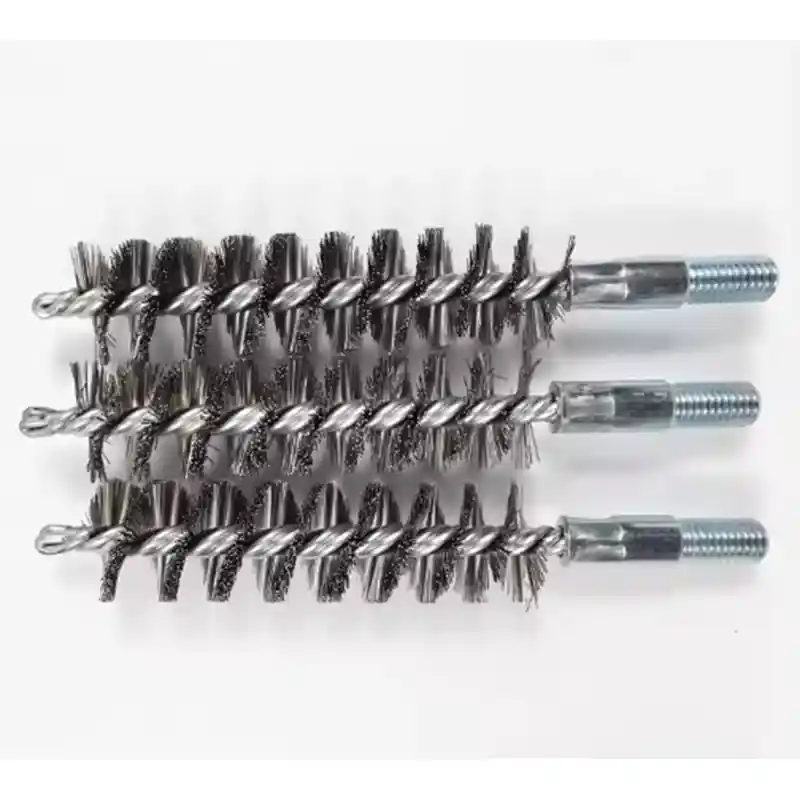
Stainless steel tube brushes work by presenting short wire ends to the bore surface. The wire is crimped or held in a twisted stem, and the trim length controls how much the filament can flex. As the brush rotates, the wire tips catch the raised edge of a burr and peel or break it away. The same action helps remove light rust, carbon, or machining scale, but it also means the brush can scratch the base material if the diameter is too large, the speed is too high, or the dwell time is long. For that reason, stainless wire is usually specified for harder base materials and for ports where a mechanical cut is acceptable.
How Abrasive Nylon Tube Brushes Blend the Edge
Abrasive nylon tube brushes replace the wire tip with a filament that carries abrasive grain throughout its cross-section and along its length. Common grains include aluminum oxide and silicon carbide. When the filament wears, new grain is exposed, which keeps the cutting action more consistent than a wire brush that can lose broken tips. The filament also flexes more than steel wire, so it conforms to a small bore or thread helix and reaches the root without loading the crest as heavily. The main limitation is that abrasive nylon is not a good choice for heavy scale or thick, hard burrs; it removes less material per pass and generates heat if the brush is packed too tightly into the bore.

Abrasive nylon depends on grain type, filament stiffness, and fill density to balance cutting speed with surface finish. <main features and applications of hx nylon cylindrical brush> covers the construction and application variables for cylindrical nylon brushes.
Where Thread Deburring Changes the Choice
On a thread, the brush works against a helical profile, not just a straight bore wall. A stainless steel brush sized to the minor diameter can clear the thread root, but if the brush is too aggressive it can round the crest and remove plating or anodizing. Abrasive nylon is often more forgiving because the filaments deflect along the thread flanks. That is why fine threads, thin-walled fittings, and plated components usually move toward abrasive nylon, while coarse threads and unplated steel connectors may stay with stainless steel for faster burr removal.

Thread root cleaning requires enough filament reach to follow the helix without beating the crest. <honing brush a magic tool for flexible burr removal> covers flexible abrasive action for deburring without cutting into the part profile.
Selection Table for Small Bore and Thread Work
Use the table as a first-pass selection guide. The final brush should still be tested on the actual part because filament density, stem length, and machine setup can change the result.
| Selection factor | Stainless steel tube brush | Abrasive nylon tube brush |
|---|---|---|
| Burr removal action | Cuts, scrapes, and breaks the burr with wire tips | Grinds and wears the burr with abrasive-loaded filaments |
| Best workpiece fit | Steel, stainless steel, cast iron, and harder ports | Aluminum, brass, thin walls, and plated or anodized surfaces |
| Thread risk | Can round crests or remove plating if over-pressured | Conforms to the thread form and is easier on crests and coating |
| Finish result | Mechanically cut edge that may need a second finishing pass | Smoother blended edge but slower on heavy burrs |
| Common failure | Wire breakage, scratching, and metallic residue | Heat buildup, glazing, abrasive wear, and lower cut rate |
| Customization focus | Wire diameter, crimp type, stem size, and trim length | Grit type, grit size, filament diameter, and fill density |
Two questions determine priority. First, does the part tolerate metallic contact? If not, use abrasive nylon. Second, how much material must be removed? If the burr is heavy or mixed with scale, stainless steel is usually faster. When finish and dimensional control rank above speed, abrasive nylon is usually the better fit.
A deburring brush is not selected by hole diameter alone; burr type, material, and required edge condition all matter. <how do you know about deburring brushes> covers the basic questions to ask before choosing a deburring brush style.
Process Controls That Prevent Damage
Small bores amplify setup mistakes. Overspeed, excessive brush diameter, or deep insertion can snap wire filaments, glaze nylon, and generate enough heat to burnish a burr without removing it. For stainless brushes, keep the brush diameter to a close fit with the bore and use a pecking or pass-through motion so chips and broken wire have a way out. For abrasive nylon, run a lower surface speed than a wire brush would normally use, and monitor filament length and brush diameter between batches because wear changes the contact pressure.

Using Both Brushes in One Operation
Some small-bore parts benefit from a two-step process. A stainless steel tube brush can break the heavy burr and clear the thread root, then an abrasive nylon tube brush can remove the remaining feather edge and improve the surface transition. This sequence is common for fluid power parts, fuel system components, and instrumentation fittings where a burr left in a cross-drilled port could break loose later. On components where the port opens into a flat sealing face, a disc brush may be used for the outer edge while the tube brush handles the bore. The sequence is not needed for every bore; if the first brush already meets the print, the second does not add value.

Confirm the Right Tube Brush for Your Print
Specify the bore or thread size, material and hardness, current burr location, required edge condition, and production volume. That is enough to determine whether a stainless steel tube brush, an abrasive nylon tube brush, or a two-step sequence is appropriate. Shanghai Huixi Trading Co., Ltd. can support custom stem diameter, filament type, trim length, and brush diameter. Send a drawing or sample to [email protected] or call +86 1580 0932 713.
FAQ
Can abrasive nylon remove a hard burr in a steel thread?
It can remove light to moderate burrs, but it cuts more slowly than stainless wire. If the thread is hardened, has a heavy folded burr, or contains scale, abrasive nylon may burnish the peak instead of removing it cleanly. In that case stainless steel is usually faster for the first pass, with abrasive nylon optional as a finishing step.
Will a stainless tube brush damage anodized aluminum?
Stainless wire is generally too aggressive for anodized or plated aluminum. The wire tips can cut through the coating at the thread crest and bore edge. For these parts choose a finer abrasive nylon filament, reduce the brush diameter overlap, and run a lower speed. If metallic contact cannot be tolerated at all, use a non-metallic stem and an abrasive nylon fill.
How do I size a tube brush for small bores and threads?
Match the brush outside diameter to the bore or thread minor diameter with a controlled overlap, usually a slight interference rather than a heavy press fit. Confirm that the stem is small enough to follow the bore without rubbing the wall, and specify a trim length long enough for the filaments to reach the thread root while still flexing at the crest.
Can one brush clean both the bore and the thread?
It can if the brush is selected for the smallest diameter in the feature and the thread form allows filament reach. Mixed features often work better with two diameters: one for the main bore and one for the thread minor diameter. If the print allows a radius rather than a sharp edge, a single conformable abrasive nylon brush may cover both areas.
If you’re interested, check out these related articles:
honing brush treat burrs in barrel parts without affecting accuracy and scale
honing brush a magic tool for flexible burr removal
rope cleaning brush for industrial use a key tool for maintaining safe production
abrasive disc brush an efficient tool for many applications
brushes for steel wire industries cleaning descaling derusting polishing


 Whatsapp
 Email