



Setting Up a Flexible Strip Brush for Sealing and Cleaning
A flexible strip brush seals and cleans an irregular gap because each filament deflects on its own. No straight edge or constant gap is needed, which is why the brush suits machine frames, conveyor transfers and guard openings where a rubber lip would either drag on the high spots or leave the low ones open. Most sealing problems with these brushes are not caused by too little contact. They are caused by too much, where filaments bend over, drag and lose their spring. Filament choice, free length, interference and mounting decide the result.
What a Flexible Strip Brush Does on a Machine
A strip brush is a row of filaments held in a narrow base. The filament is folded around a wire core and crimped into a U-channel, usually galvanized steel or stainless steel, and the base is drilled or slotted so it can be fixed to a frame. Filament diameter, length, density and material are specified at order, and the base can be straight, coiled, or formed to follow a profile.
Mounted correctly, the brush does three jobs. It acts as a barrier that keeps dust, chips, mist, light or draughts on the side where they belong. It wipes, because every surface that moves past the filament tips is scrubbed. And it guides, keeping small parts on a track or stopping debris from travelling along a gap toward a bearing or a sensor.
The limits matter as much as the capability. A strip brush is a curtain, not a gasket. It reduces airflow through a gap and contains solid particles, but it will not hold liquid head or line pressure the way a compressed gasket does. Where a machine needs both functions, a lip seal handles the pressure and a strip brush keeps the debris that would otherwise reach the lip.

Why Filament Deflection Decides Whether the Gap Seals
Every filament is a small cantilever. Its tip force depends on three things: filament diameter, the free length beyond the base, and how far the surface pushes it out of straight. Stiffness drops sharply as free length grows, so a long filament at a given interference presses far more gently than a short one at the same setting. That relationship explains most of the behaviour people find surprising.
An irregular gap is where this matters. A rubber lip has to be sized for the widest point of the gap, which means it drags at the narrowest point and lifts where the frame is out of line. Filaments do the opposite: each one bends to the local distance, so a tight spot simply deflects more and a wide spot less. The result is a contact band of tips that follows the profile instead of fighting it.
What the brush cannot do is hold a fixed force. Where the gap narrows sharply, local pressure rises and so does friction. A strip brush therefore works best against moderate variation, such as runout on a roller or a frame that is not perfectly straight, rather than against a heavily stepped profile, which needs a formed base or a different seal type.
Sealing performance also depends on how much air can pass between the filaments. Two staggered rows of shorter filament block more dust than one row of long filament, because long filaments splay and leave paths near the base. A backing plate behind the brush closes the remaining route.
How the Same Brush Cleans While the Line Runs
Cleaning comes from relative motion. When a belt, a roller, a sheet or a part edge moves past the tips, the filaments scrub the surface at the speed of the line. That is why a strip brush under a conveyor return run removes carryover before it reaches the pulleys, and why a brush on the outfeed of a press keeps trim and slugs off the finished part.
Three variables set how well it cleans. Contact pressure decides whether the tips reach into pits and scratches. Relative speed decides how quickly a deposit is broken up. Dryness decides whether the debris can be lifted at all, because a wet or tacky residue tends to smear under a dry brush instead of leaving the surface.
Where a static row cannot deliver enough cleaning, the same machine usually carries rotating formats as well. A cylindrical brush roller can be driven against a belt or roller surface to combine higher relative speed with fresh filament contact. A wheel brush reaches an edge or a weld line that a straight strip cannot follow. A disc brush covers a flat web.


Rotary formats cover what a static row cannot reach, including belt return runs and roller surfaces, and the choice between them usually comes down to mounting space. <main features and applications of hx nylon cylindrical brush> covers nylon cylindrical brush features and applications.
One caution belongs beside the cleaning discussion. Dry nylon filaments running on a fast web generate static, and in a solvent area or a combustible dust zone that charge matters. Conductive filament, a grounded base, or brass wire where the duty is light, are the usual ways to deal with it.
Which Filament Material Fits the Gap
Filament choice is a compromise between cleaning aggression, surface damage, temperature and chemistry.
| Filament | Best for | Keep in mind |
|---|---|---|
| Polypropylene | Dust sealing, light wiping, washdown areas, wet or mildly chemical environments | Soft and inexpensive, but has the lowest heat tolerance and wears quickly on abrasive surfaces |
| Nylon (PA 6 or PA 66) | Repeated flexing, abrasive dust, higher running temperatures, general wiping | Absorbs moisture, so stiffness shifts between humid and dry conditions; costs more than polypropylene |
| Crimped steel wire | Hot chips, scale and heavy debris on robust steel surfaces | Scratches finished faces and can shed broken wire, so it needs a containment check downstream |
| Brass wire | Spark-sensitive areas, light wiping and corrosion resistance | Lower strength than steel, so it suits light contact rather than aggressive scraping |
| Abrasive nylon | Light deburring and edge cleaning combined with wiping | The grit changes contact behaviour, so treat it as a cutting brush rather than a sealing brush |
Diameter and form matter as much as the polymer family. Thicker filament is stiffer and more aggressive, while finer filament seals dust better and is gentler on a finished surface. Crimped filament gives softer contact and holds more debris than straight filament, and a denser fill seals better but retains moisture and is harder to clean. Where the brush touches product, confirm the filament grade and paperwork with the supplier instead of assuming that any nylon is acceptable.
Brass wire is the usual answer where a spark would be dangerous, and the same U-channel construction applies to other wire strip brushes. Brass is also chosen for its corrosion resistance on washdown equipment, though it is not a cutting filament. Light contact is the working range.
Brass wire is chosen where spark risk or corrosion matters more than cutting power, and the base construction follows the same logic as other wire strip brushes. <what you know about brass wire brush strip> covers brass wire strip brushes and the applications they suit.
How Much Interference Should You Build In
Interference is the distance the surface pushes into the filament. Too little and the contact band breaks at the wide points. Too much and filaments bend over near the base, drag, generate heat and take a permanent set, after which the brush does not recover its working length.
Because filament stiffness depends on free length, the right interference is not one number. It is a relationship between filament diameter, free length and surface speed, and it should come from the brush supplier for the specific construction being fitted. What you control on the machine is adjustability.
Set the mounting so the brush can move toward and away from the surface in small steps. Commission light, with the tips just visibly deflected, then bring the brush in until the contact band closes along the whole length. Run the machine and check again, because frames settle, belts bed in and filament takes an initial set.
Plan for movement after commissioning as well. A warm frame grows, a belt sags between rollers, and a splice or weld seam lifts the surface at every pass. The brush absorbs this through deflection, but the setting has to be made at the widest expected gap rather than the nominal one.
The same rule applies to rotating formats. A disc brush set against a plate is brought in until the tips just bend, then checked after the first run for heat and current draw.

How to Set Up a Flexible Strip Brush on a Machine
- Measure the gap along its full travel, cold and at running temperature. A gap measured at standstill is often not the gap the brush sees after two hours of production.
- Record the surface the brush will touch: material, finish, joints, splices and weld seams. Anything standing proud of the surface will hammer the filament once per revolution or once per pass.
- Choose filament material and diameter from temperature, chemistry, spark risk and how easily the surface scratches.
- Set free length so the brush spans the widest gap while still touching at the narrowest. Free length is fixed at order, so this is the point where a wrong drawing becomes an expensive mistake.
- Choose the base profile and an adjustable mounting: slots rather than round holes, enough clearance for filament splay, and room for a backing plate where air leakage matters.
- Commission the line and check the contact band, dust escape, filament set, surface temperature and motor current before handing it over to production.
| Step | Required or optional | What it prevents |
|---|---|---|
| Gap survey, cold and hot | Required | A brush sized to a gap that closes once the frame warms |
| Surface and joint check | Required | Filament damage at splices and weld seams |
| Filament and diameter choice | Required | Scratched parts or a brush that softens in service |
| Free length calculation | Required | Contact lost at the widest point |
| Adjustable slotted mounting | Required | A brush that cannot be corrected without re-drilling the frame |
| Backing plate or second row | Optional | Dust escape and air leakage on a high-differential gap |
Where the gap follows a shaft or a curved frame, a coil or spiral base holds contact through runout better than a straight channel bolted to a machined face.
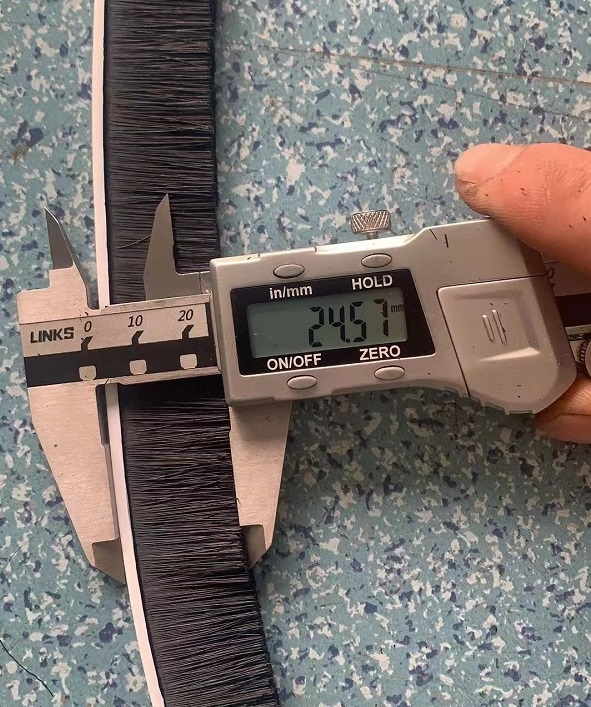
Most automated machines do not carry one brush. A block machine, a panel line or a pallet conveyor usually has several, each set against a different surface and each needing its own adjustment. Setting them as a group by eye is how one brush ends up doing all the work while the others barely touch.
Machines that run blocks, panels or pallets usually carry several brushes at once, and each one needs its own adjustment rather than a shared setting. <introduction of our concrete block machine brushes> covers the brushes fitted to concrete block machines.
What to Check as the Brush Wears
A strip brush is a consumable, and its wear pattern tells you what to correct.
Check the contact band first. It should be even along the length. A band that is heavy at one end means the base is not parallel to the surface, and that end will fail long before the rest. A band that is very wide, with filaments bent flat, means too much interference.
Check the filaments themselves. Filaments that stay bent after the brush is lifted have taken a compression set, usually from heat or from running too tight. Broken wire in a wire brush matters beyond wear, because fragments can travel into product or into a bearing, so wire brushes on product-contact lines need a downstream check.
Check the hardware as well. Fasteners loosen, bases distort when they are tightened unevenly against a rough frame, and galvanized bases corrode in washdown areas where stainless was needed. After a jam or a tooling change, inspect before restarting rather than waiting for the next planned stop.
| What you see | What it usually means | First check |
|---|---|---|
| Even wear band, short life | Too much interference, or filament that is too aggressive | Contact setting and filament grade |
| Heavy wear at one end | Base not parallel to the surface | Frame straightness and mounting slots |
| Filaments bent flat and staying bent | Heat or over-compression | Running temperature and interference |
| Dust escaping at one point | Contact lost at a local wide spot | Gap survey at that point |
| Broken wire found downstream | Wire filament failing under load | Filament grade and surface joints |
Replace the brush when contact is lost at the widest gap, or when cleaning performance drops and adjustment no longer brings it back. Do not answer the problem by pressing harder, because that shortens the life of the replacement as well. Where wear runs from one end to the other and the base is symmetric, reversing the brush end for end can use the remaining filament, provided the mounting allows it.
What to Send With a Strip Brush Enquiry
Tell us the gap range at its widest and narrowest, the surface material and finish, the line speed, the operating temperature, and any washdown, solvent or food-contact exposure. Add a sketch of the mounting profile with the space available behind the brush, and note any splices, weld seams or joints the brush will pass over. Those details decide filament, free length and base profile, and they usually prevent a second order.
A drawing based on the real gap is worth more than a nominal size, because no filament specification can correct a frame that is out of line or a bracket that has no adjustment left.
Email [email protected] or call +86 1580 0932 713 with your drawing. Huixi Brush supplies strip, cylindrical, spiral, disc and wheel brushes in custom lengths and filament grades, with ODM and OEM support for machine builders.
FAQ
Can a flexible strip brush make a gap completely airtight?
No. It is a barrier rather than a gasket. Filaments reduce airflow and stop solid particles, but air still passes through the array wherever a pressure difference exists. If a gap must hold pressure or liquid, a lip seal or gasket should do that job, with a strip brush in front of it to keep debris away. Where leakage only needs to be reduced, add a second staggered row, shorten the free length, or fit a backing plate behind the brush.
Should I choose nylon or polypropylene filament?
Polypropylene is the lower-cost option and suits dust sealing, light wiping and wet areas, but it softens at lower temperatures and wears faster on abrasive surfaces. Nylon is tougher, resists abrasion better and tolerates more heat, which usually makes it the longer-lasting choice where the brush wipes a rough surface or runs continuously. Nylon also absorbs moisture, so its stiffness shifts slightly with humidity. If the brush touches product, confirm the filament grade and paperwork with the supplier before ordering.
What makes a strip brush wear out too fast?
The usual causes are too much interference, a base that is not parallel to the surface, and a joint that strikes the filaments once per pass. Heat and chemical attack soften filament and speed up wear, and abrasive dust trapped in the brush turns it into a slow grinding tool. Look at the wear band before changing anything: an even band that fails early points to the contact setting, while a band that is heavy at one end points to alignment.
Can a strip brush run on a high-speed line?
It can, with a setting made for speed. Friction and tip temperature rise with surface speed, so a brush that works at low speed may wear quickly or load the drive at high speed. Use a shorter free length with light interference, check filament temperature and motor current after the first production run, and re-check the setting once the brush has bedded in. If the line carries dry webs, deal with static through conductive filament or a grounded base.
How do I mount a brush along a curved or stepped profile?
Use a formed or coil base that follows the profile rather than forcing a straight channel into place, because a distorted base loads one section of filament harder than the rest. Keep slotted mounting so the brush can be adjusted after the frame is welded and painted. Then check the contact band along the full length with the machine at running temperature, since a frame that is straight when cold may not be straight in production.
If you’re interested, check out these related articles:
brass brushes work perfectly for pipe cleaning
main features and applications of hx nylon cylindrical brush
introduction of our concrete block machine brushes


 Whatsapp
 Email