



Industrial Strip Brush: Sealing, Dust Control and Cleaning
An industrial strip brush is a sealing and cleaning component, not a consumable bolted on at the end of a build. Its filaments deflect against a moving surface and close a gap that a rigid lip could only close with a tight tolerance, which is why the same construction appears at machine enclosures, conveyor transfers, panel edges and guide rails. It also explains why two brushes with identical overall dimensions behave differently on the line: filament grade, trim height and the interference at the gap decide whether the brush holds its seal for years or lays over within a month. This guide works through that relationship and the measurements that carry it.
What an Industrial Strip Brush Does Inside a Machine
A strip brush has two parts doing different jobs. The backing, usually a U-shaped metal channel closed around a wire core, sets the mounting datum and carries the reaction load. The filament is the working part, folded into the channel and packed densely enough that the tips form a continuous face rather than a row of separate bristles.
That face performs one of three duties, and the duty decides the specification:
- Sealing: the brush closes an opening around a moving part or between two structures.
- Wiping: the brush lifts dust, chips, coolant or debris off a surface as that surface passes.
- Screening: the brush keeps coarse material, insects or wind-blown dust out of an enclosure without closing it completely.
What makes all three duties work is compliance. Each filament deflects on its own, so the brush follows surface runout, weld distortion, thermal movement and gap variation that a rigid seal cannot follow without losing contact or being driven into the moving part. The same property sets the limit. A strip brush is not a pressure seal, it does not hold a liquid head, and it does not capture fine aerosol. Expecting those things is the most common reason a correctly sized brush gets reported as a failure.
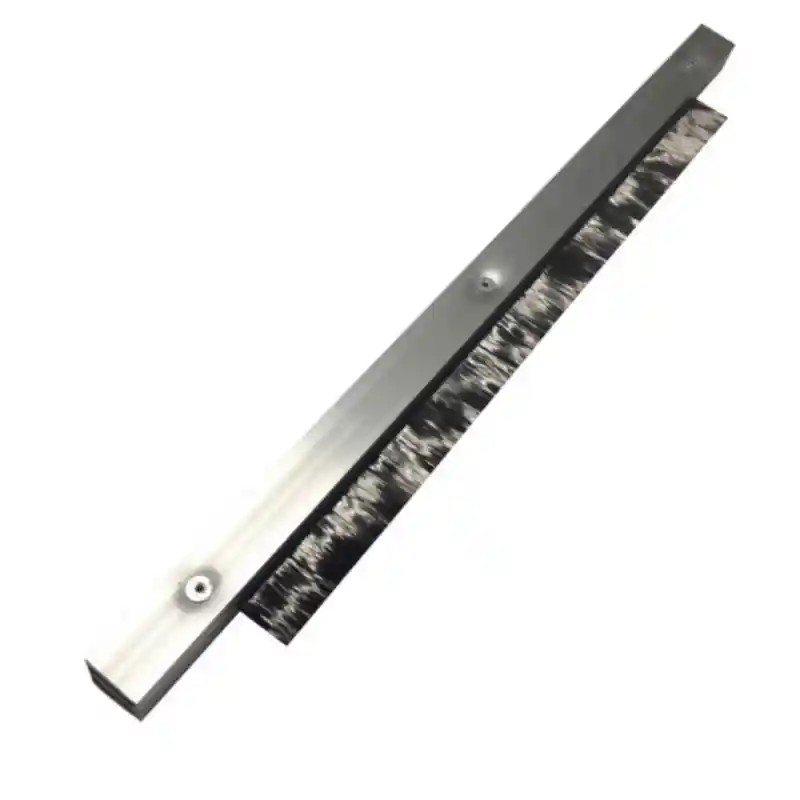
How Filament Deflection Turns a Gap Into a Dust Seal
Contact force comes from bending. A filament pressed against a surface behaves as a small cantilever, so the force it returns rises with diameter and material modulus and falls away quickly as free length increases. Two brushes cut from the same channel with different trim heights can therefore sit at opposite ends of the range, one scraping the surface and one barely touching it.
The angle at which the filament meets the surface matters as much as the filament itself. A brush mounted square to a flat plate loads evenly across the whole face. The same brush on a curved edge, a raised weld or a machined step loads only the filaments sitting over the high point, while the rest stand idle and contribute nothing to the seal.
Dust control then works through two mechanisms at once. The first is interception: the filament face breaks the direct line that particles would otherwise follow out of the enclosure. The second is flow restriction, and it is the one that is usually underspecified. Closing most of an opening with a brush leaves a much smaller free area, so the extraction fan pulls air through the remaining gaps at higher velocity and holds capture closer to the source. A brush fitted while the enclosure stays open somewhere else gains very little, because the air takes the easy path.
That gives a practical order for fault finding on a dust problem: check the extraction path first, then the brush coverage, then the filament grade.
The limits follow from geometry. A strip brush closes straight gaps and gently curved ones where the surface travels along the brush face. It does not close a bore, a pipe end or a round passage, where the filament has to surround the surface instead of lying against it. Those duties belong to spiral and tube forms, which wrap the working face around the circumference and present filament from every angle.

Where Strip Brush Sealing Fails in Service
When a surface deflects a filament past the point where it recovers, the filament stays bent. The brush then carries a compressed band along its face and an open line where it used to seal. This is why a brush that felt tight at installation can be leaking a few months later, and why the correction is usually more trim height or less interference rather than a denser brush. Density adds filaments; it does not restore the angle that was lost.
A second cause is a gap wider than the filaments can span while still standing. Filaments that lie along the surface instead of standing across it seal poorly and wear on the side of the tip, because the working contact has moved from the end of the filament to its flank. The check is the gap at its widest point across the full stroke, not the gap in the closed position.
Temperature and chemistry act slowly and then suddenly. Polypropylene in a hot zone softens and creeps under load, so an interference that was correct when cold becomes an over-compression when warm. Solvent contact can swell or embrittle nylon. A galvanized backing in a washdown area corrodes at the crimp, which is exactly where the filaments are anchored, and the failure shows up as loose filament rather than as an obvious leak.
| What you see | Likely cause | First check |
|---|---|---|
| Filaments flattened in one band, no seal at that line | Interference beyond elastic recovery, or heat creep | Measure the narrowest gap against the free trim height |
| Filaments lying along the surface, tips worn on the side | Gap wider than the trim can span | Measure the widest gap across the full stroke |
| Seal holds when cold and leaks at running temperature | Filament softening or thermal growth in the frame | Record gap and brush temperature at operating condition |
| Rust staining at the backing, filaments pulling loose | Galvanized backing in wet or washdown service | Move the backing to stainless and recheck the mounting face |
| Even wear across the face, dust still escaping | Extraction losing capture, not a brush fault | Inspect open area elsewhere in the enclosure before changing the brush |
A trial settles a disputed case, provided its conclusion stays inside its own conditions. A run on one machine tests one filament grade, one trim height, one surface speed and one dust. It does not transfer to a second line with finer dust or a faster belt; that line needs its own gap and speed measurement before the result is reused. Treat the trial as evidence about the case you ran, not as a recommendation for the plant.
Dust that escapes a seal does not disappear. It settles on frames, floors and machine tops, and it becomes a second cleaning duty that is better handled by sweeping equipment than by adding interference to the seal. Adding load to a leaking seal usually accelerates the failure it was meant to fix.

Cleaning Duties That Suit a Strip Brush and Ones That Do Not
A strip brush works as a wiper when the load is light and the debris has somewhere to go. A belt cleaner under a head pulley, a roller wipe ahead of winding, a rail sweep before a transfer station: in each case the filament lifts material off the surface and the machine either drops it into a tray or carries it clear. Design the drop path before the brush, or the brush pushes debris to the end of its travel and builds a ridge there.
Removing baked-on material, heavy scale or packed chips is a different duty. It needs higher interference, an abrasive filament or wire, and a backing stiff enough to carry the reaction without flexing away from the work. A straight strip in a light holder will lean back under that load and stop cutting, which reads as a soft brush when the real problem is the mounting.
Rotating formats answer a related problem, because a cylinder or a spiral presents fresh filament to the surface as it turns instead of relying on one fixed line of contact. That matters when the debris load is high enough to clog a static face.
Rotating brushes trade a fixed contact line for a continuously renewed one, which changes how much debris the face can carry before it stops working. <advantage of hx cylindrical nylon brushes> covers how nylon cylindrical brushes are applied in industrial cleaning work.
Where the workpiece itself has to be brushed, the brush is usually fixed in a frame over a conveyor or a worktable and the part passes through the filament face. A powered brush table does the same job with the brush under the load and the part held against it, which suits flat parts carrying burrs or residue on one face.


A strip brush cannot replace a wash stage or an extraction hood. It moves debris and restricts airflow; it does not dissolve contamination or capture fine particulate. Where a process needs a clean, dry surface before coating or printing, the brush is the last mechanical step, not the only one.
Choosing Filament, Backing and Trim Height for the Gap
Filament choice sets the behaviour of the whole brush, because the backing only decides where the filament sits.
| Filament | Behaviour at the gap | Suits | Avoid when |
|---|---|---|---|
| Polypropylene | Springy, low moisture pickup, lowest heat resistance of the common filaments | Aqueous washdown, general dust sealing, room temperature wiping | Hot zones, drying oven edges, surfaces near its softening range |
| Nylon 6 and 6.6 | Tougher and more abrasion resistant than PP, takes up moisture | Dust sealing on fast moving surfaces, belt and roller wipes | Wet or humid service where dimensional stability matters |
| Abrasive nylon | Cuts lightly as it wipes | Light deburring, scuffing, oxide removal on a moving part | Polished or coated surfaces that must stay scratch free |
| Brass wire | Soft metal filament, light abrasion, leaves no ferrous residue | Light rust and scale, brass parts, painted surfaces | Hard scale, or a duty needing a stiff cutting action |
| Carbon steel wire | Stiff and aggressive | Heavy scale, rust and baked deposits on robust steel parts | Stainless or aluminium parts, wet service |
| Stainless steel wire | Stiff and corrosion resistant | Washdown, food adjacent areas, hot or wet sealing and scraping | Soft surfaces that mark easily |
Backing choice is a service life question rather than a performance one. Galvanized steel covers most dry indoor duties. Stainless steel belongs anywhere the brush sees washdown, coolant mist or food contact. Aluminium suits light screening where weight matters. The mounting profile matters as much as the material, because a strip that does not fit the track gets shimmed, and shimming moves the contact line away from where the drawing put it.
| Form | What it is | Typical mounting | Do not use when |
|---|---|---|---|
| Straight strip | Continuous channel at one trim height | Slotted holder or clamped track | The gap curves in more than one plane |
| Flexible strip | Segmented or bendable spine | Bent by hand to a curve, then fixed | The radius is tight enough to close the filament spacing on the inside of the bend |
| Formed strip | Pre-shaped ring, coil or profiled run | Bolted to a shaped plate | The gap tolerance is still being defined |
| H or T profile | Channel with an integral locating rib | Slides into a matching rail | The rail is worn or out of alignment |
| Strip with holder | Brush plus a mounting bracket | Bolted to a frame or guard | Space behind the face is less than the bracket depth |
Trim height is the free filament length in front of the backing, and interference is how far the working surface bends that filament. Set interference from the tolerance band rather than from a single nominal gap. The brush has to stay in contact at the widest gap the machine can produce, and it must not be over-bent at the narrowest. Both numbers belong on the drawing before a trim height is chosen.
Moisture is easy to overlook. Nylon absorbs water, which changes both its dimensions and its stiffness over time, so a nylon brush specified in a dry workshop can behave differently in a humid plant or a washdown line. Polypropylene is the more stable choice in that environment, at the cost of heat resistance.
Wire filaments move the duty from wiping to light abrasion, and brass is chosen where steel wire would leave ferrous contamination or mark a softer surface. <what you know about brass wire brush strip> covers brass wire brush strip in more detail.
Specifying a Strip Brush From the Gap and the Duty
Four inputs decide the specification, and three of them are measurements rather than preferences. The gap, taken at its narrowest and widest across the full stroke. The surface speed and direction at the contact line. The temperature and chemistry the filament will meet. The fourth is the duty itself, because the same gap needs different interference for sealing than for wiping.
Depth behind the mounting face belongs in the same conversation. A brush that fits the gap but not the available space gets an adapter, and an adapter shifts the contact line, which changes the interference that was calculated for the original position.
| RFQ field | What to send | Why it matters |
|---|---|---|
| Gap range | Minimum and maximum gap across the full stroke, with measuring points marked on a sketch | A single nominal figure hides the over-compression that flattens filaments |
| Surface speed and direction | Line speed at the contact face and the direction of travel relative to the filament | Direction decides whether the brush wipes debris clear or drives it into the gap |
| Temperature and chemistry | Working temperature at the brush, washdown chemicals, solvents, humidity | Heat creep and chemical attack both show up as a lost seal rather than a visible fault |
| Duty | Seal, wipe or screen, and what has to be excluded or removed | Sealing and wiping need different interference from the same gap |
| Mounting | Space behind the face, rail or holder type, material of the surrounding frame | A brush that does not fit the track gets shimmed, and shimming moves the contact line |
| Filament preference | Any material already in use, and any restriction such as no ferrous content | Prevents a working choice from being replaced by an untested one |
Reject this request: “Strip brush, one metre long, black filament.” Replace it with the gap at its narrowest and widest, the surface speed and direction, the working temperature, the debris type, the backing material, a trim height that still touches at the widest gap, and the depth available behind the mounting face.
Where the run is not straight, a formed strip is set to a profile, and the dimensions that matter are the ones the profile has to seal rather than the shape on its own. Custom strip brushes are built in that order: filament, trim, backing profile and gap first, drawing second. At Huixi Brush the strip, flexible and formed profiles are produced alongside the mounting hardware, which helps when the gap and the available space disagree and the profile has to change instead of the machine.
Send the Gap Dimensions and the Duty
Send us the gap measured at its narrowest and widest, the surface speed and direction, the working temperature, the dust or debris type, and the depth behind the mounting face. We will reply with a filament, trim height and backing profile that hold contact across the whole tolerance band, or tell you where the gap itself needs correcting before a brush can seal it.
Huixi Brush
[email protected]
+86 1580 0932 713
FAQ
Is a strip brush a seal or a cleaning tool?
It is whichever the duty requires, and the duty has to be named before the brush is specified. A sealing brush is set so the filaments stay in contact across the gap range with enough interference to close the opening. A wiping brush is set lighter, because its job is to lift material off a passing surface, not to block a path. Using a sealing specification for a wiping duty flattens the filaments early, and using a wiping specification for a seal leaves a visible open line at the widest part of the gap.
Can a strip brush replace a rubber lip seal?
Sometimes, and the deciding factors are gap variation and pressure. A brush tolerates runout, weld distortion and a gap that changes size along the stroke, which a lip seal cannot do without losing contact or being forced into the moving part. A brush does not hold a pressure differential, does not retain liquid and does not stop fine aerosol. Where the enclosure runs under negative pressure with extraction and the gap varies, a brush is often the more practical choice. Where the seal has to be airtight or liquid tight, it is not.
Which filament suits an outdoor or washdown application?
Polypropylene with a stainless backing covers most of these cases. Polypropylene picks up very little moisture, so its dimensions and stiffness stay stable through humidity and washdown cycles, and stainless backing avoids the crimp corrosion that eventually releases filaments from a galvanized channel. Nylon is tougher in abrasion but absorbs water, which changes both length and stiffness over time. Wire filaments are best kept for hot or heavily contaminated duties, and carbon steel wire should stay out of wet service entirely.
How much interference should the brush have?
Set it from the tolerance band, not from a single nominal gap. The brush needs enough interference to stay in contact at the widest gap the machine can produce, and little enough that the filaments still recover at the narrowest. Check both ends before choosing a trim height, then recheck at running temperature, because a filament that is correct when cold can creep once the frame and the brush warm up. If the band is too wide for one brush to cover, two rows at different trim heights work better than one over-compressed row.
How do I know when a strip brush needs replacing?
Look at the filament, not at the calendar. Filaments that no longer spring back after the surface passes have taken a permanent set, and the contact line has already opened. Tips worn on the side rather than the end mean the filaments are lying along the surface instead of standing across it. A visible band of flattened filament, loose filament at the backing, or rust staining around the crimp all point to replacement. Even wear across the whole face with dust still escaping usually points to extraction rather than to the brush.
If you’re interested, check out these related articles:
honing brush a magic tool for flexible burr removal
the differences between knotted wire wheel brush and crimped wire wheel brush


 Whatsapp
 Email