



Rope Cleaning Brush: How It Removes Grease From Wire Rope
A rope cleaning brush removes grease, grit, and debris from the outer strands of industrial cables and wire ropes before that contamination is pulled deeper into the rope. It does not replace lubrication or inspection. It makes both of them possible. A wire rope is a machine built from sliding contact between wires, and every particle of abrasive grit carried past the outer layer works at the contact points where damage usually starts. Cleaning protects the lubricant film, keeps the strand surface visible for examination, and reduces the abrasive load that debris carries onto sheaves and drums.
What Grease and Debris Actually Do to a Wire Rope
A wire rope is made of wires laid helically into strands, and those strands laid around a core. Under tension, adjacent wires move a small amount against each other. Lubricant separates them and carries that movement. When the outer grease layer collects grit, the grit turns into a lapping compound at exactly the points where the film is thinnest. Wear then appears as broken wires on the outer layer and as a slow reduction in rope diameter.
Contamination also hides the evidence. A rope packed with dark, gritty grease cannot be examined by eye, and a heavy crust holds moisture against the strands. Moisture plus a break in the lubricant film starts corrosion pitting, and a pit is a stress raiser that shortens fatigue life.
There is a second path. Debris carried on the rope packs into sheave grooves and drum surfaces. A groove that no longer matches the rope profile pinches the rope instead of supporting it, so the same contamination that started on the rope surface begins to damage the running gear.

How a Rope Cleaning Brush Works Along the Rope
The filament tips do the cleaning, not the brush body. A rotating cylindrical or spiral brush is mounted so the rope passes across the filament tips under light deflection. The contact arc, not the brush diameter alone, decides how much of the circumference is cleaned in one pass.
Rotation direction matters. The brush should turn against the direction of rope travel so contamination is lifted off the surface and thrown clear. A brush turning with the rope tends to push grease back into the lay.
A spiral filament arrangement gives a continuous sweeping edge along the rope and lets removed material fall away between tufts instead of loading the brush.

Spiral brush geometry is used well beyond rope work, wherever a rotating edge has to follow a long continuous surface. <descaling spiral brush an innovative tool and generalist in the field of industrial cleaning> covers how spiral brushes handle scale and deposits across industrial cleaning duties.
Dry brushing removes loose grit, dust, and excess grease. Caked deposits usually need a compatible cleaner or detergent to soften them first, and that cleaner has to be removed before relubrication, because a solvent trapped under fresh grease dilutes the new film.
Choosing the Bristle Material for the Contamination You Have
Filament choice decides whether the brush cleans or damages the rope. Match the filament to the contamination and to the rope surface, not to the brush price.
| Filament | Works well on | Avoid when | Practical note |
|---|---|---|---|
| Polypropylene (PP) | Loose dust, mud, light grease, wet service | Heavy caked grease, hot surfaces | Softest and lowest cost; softens and deforms at elevated temperature |
| Nylon (PA) | Grease films, general plant debris, wet or dry | Abrasive scale, sharp broken wires | Better fatigue life and abrasion resistance than PP |
| Abrasive nylon | Light surface rust, stubborn film | Smooth rope, tight diameter tolerance | Leaves a fine scratch pattern on the wire surface |
| Crimped steel wire | Heavy rust, scale, dried mud | Running ropes, coated or galvanized rope, wet corrosive atmosphere | Aggressive; can scratch wires and shed broken filaments |
| Brass or phosphor bronze | Non-sparking areas, soft cable jackets | High tension steel rope | Low spark risk, softer than steel |
For most running wire ropes, nylon or PP is the working choice. Steel wire belongs on stationary cable, structural rod, or heavily scaled stock that will be inspected and relubricated afterwards.
Matching Brush Geometry to Rope Diameter and Line Speed
A brush that is too small touches only the crown of the strands. A brush that is too large wraps too far, deflects heavily, and generates heat. The useful setting is a light, even contact arc across the full circumference.
| Setup variable | What to check | Why it matters |
|---|---|---|
| Brush diameter against rope diameter | Contact over an arc, not a single line | An undersized brush cleans only the top of the strands |
| Free filament length | Long enough to flex, short enough to stay stiff | Long thin filament folds over instead of cleaning |
| Rotational speed | Fast enough to sweep, slow enough to avoid heat | Excess speed glazes grease instead of lifting it |
| Travel speed | Slow enough for the brush to act on each section | Fast travel skips the valley between strands |
| Wrap angle | Contact across the full circumference | Partial wrap leaves the underside dirty |
| Containment | Tray or guard under the brush | Removed grit must not fall back onto the rope |
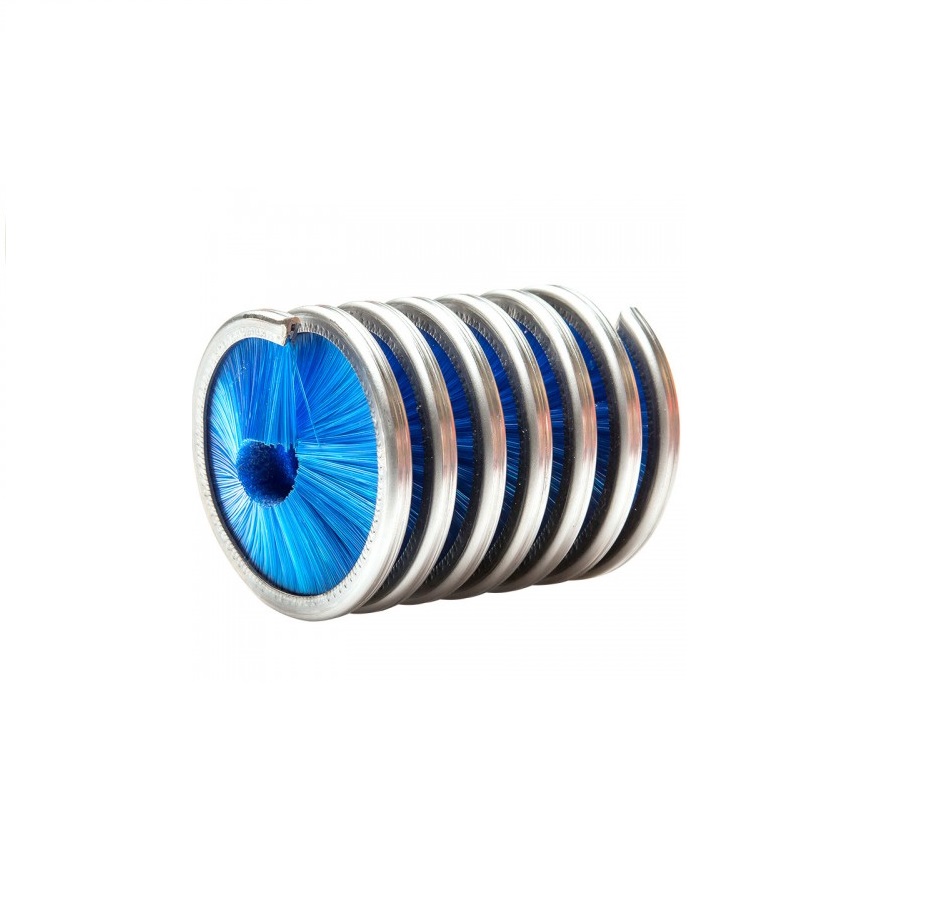
Line speed and brush speed are linked. If the rope runs fast, the brush has fewer revolutions of contact per meter, so either the brush speed rises or the contact arc grows. Both changes add heat, and heat softens thermoplastic filament. On high speed lines, a larger brush running at moderate speed usually holds its shape longer than a small brush running fast.
Brush specification for wire and cable work usually comes down to filament grade, tuft density, and how the brush is mounted on the line. <brushes for steel wire industries cleaning descaling derusting polishing> covers the brush types used across cleaning, descaling, derusting, and polishing stages in steel wire plants.
Setting Up a Cleaning Pass Step by Step
- Identify the rope. Record construction, diameter, lay direction, core type, lubricant, and the examination criteria the equipment owner applies.
- Characterize the contamination. Decide whether the deposit is grease, dried mud, scale, dust, or a mix, and whether the rope runs wet or dry.
- Select the filament from the table above, then confirm it against the rope coating. Galvanized and plastic-coated ropes need the softer options.
- Position the brush square to the rope axis and set the contact arc by adjusting the mount, not by bending the filament.
- Set rotation against rope travel. Confirm the direction with the rope stopped before the line runs.
- Fit containment and, where dust is fine, extraction. Removed material has to leave the area.
- Clean, inspect, then relubricate. This order is not optional. Grease applied over contamination seals the abrasive in place.
- Record the brush type, date, running hours, and condition found. The record is what turns a cleaning habit into a maintenance interval.
A strip brush curtain around the cleaning station keeps thrown grit inside the tray instead of spreading it along the line.

The same logic applies to the rest of the rope path. Sheaves, guide tubes, and conduits collect the same debris and pass it back to the rope.

Where the Brush Stops and Inspection Begins
A rope cleaning brush works on the outer surface. It does not clean between strands, it does not reach the core, and it does not detect broken wires. A cleaned rope can look better than it is, and that is the main risk in adding a brush to a maintenance program.
Filament that is too stiff removes more than grease. It can polish away the zinc coating on galvanized rope, open the surface to corrosion, and drag broken wires out of the lay. Any brush that leaves visible scratches on the wires is too aggressive for that rope.
Cleaning is a production step as much as a maintenance one, because a rope that is inspected on schedule keeps the equipment running instead of stopping it. <rope cleaning brush for industrial use a key tool for maintaining safe production> covers the role rope cleaning plays in keeping industrial handling equipment in service.
Cleaning also has a defined place in the inspection sequence. A probe or gauge that must ride on the rope surface works better on a clean rope, but a clean surface is not evidence of internal condition. Examination criteria, retirement limits, and the decision to keep or replace a rope stay with the applicable rope standard and the responsible engineer.
Get the Brush Matched to Your Rope
Send the rope diameter, construction and lay direction, the contamination type, the line speed, and the mounting space available at the cleaning station. Huixi Brush builds cylindrical, spiral, and strip brushes in PP, nylon, abrasive nylon, brass, and steel wire, and can quote a matched set for a single line or an OEM program. Email [email protected] or call +86 1580 0932 713.
FAQ
Can a wire brush be used on a running wire rope?
No. Crimped or knotted steel wire removes metal along with contamination and can open the surface to corrosion. Running ropes are normally cleaned with nylon or polypropylene filament, with steel wire reserved for stationary cable, structural rod, or heavily scaled stock that will be inspected and relubricated afterwards.
How often should a wire rope be cleaned?
Base the interval on contamination rate, not on a calendar. Track how quickly grease and grit return after cleaning, then set the interval so the rope is cleaned before debris reaches the sheaves. Ropes in dusty, wet, or high cycle service usually need shorter intervals than sheltered indoor ropes.
Does cleaning replace relubrication?
No. Cleaning removes the contaminated film; relubrication rebuilds the film that separates the wires. The two steps belong together, and the order matters. Grease applied over grit traps the abrasive against the strands.
What causes heavy grease buildup on wire rope?
Common causes are over-application at the previous relubrication, dust and fiber carried in from the working environment, heat that softens the lubricant so it migrates, and seal or wiper failure on the equipment. Finding the source is usually faster than cleaning more often.
Can a rope cleaning brush damage the rope?
Yes, when the filament is too stiff for the rope, the brush speed is too high, or the wrap is too tight. Visible scratches on the wires, filament breakage, or heat at the contact point all indicate the setup is too aggressive.
If you’re interested, check out these related articles:
honing brush a magic tool for flexible burr removal
what you know about brass wire brush strip
the differences between inward and outward spiral brush


 Whatsapp
 Email