


Descaling Spiral Brush for Pipe Rust and Limescale Removal
A descaling spiral brush removes pipe rust, limescale and heavy deposits because it does three jobs at once. The rotating filaments strike the deposit, the helix angle drags them along the bore axis instead of only around it, and the spiral channel carries the loosened material toward one end. That combination keeps working where a flat scraper cannot reach and where a straight tube brush pushes debris ahead of itself. What the brush cannot do is choose its own specification. Filament material, brush outside diameter and rotation direction decide whether the pass cleans the pipe or polishes the deposit in place.
How a Descaling Spiral Brush Breaks Down Pipe Deposits
A descaling spiral brush is a band of filament wound in a helix around a central stem. The stem carries the brush through the bore, the filament band contacts the full circumference, and the spiral pitch sets how much axial travel each turn provides. Three actions happen in the same rotation.
The filament tips strike the deposit. On brittle material such as mill scale or calcium carbonate, the impact starts cracks and the layer flakes at its boundary with the steel. On softer rust the break happens at the bond line between the oxide and the base metal, which is why a light-looking pass can lift a layer that appeared tightly held.
The helix angle turns part of that contact into an axial scrape. A radial brush only cuts in the direction of rotation, so it polishes the top of the deposit. A helical band also drags along the bore axis, lifting the edge of the layer so the following filament can get underneath it.
The spiral then acts as a screw conveyor. Loose scale collects in the channel between turns and is pushed toward the discharge end as the brush advances.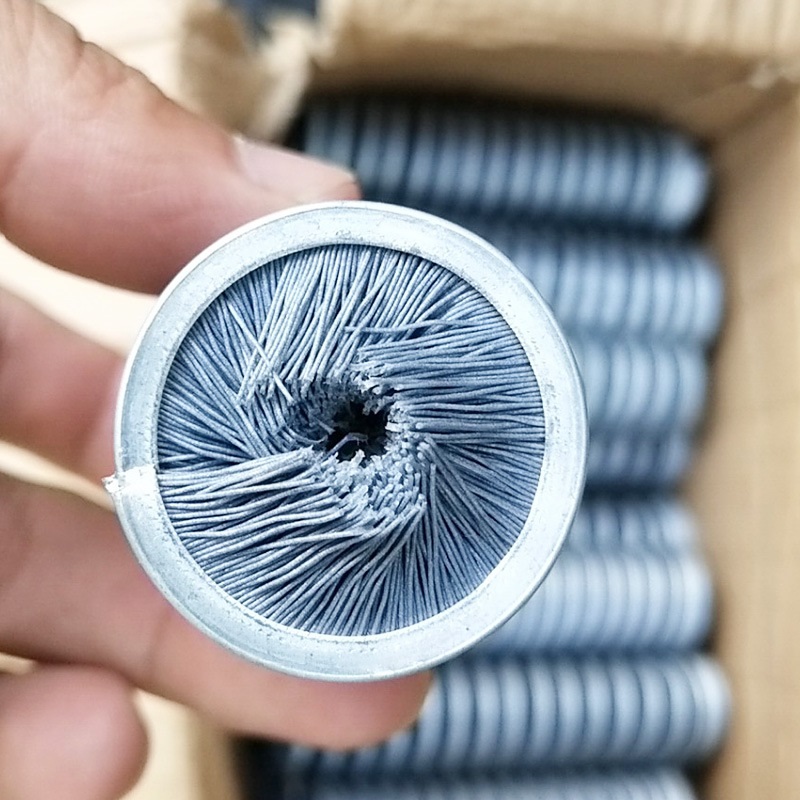
Contact pressure comes from interference. A brush slightly larger than the measured bore has to compress its filaments to fit, and that compression is the only pressure available. It is also where the job fails. An undersized brush touches lightly, the deposit is burnished rather than broken, and the bore looks smoother while the layer is still there.
Pipe cleaning covers a wide range of tools, and the practical difference between them is how each one handles the material it has just loosened. <descaling spiral brush an innovative tool and generalist in the field of industrial cleaning> covers where this brush type sits among other industrial cleaning tools.
Why Spiral Geometry Beats a Straight Tube Brush
A straight tube brush carries tufts fixed at set positions along the stem. Between tufts there are gaps, so contact happens in rings rather than a continuous band. Those rings do remove scale, but the loosened material collects in front of each tuft row until the brush is pushing a plug of debris instead of cutting into the wall.
The helical band closes those gaps. Because the band advances as it turns, every point on the circumference is swept and the contact point travels along the bore rather than staying in one plane. Pits, weld seams and oval sections are crossed progressively instead of being struck repeatedly at the same angle.
Spiral filaments also give the brush room to flex. Pipe bore is rarely a true circle after welding or bending. A brush with spring in the filament can hold pressure on the narrow side and still reach the wide side, while a rigid scraper either misses the oval or jams on it.
Direction is the detail that gets missed. The helix hand and the rotation direction together decide whether the brush pulls itself into the pipe, pushes debris out, or screws itself tight and stalls the drive.
A spiral brush that feeds itself forward too quickly can compact the debris it was meant to remove, or stall a small motor. <the differences between inward and outward spiral brush> covers how the two spiral directions behave differently inside a pipe.
Matching Filament to Rust, Limescale and Heavy Scale
The deposit decides the filament more than the pipe size does. The table below covers the first attempt on a typical bore.
| Deposit | First choice | Why it cuts | Avoid using it on |
|---|---|---|---|
| Mill scale from hot rolling | Knotted or heavy crimped steel wire | Brittle oxide cracks under impact and lifts in flakes | Thin wall tube where wire pressure could round the surface |
| Rust and light oxide | Crimped steel wire or silicon carbide abrasive nylon | Porous oxide breaks at the bond line with the steel | Stainless steel unless the filament is dedicated stainless |
| Limescale and hard water deposit | Silicon carbide abrasive nylon | Abrasive grains cut the carbonate layer without needing heavy impact | Thick layered scale that needs a wire breaker pass first |
| Grease, sludge and organic film | Nylon or PP with a detergent flush | The bristle carries fluid and lifts soft material | Wire, which smears grease back onto the wall |
The table describes the first attempt, not a fixed rule. A heavily scaled line often needs two stages: a wire brush to break the crust, then an abrasive nylon brush to clean the surface the crust was hiding. Skipping the second stage leaves a rough, pitted wall, and a rough wall gives the next layer of scale more places to grip. That is why a line that was descaled once and re-scaled within a season often has a surface problem rather than a chemistry problem.
Stainless steel needs its own note. A carbon steel brush run through a stainless line leaves free iron on the surface. That iron rusts, and the rust is usually read as a failure of the stainless rather than contamination from the brush. Dedicated stainless filament avoids the transfer, and a free iron test after cleaning confirms what is left on the wall.
Where a Descaling Spiral Brush Reaches and Where It Fails
The brush works best in straight runs and long radius bends, in tube bundles, drain lines and process pipe that can be opened at both ends. Brush length, shaft type and bore size set the practical reach, and a flexible shaft extends that reach through gentle curves.
It fails at tight elbows, mitre bends, tees and reducers. The filament catches on the inner radius, the shaft kinks, and the brush can lose filaments in a place no one can inspect. Lined pipe is the other hard limit. Cement mortar, epoxy and HDPE linings are cut by wire, and when the lining is the protected surface, mechanical descaling may not be acceptable at all.
Soft metals belong in a separate category. On copper, brass, aluminium and plastic, steel wire removes parent metal and embeds particles in the wall. Brass or nylon filament does the cleaning without cutting the pipe it is meant to protect.
Copper and brass lines need a filament that lifts deposit without cutting the metal underneath it. <brass brushes work perfectly for pipe cleaning> covers brass filament brushes used for pipe cleaning work.
Thin wall and pitting carry their own risk. A brush follows the wall, and pits are low points where the filament tips concentrate. The pass removes pit edges and any remaining wall in exactly the section that was already weakest, so wall thickness readings before and after the job are the only reliable control.
Flat surfaces need a different format. Flange faces, tank floors and header plates are cleaned with a disc or cup brush on a right angle drive, because a spiral brush only cleans what it can pass through.
What to Specify Before You Order a Spiral Brush
An order that lists only the pipe size leaves the supplier guessing on the points that decide the result.
| Field | What to send | Why it matters |
|---|---|---|
| Bore size | Smallest and largest measured ID, plus ovality | Sets brush outside diameter and filament compression |
| Pipe material and wall | Grade, lining, measured wall thickness | Selects filament and limits contact pressure |
| Deposit | Type, thickness, whether it is layered | Decides stiffness and whether two stages are needed |
| Reach and access | Run length, bend radius, tees, entry port size | Decides shaft type and brush length |
| Drive | Motor type, speed range, chuck or coupling | Prevents whip, heat and stalling |
| Acceptance | Borescope, wipe test, flow target, surface finish | Defines when the job is finished |
A common order line reads: one 50 mm spiral wire brush for 2 inch pipe. A line that can actually be built reads: pipe material and grade, measured minimum and maximum ID, deposit type and thickness, brush outside diameter and overall length, filament material and diameter, helix direction, shaft type and coupling, drive speed, flush medium, acceptance check.
Two brushes can look identical in a photo and behave differently in the bore, because filament diameter, tuft density and helix pitch do the work. Huixi Brush builds spiral brushes to the measured bore and the stated deposit, and confirms helix direction and shaft type on the order, since those two details decide whether the brush conveys debris out of the line or screws itself in.
Running the Cleaning Pass Without Damaging the Pipe
- Record the starting condition. Take bore measurements at several points, wall thickness readings, an estimate of deposit thickness and a photo or borescope record of the worst section. Without a baseline, a clean-looking bore becomes the only evidence available at the end.
- Size the brush to the smallest measured ID rather than the nominal size. The filament needs compression at the tightest point so it still holds pressure through the rest of the run.
- Wet the pipe before the first pass. Water carries heat away from abrasive nylon, suppresses dust and gives loosened scale somewhere to travel. A dry wire pass on a long run leaves the debris sitting in the bottom of the bore.
- Set the drive to a moderate speed and let contact do the work. High speed raises filament temperature and throws the ends away from the wall, which reduces cleaning and shortens brush life.

- Control the feed with the shaft. When the helix wants to pull the brush forward faster than the operator can follow, hold it back, or it will run ahead of the flush and pack the debris.
- Work in one direction, then withdraw and inspect. Reversing rotation mid-pass drops loosened material back onto the wall that was just cleaned.
- Repeat while the brush still shows compression. Once the brush passes without resistance, it has reached bore size, and further passes only polish.
Wire brushes shed filament ends. Protect valves, pumps and instruments downstream with a strainer or a temporary spool, and inspect the bore before the line returns to service.
How to Confirm the Pipe Is Actually Clean
Checks the operator can run at the pipe end
A white cloth wiped at the exit and, where reachable, inside the bore shows whether loose deposit is still coming off. A clean cloth with no grey or brown transfer means the loose material is gone, though it says nothing about whether the surface is fit for coating. A borescope pass along the cleaned length adds the part a cloth cannot show, especially the bottom of the bore where flush water drains and debris settles. A flow or pressure drop reading taken under the same conditions as the baseline shows whether the bore is genuinely open.
Checks that belong in the record
Wall thickness readings at the same points measured before the pass show how much metal the job removed. A drop beyond the agreed allowance means the brush was too stiff or the pass count too high. Surface condition matters for whatever comes next, because coating, lining and passivation each need a defined surface, and a wire-scratched bore holds a coating poorly at the peaks while re-scaling faster in the pits. On stainless steel, a free iron test after wire cleaning confirms the surface is not contaminated.
| Check | What it shows | What it does not show |
|---|---|---|
| Borescope | Deposit left, pit condition, brush marks | Wall thickness |
| White cloth wipe | Loose residue still in the bore | Coating adhesion |
| Wall thickness gauge | Metal removed by the pass | Surface roughness |
| Flow or pressure drop | Whether the bore is open | Scale still bonded to the wall |
Agree the acceptance check before the first pass. Clean has no fixed meaning across pipe services, and a drain line, a heat exchanger tube and a coating-ready steel main are judged by different evidence. Where the bore needs a controlled internal finish rather than only deposit removal, a honing brush follows the descaling pass with a finer filament.
Send the Bore Measurements Before the Brush Is Built
The measurements settle more than a description can. A brush that suits mill scale in a carbon steel main is not the brush for a copper line or a lined water main, and the difference sits in filament choice, outside diameter and helix direction rather than in the brush family.
Send the pipe material and grade, the smallest and largest measured ID, an estimate of deposit type and thickness, the run length and bend radius, and the drive you intend to use. We will match the filament, brush diameter, helix direction and shaft type to that bore, and state which deposits the chosen brush will not remove so the scope is clear before the order. Email [email protected] or call +86 1580 0932 713.
FAQ
Can a descaling spiral brush clean a pipe without chemicals?
For rust, mill scale and limescale, yes. These deposits are held by mechanical or chemical bonds at the surface, and a filament that gets under the layer breaks that attachment without needing an acid. Chemicals still have a place where the deposit sits behind an obstacle the brush cannot pass, such as a tight elbow or a filled branch, or where the contamination is a process residue rather than a mineral scale. Many jobs combine the two: the brush removes the bulk, and a short chemical stage handles what remains in the areas the brush could not reach.
Will a wire spiral brush damage the pipe wall?
It can, and the risk follows the wall thickness rather than the brush size. On a thick wall carbon steel main, a correctly sized wire brush removes scale and leaves the steel intact. On thin wall tube, on badly pitted sections and on soft metals, the same pressure removes parent metal, and pits concentrate the filament tips. Measure wall thickness before the pass, keep the brush sized to the smallest measured ID, and check the same points afterwards. Brass or nylon filament removes the choice on copper and plastic lines.
How do I choose between steel wire and abrasive nylon for limescale?
Start with abrasive nylon for scale that is mostly calcium carbonate. Silicon carbide grains cut a hard, brittle carbonate layer without needing heavy impact, and they leave a more even surface than wire. Switch to a wire breaker pass first when the scale is thick, layered or mixed with rust, then finish with nylon. If the pipe is stainless, use dedicated stainless wire or go straight to nylon, because carbon steel filament transfers free iron that later shows up as rust spots.
Can the brush pass through elbows and bends?
A long radius bend usually accepts a brush on a flexible shaft, though the filament loses some wall contact through the curve. Tight elbows, mitre bends, tees and reducers stop the brush, and forcing it risks a kinked shaft or filaments left inside the line. On a run with several tight bends, clean between access points, or confirm the condition of each straight section separately rather than assuming a single pass reached the whole line.
How many passes does a heavily scaled pipe need?
Count passes until the brush stops showing compression at the bore, not until the bore looks bright. A heavy scale load usually needs a breaker pass with a wire brush, a cleaning pass with abrasive nylon and a final inspection pass, with the debris flushed out between each one. Record the brush outside diameter before and after the job. Once the diameter no longer changes after a pass, the brush has reached the wall and more passes only polish the surface.
If you’re interested, check out these related articles:
where stainless wire spiral brush can be used
rope cleaning brush for industrial use a key tool for maintaining safe production
descaling spiral brush an innovative tool and generalist in the field of industrial cleaning
advantage of hx boiler tube brush


 Whatsapp
 Email