



How to Use a Solar Panel Cleaning Brush Without Scratching
A solar panel cleaning brush protects the array only when three conditions hold at once: the filament is softer than the glass coating, the surface is wet enough to float grit away instead of dragging it, and the work happens while the glass is cool. Miss any one of them and the brush becomes the damage source. The failure rarely looks dramatic. It appears months later as a dull patch, a slow drift in string current, or a set of fine parallel lines that follow the brush path. This guide covers the checks that keep dust removal effective without trading a recoverable soiling loss for a permanent surface defect.
What Makes PV Cleaning Risky for the Glass and the Cells
Dust is not one material. At a coastal site it is salt and sand; near a cement plant it is alkaline powder; on farmland it is pollen and spray drift; around construction it is silica-rich cuttings. What these deposits share is a habit of bonding. Overnight dew dissolves the soluble fraction, and the next dry cycle leaves a crust that sits on the glass rather than resting loosely on it. A dry brush then has to shear that crust off, and shearing is a different operation from sweeping.
Removal is where the damage starts. Most mineral dust contains quartz, which is harder than soda-lime glass and considerably harder than the anti-reflective coating on the outer surface. When a particle is pinned between a filament tip and the glass, the brush turns a sliding motion into a cutting one. The marks are shallow, parallel, and permanent. Transmittance drops a little at each mark, and no later cleaning brings it back.
Two other failure paths are less visible than scratches. Water driven into a connector body or under a junction box lid lowers insulation resistance and can trip residual current protection long after the crew has left the site. A sharp temperature gradient from cold water on hot glass adds stress to the laminate, its edge seal, and the frame adhesive. Module qualification covers mechanical load and impact; it does not certify any particular cleaning method.
The controlling document is the module manufacturer’s installation and maintenance manual together with the warranty terms. Several warranties exclude surface damage caused by abrasive cleaning, and a procedure that contradicts those clauses creates a claim problem even on a day when the glass survives.
Match the Solar Panel Cleaning Brush to Your Array and Method
The brush form should follow the access you actually have, not the cleaning power on the specification sheet. Each setup below carries a different limit.
| Cleaning setup | Brush form | Works when | Main limit |
|---|---|---|---|
| Telescopic pole with water feed | Rectangular head with soft nylon filament | Rooftop and small ground arrays, isolated problem areas | Operator fatigue changes contact pressure across a shift |
| Roller machine | Cylindrical brush with trailing squeegee | Ground-mount rows with clear access and uniform tilt | Row spacing and pressure setting decide results |
| Crawler robot | Cylindrical or disc head, sometimes microfiber | Large arrays with repeatable routes | Dry brushing in abrasive dust |
| Tractor-mounted sweeper | Wide cylindrical sweeping brush | Pre-cleaning heavy deposits before a wet pass | No control of contact at panel level |
The cylindrical brush on a roller machine does the most continuous work in any PV cleaning programme. It touches glass along its full working width on every pass, row after row, so two properties matter more than apparent cleaning power: filament recovery after each deflection, and core balance at operating speed. A roller that has taken a permanent set, or one whose core runs out of true, loads a narrow band of glass harder than the rest and leaves a stripe that repeats down the array.
Roller brushes on cleaning machines carry their work through constant glass contact, so filament recovery and core balance decide how even that contact stays. <advantage of hx cylindrical nylon brushes> covers the construction points behind a cylindrical nylon brush.

Disc and small rotary heads reach what a roller cannot: the frame return, the shadow behind a clamp, and the corner of a module string. They are also the heads most often used too aggressively, because the operator cannot see contact pressure under the head. On coated glass a disc head should run at the lightest pressure that still turns, and it should be lifted at the end of each pass rather than dragged sideways into the next one.
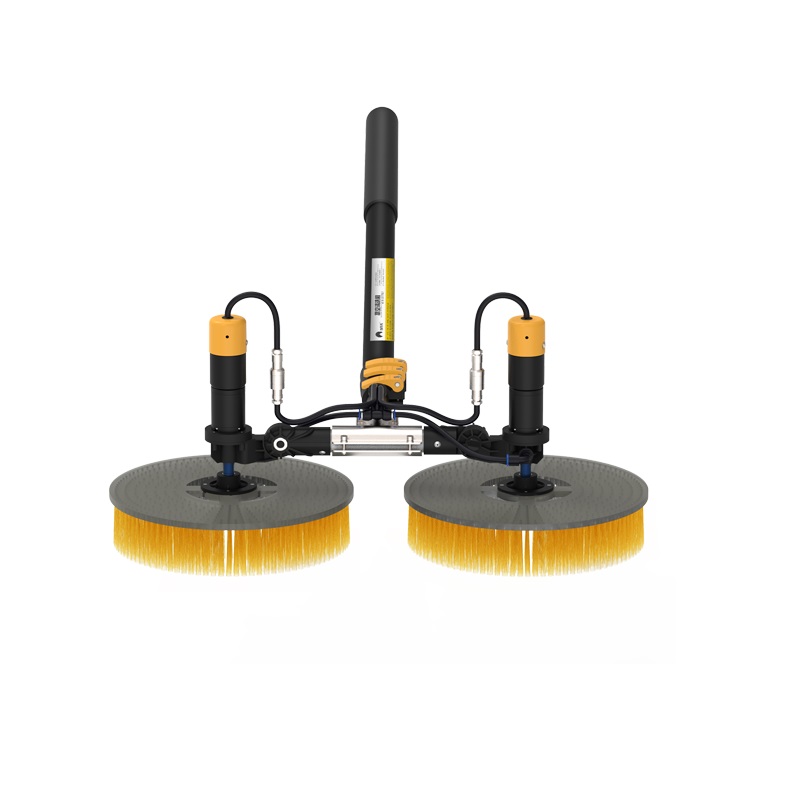
Manual work still has a place. For a few rooftop modules, a soft hand brush keeps the operator close enough to feel the pressure and to see what the bristles are lifting. The risk with a hand brush is the same as with a pole: reach and habit encourage scrubbing, and scrubbing is the motion that drives grit into the coating instead of lifting it clear.

Which Filament Keeps Contact Gentle on Coated Glass
Filament choice is the single decision with the longest consequence, because the wrong material keeps damaging glass on every clean.
| Filament | Behaviour on coated glass | Use it when | Avoid when |
|---|---|---|---|
| Nylon (PA6 or PA66) | Flexes and recovers, keeps even contact across slight surface variation | General wet cleaning, pole and machine heads | Dry sweeping with hot filament running at load |
| Polypropylene | Stiffer and cheaper, tends to take a set under continuous load | Light dust, low-pressure manual heads | Machine rollers run at working pressure |
| Abrasive nylon | Contains silicon carbide or aluminium oxide grit | Metal deburring and edge blending | Any coated or uncoated PV glass |
| Natural fibre | Absorbs water, softens, and holds dirt between filaments | Not for repeated wet cycles | Machine use and dirty sites |
| Steel or brass wire | Hard enough to score glass and strip the coating | Frame and hardware work with the head kept off the glass | Contact with the module surface |
Filament diameter and trim length set how much load each tip carries. Thin filament bends at low load, so pressure per tip stays gentle and the brush follows small surface variation; the same filament over a heavy crust simply bends away and leaves the deposit behind. Thicker filament carries more load, which suits a machine sweeping grit ahead of the rinse, and cuts into the glass when an operator leans on it. Trim length works in reverse: a long trim is springy and forgiving, a short trim is stiff. Machine brushes are usually specified with the shortest trim that still keeps filament ends in contact at the set working height.
Tip finish is worth a question at the ordering stage. Cut filament ends present a small flat edge; rounded ends present a softer contact point. For coated glass the rounded finish costs little and removes one source of point loading. Check the core as carefully as the bristles: shaft ends should be capped, no staple or wire loop should be able to work loose, and the housing should have a bumper that meets the frame before the filament does.
Condition a new brush before its first pass. Cut filament fragments, packing dust, and workshop oil all sit in a new brush, and all of them are abrasive on glass. Huixi Brush builds cylindrical and strip brushes for cleaning equipment, and the specification conversation that matters for a PV buyer is filament grade, diameter, trim length, and core end finish.
Water, Timing and Pressure Choices That Prevent Damage
Timing decides how much of the work the chemistry does for you. Clean while the glass is cool: early morning after dew has dried offers the widest working window, and late afternoon is the second option. Midday cleaning combines hot glass with cold water and fast evaporation, which leaves mineral spots before the crew reaches the next row.
Wet the surface before the brush touches it. A pre-rinse floats loose grit and softens the bonded crust, so the filaments work on a slurry rather than a grinding paste. A brush laid onto dry dust behaves like a lap, holding particles against the glass and pressing them in with every stroke.
Water quality shows up after the water has gone. Dissolved solids stay on the glass as calcium and magnesium salts that scatter light and attract the next layer of dust. A final rinse with demineralized water sheets off cleanly; where that supply is not available, rinse with the cleanest source on site and remove residue before it dries.
Contact pressure is the variable crews adjust without noticing. A brush should be guided, not pressed. When filament tips bend flat against the glass, the load has shifted from the tips to the filament sides, where trapped grit has nowhere to escape. Keep high-pressure jets away from frame joints, junction box lids, and connector bodies. Those seals are built for rain arriving at an angle, not for a directed jet.
Stop the work and reschedule when wind is carrying dust or sand across the array, when the surface is too hot to touch comfortably, or when rain is imminent. Cleaning into blowing dust simply redistributes the problem and adds a fresh abrasive layer.
A Cleaning Sequence With Checkpoints at Each Stage
The sequence below is written for a wet clean with a brush head. Each row carries the check that has to pass before the crew moves on.
| Step | Action | Check before moving on | Status |
|---|---|---|---|
| 1 | Confirm the module manual and warranty allow the method, then record baseline yield and photographs | Written reference for the method | Required |
| 2 | Agree string or inverter status with the plant operator | Isolation confirmed where required | Required on grid-connected arrays |
| 3 | Pre-rinse the full area to be cleaned | Water sheets evenly with no dry patches left | Required |
| 4 | Wash from the top edge downward in overlapping passes | Filaments stay flat on the glass, no scrubbing motion | Required |
| 5 | Detail frame lip, clamps, and mounting hardware with a separate dry tool | No water sitting at connector bodies | Required |
| 6 | Final rinse with low-solids water | Glass dries without visible spots | Required |
| 7 | Inspect at a low sun angle against the baseline photographs | No new line marks compared with the previous cycle | Required |
| 8 | Record the cycle and re-read yield on the next clear day | Gain or no gain documented | Required |
Two checkpoints catch most problems before they become expensive. The first sits before the brush touches glass: if the pre-rinse has not wetted the entire area, the first pass will drag. The second sits at the final rinse: any patch that dries before the rinse reaches it needs a second light pass, not a harder scrub.
Keep the working order consistent. Water runs down, so the top edge is cleaned first and the bottom edge last, and frame channels are followed in the direction that lets water leave the module. Two people working the same row from opposite ends is a common cause of double pressure at the overlap point.
Reading Surface Damage Before It Becomes Permanent
Inspection is only useful if it happens at the right angle. Stand so the sun reflects across the glass at a shallow angle; scratches and haze become visible in reflection long before they show up in output data.
- Parallel lines following the brush path point to grit trapped under filament, or a brush that has taken a set. Replace the head and review the pre-rinse step.
- Milky patches with soft edges suggest coating abrasion rather than glass damage. Compare against a control module that is cleaned less often.
- Chips at the frame edge usually come from the head or pole striking the frame. Check the bumper and the working height.
- Brownish discoloration along cell fingers is a laminate and moisture issue, not a cleaning result. Record it and report it to the asset owner.
- Spots that reappear after drying come from dissolved solids in the rinse water, not from the brush.
Photograph one fixed reference module before every cycle. A defect found in the first month costs a brush change; the same defect found after two seasons costs modules, because scratch damage and coating loss accumulate with no route back.
How Often to Clean and What to Record
Frequency should follow measured soiling loss, not the calendar. A workable method is to clean one row and leave the neighbouring row untouched, then compare specific yield on the next clear day. That single comparison tells you whether the array is losing more energy than the cleaning cycle costs, which is the only figure that decides interval.
Fixed triggers still earn a place in the schedule: dust storms, nearby construction, pollen peaks, bird roosts on tracker frames, agricultural spraying seasons, and the first rain after a long dry spell, which turns surface dust into mud that bakes on. Light rain does not clean a module. It wets the dust, dissolves part of it, and dries it into a harder film than before.
Record enough per cycle to make the next decision easier: date, array section, cleaning method, water source and its solids level, filament type and brush hours, observed soiling type, yield before and after, and any surface change. Over-cleaning wears coating and filament and adds labour hours; under-cleaning gives away generation. The record is what separates the two.
Send Your Array Details for a Brush Match
Brush specification for PV work comes down to a short list of facts, and most wrong orders are caused by one of them being missing. Tell us the module size and glass coating, the array layout and tilt, the mounting type, the cleaning method you plan to run, the brush length and diameter your machine or pole accepts, the filament preference, and the water source available on site. Send those details to [email protected] or call +86 1580 0932 713, and Huixi Brush will match a filament grade, trim length, and core finish to the way your crew actually works.
FAQ
Can I clean solar panels with a brush and plain water?
Yes, for most arrays. Water plus a soft filament brush removes dust, pollen, and bird droppings without detergent. Detergent helps only when the deposit is greasy or oily, and any residue left behind attracts the next layer of dust, so rinse it thoroughly if you use one. The condition that matters more than the additive is water quality: a final rinse with low-solids water prevents the spotting that hard water leaves on coated glass.
Which bristles will not scratch solar glass?
Soft nylon filament with rounded ends is the safest common choice, and polypropylene suits light dust on low-pressure manual heads. Filament diameter, trim length, and contact pressure matter as much as the material itself, because a thin soft filament pressed flat against glass stops behaving like a soft filament. Abrasive nylon and wire are built for metal work; keep both away from the module surface and use them on frames and hardware only.
Is it safe to clean panels in full sun?
It is the worst window for the glass and for the crew. Hot glass meeting cold water creates a sharp temperature gradient, and fast evaporation leaves mineral spots before the rinse reaches the next row. Work early in the morning after dew has dried, or in late afternoon. The frame and glass also get hot enough to make close work uncomfortable, which shortens patience and raises contact pressure.
How often should solar panels be cleaned?
Set the interval from a measured comparison, not a fixed schedule. Clean one row, leave the next row untouched, and compare specific yield on the next clear day. If the gain is larger than the cost and risk of the cycle, shorten the interval; if not, extend it. Sites near construction, cement plants, farmland, or bird roosts usually need extra cycles triggered by events rather than a calendar date.
If you’re interested, check out these related articles:
advantage of hx cylindrical sanding brushes
the differences between inward and outward spiral brush
advantage of hx cylindrical nylon brushes


 Whatsapp
 Email