



Abrasive Nylon vs Steel Wire Roller Brushes for Conveyors
Abrasive nylon roller brushes and steel wire rollers both spin against a moving part, but they do not clean it the same way, and the softer option is not automatically the safer one. A nylon roller run at too much interference will smear its own filament across the part, while a crimped wire roller set lightly can clean steel with little stock removal. The decision comes down to three questions: what you are removing, what the surface must look like afterward, and how tightly the station can control contact. This comparison works through those three questions so you can specify the roller that fits the line rather than the one that sounds gentler.
How the Two Rollers Remove Material Differently
Abrasive nylon roller brushes carry their cutting action inside the filament. The nylon is loaded with abrasive grain, usually aluminum oxide for general work or silicon carbide where a sharper cut is needed, and every filament tip presents that grain to the surface. Because the filament bends under load, the roller spreads contact across the full face, follows part contour and coating thickness, and cuts many small chips instead of dragging a stiff edge through the work.
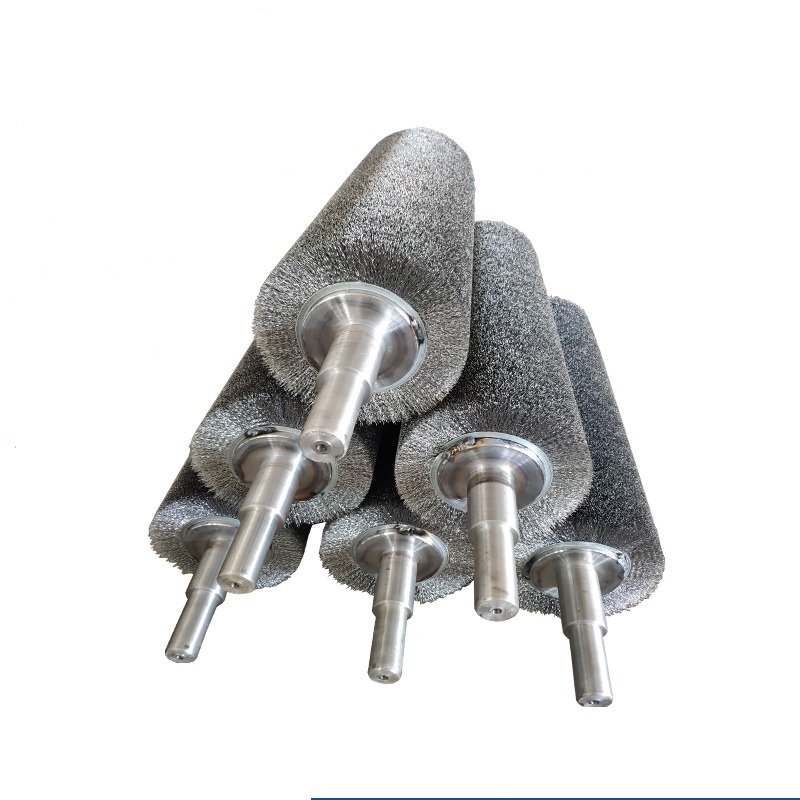
Steel wire rollers work by scraping and impact. Crimped wire is waved to spread the tufts and soften the contact; knotted wire is twisted into tight, stiff tufts for aggressive removal. Wire does not conform the way filament does, so individual tips strike the surface, flick debris away, and leave a directional scratch pattern.
That difference explains the wear you see on each roller. Nylon filaments flatten at the tip and lose grain, so removal falls off gradually and the brush keeps turning long after it has stopped cutting. Wire tips blunt, and wires fatigue and break, so removal falls off at the same time the risk of a loose wire rises. Both wear out; only one of them usually gives you a visible warning first.

Where Steel Wire Rollers Still Do the Work Nylon Cannot
Steel wire keeps the job wherever the deposit is thicker or harder than a filament can reach. Mill scale, rust, weld spatter, burnt-on carbon, foundry sand, and heavy paint sit above the surface, and wire breaks them up by impact rather than cutting them away. A nylon roller tends to polish the top of that layer without removing it, because the filament deflects over the high points instead of digging under them.
Temperature sets the other limit. Nylon has a working ceiling, and a station placed after a drying oven, a preheat, or a welding operation can sit above it. Once the filament softens it smears, transfers nylon to the part, and stops cutting, while steel wire tolerates the same location.
Wire selection inside that family matters as much as the nylon-versus-wire decision. Crimped wire gives a wider, softer contact pattern and suits general cleaning and light descaling, while knotted wire concentrates force for heavy scale and spatter. Changing between crimped and knotted affects aggressiveness more than changing wire diameter does.
Contamination is the one rule worth treating as non-negotiable. Carbon steel wire sheds iron onto stainless and aluminum, and that free iron becomes a rust point. Stainless wire, or a non-ferrous filament, avoids introducing the problem at all.
Crimped and knotted wire behave differently enough that the wire form, not the wire diameter, often decides how hard the roller hits. <the differences between knotted wire wheel brush and crimped wire wheel brush> covers how the two wire constructions differ in stiffness and contact.
Where Abrasive Nylon Rollers Protect the Part and the Line
A nylon roller earns its place when the surface after cleaning is part of the specification. Aluminum, brass, copper, anodized sheet, painted coil, and polished stainless all show a wire mark that a filament will not leave. The same conformability that limits removal depth also keeps the roller from gouging a soft alloy or lifting a coating at a sheared edge.
The second case is dimensional. A machined edge with a burr and a tolerance callout can be deburred with a nylon roller because the filament deflects at the edge instead of cutting into the flank. Wire does not stop at the burr. It keeps cutting into the corner, and the corner radius grows with every pass.
The third case is handling. Nylon rollers generally run quieter and throw less debris, and they do not shed wire fragments into a station, a bin, or a downstream process. That matters where loose metal is a foreign object risk or where parts feed straight into assembly. Bristle fragments are not nothing, so a line that cannot tolerate any polymer debris needs a containment or extraction decision rather than an assumption.
Where a continuous roller does not fit the part flow, a brush table delivers the same filament contact in a batch format, and it suits parts that are hand-loaded or cleaned in groups rather than passed on a belt.

Setting the Contact Window on a Conveyor Brush Station
Every roller has a contact window: the range of interference and surface speed where it removes what it should without smearing, gouging, or overheating. Filament below the window glides across the surface and polishes it; filament above the window overheats, smears, and transfers nylon onto the part. Wire below the window burnishes; wire above it digs, work hardens the surface, and breaks.
Find the window by working up from the low side. Set the smallest interference that produces a clean part on a strip test, then raise surface speed until removal is consistent across the full face, and stop before the part temperature climbs or the filament tips begin to glaze. A fixed-speed station is set on interference alone; a station with a variable drive gives you both adjustments.
Rotation direction is a setup decision, not a detail. A roller turning against conveyor travel lifts debris off the surface and cleans harder, while a roller turning with travel is gentler on thin parts and coatings. Helical winding adds a sideways component: a spiral-wound roller moves debris along its axis, so dust tends to collect at one end of the face and the extraction hood should sit where the helix delivers it rather than where the drawing says.
Part gaps create their own problem. Each gap lets the roller spring forward and strike the next leading edge harder than it strikes the middle of a part. That shows up as edge marks, filament breakage on one side of the face, or a bright band at the leading edge. A chamfer, slightly reduced interference, a softer filament, or a pivoting mount all address it, and which one you choose depends on whether the edge or the finish carries the tighter requirement.

Matching Roller Specification to the Station
The specification that matters is the one the station can hold, not the one printed on a catalogue page. Start with the mounting: outside diameter, face width, bore or arbor, keyway, and core material decide whether the roller fits at all, and core balance matters as surface speed rises.
On the nylon side, filament diameter and grit size set the cut, and trim length sets how far the filament can deflect before it stops conforming. A longer trim is more forgiving on uneven parts and gentler at edges. On the wire side, wire diameter, crimp or knot, and tuft density set the impact, and trim length sets how much the wire can whip.
Geometry deserves the same scrutiny before either material is chosen. A roller suits a continuous strip, a wide face, and a part that passes once. A disc brush suits a flat face or a short footprint where a roller will not fit, and it can be mounted on the same head as a roller when one station has to clean both a face and an edge.
Edge containment belongs in the same conversation. A strip brush mounted along the conveyor edge keeps dust and chips inside the extraction zone instead of letting them travel down the line, and it stops the roller from dragging loose debris back across the cleaned surface.

Comparing Cost and Changeover Over the Life of the Roller
Sticker price is the weakest comparison point. A wire roller usually costs less to buy and a nylon roller usually costs more, but neither number survives contact with a production line. The useful figure is cost per cleaned part: roller price plus changeover labour plus the value of rejected or reworked parts, divided by the number of parts cleaned between changes. The formula is simple; collecting honest inputs is the work.
The inputs differ by material. Wire fails by losing wires and by dulling, and a broken wire can mark a part, jam a fixture, or contaminate a bin. Nylon fails by flattening and losing grain, which is quieter but harder to see, so the replacement point depends on a check rather than on a visual cue.
Secondary operations belong in the comparison. A wire roller that leaves a scratch pattern can create a polishing step a nylon roller would not need, and a nylon roller that leaves a burr root can create a wire-brushing step it cannot remove. Whichever way the sequence runs, the total operation is the honest unit of comparison.
A trial settles more than a spreadsheet. Run one station, one part family, and one shift pattern, and record the roller hours, the removal result, the reject count, and the wear pattern at the end. That result covers the trial conditions and nothing beyond them; a different alloy, a different deposit, or a different line speed needs its own confirmation.
Abrasive filament rollers are consumables, and how they wear sets the replacement interval as much as how they cut. <advantage of hx cylindrical sanding brushes> covers the advantages cylindrical abrasive brushes bring to repeated surface work.
Which Roller Fits Your Conveyor Cleaning Task
Read the table as a screening step. It separates stations where the material choice is already decided by the surface, the deposit, or the temperature from stations where either roller can work and the setup decides the result.
| Station condition | Abrasive nylon roller | Steel wire roller | Avoid |
|---|---|---|---|
| Visible cosmetic face on aluminum, brass or coated sheet | Fine grit nylon at light interference | Hidden faces only, at low pressure | Knotted carbon wire on a visible face |
| Heavy rust, mill scale or weld spatter on structural steel | Polishes the top of the deposit | Crimped or knotted wire matched to deposit thickness | Nylon where the deposit stands above filament reach |
| Stainless or aluminum parts with a no free iron requirement | Silicon carbide nylon | Stainless wire only | Carbon steel wire on stainless |
| Burr on a machined edge with a tolerance callout | Nylon at controlled interference | Possible corner radius growth | Wire where the corner radius is called out |
| Station after an oven, dryer or welding head | Only within the filament temperature limit | Steel wire, checked for heat | Nylon where part temperature exceeds the filament limit |
| Wet station with coolant or wash spray | Nylon 6/12 on a protected core, supplier confirmed | Stainless wire | Standard nylon in hot aqueous service |
Whichever row your station lands in, verify before release. A strip test on scrap shows whether removal happens at the interference you set. A first-off inspection under low-angle light shows scratches and smears that a straight-on look hides. A dimensional check after deburring shows whether the roller is cutting the edge or the flank. On wire, a magnet check and a visual sweep of the bin catch loose fragments before they reach a customer.
Two limits are worth stating plainly. A supplier’s grit or wire callout describes the brush, not the finish on your alloy, because finish also depends on pressure, speed, dwell, and part hardness. And a trial that passes on one part family does not authorise the same setting on a different alloy or a different deposit.
Send Your Line Details and We Will Match the Roller
Tell us the part material and the finish the surface must hold, the deposit or burr you are removing, the roller outside diameter, face width, bore and keying, the conveyor speed and roller rpm, whether the station runs wet or dry, the temperature at the brush, and the check you use to accept a cleaned part. Send those details to [email protected] or call +86 1580 0932 713, and Huixi Brush will match a roller construction to your station instead of to a catalogue page.
FAQ
Can an abrasive nylon roller replace a steel wire roller for rust removal?
Only when the rust sits at the surface. Light flash rust and surface oxidation come off with a coarse nylon filament at enough interference, but pitted rust, laminated scale, and heavy corrosion need impact to break the layer apart, and a filament deflects over those high points. Test on scrap first, and if the strip test still shows brown residue in the pits after two passes, the deposit is beyond filament reach.
Which roller is less likely to scratch aluminum?
The nylon roller, in most setups, because the filament conforms and cuts shallow. That advantage disappears if you run it at excessive interference or surface speed, where the filament overheats and smears, or if the grit is coarse for a cosmetic face. Wire can clean aluminum without deep scratching when the pressure is light and the wire is fine, but any stiff knotted wire on a visible face is a risk you do not need to take.
Does grit number alone determine the surface finish?
No. Grit describes the abrasive in the filament, and the finish also depends on filament diameter, trim length, interference, surface speed, dwell time, and the hardness of the part. Two rollers with the same grit can produce different finishes on the same alloy if one station presses harder or runs faster. Set the finish by testing the full setup, not by comparing grit numbers between suppliers.
Can I run an abrasive nylon roller on a wet conveyor?
It can work, with the right filament and core. Nylon absorbs moisture, and the grades differ in how much they take up and how they hold stiffness when wet, so a wet station needs a filament grade and a core material confirmed for that service rather than a standard dry-running roller. Hot wash spray adds a temperature question on top. Confirm both with the supplier before the roller goes on the line.
If you’re interested, check out these related articles:
advantage of hx cylindrical nylon brushes
introduction of our concrete block machine brushes
honing brush treat burrs in barrel parts without affecting accuracy and scale
what you know about brass wire brush strip
how do you know about deburring brushes


 Whatsapp
 Email