



Honing Brushes for Internal Finishing and Deburring
Honing brushes carry a specific job: cut the burr root and refine the bore surface without changing the designed diameter. When a part leaks or a valve binds after deburring, the fault is rarely the brush concept. It is usually the match between abrasive grade, filament length, and hole geometry. I select a honing brush around the hole condition first, not around the machine or the cycle time. The same tool that polishes a through hole can damage a blind bore or miss cross-hole intersections. The sections below move through the choices and failure points that matter before production.
What a Honing Brush Does Inside a Precision Bore
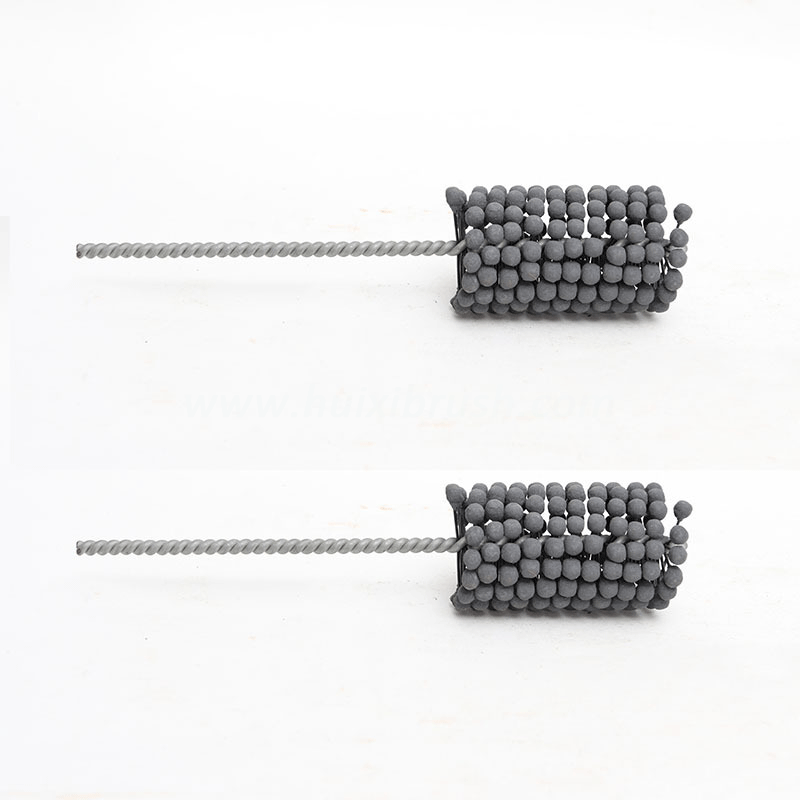
A honing brush is a precision abrasive tool, not a fixed stone. The abrasive filaments are arranged around a metal core, and the working interference between filament tip and bore wall controls how much material moves. That makes it different from a reamer because a reamer guides on the tool while a honing brush guides on the surface already present. On cast iron, steel, stainless steel, and aluminum housings, it removes micro burrs and light scale while reducing surface roughness toward the Ra 0.8 to Ra 0.2 range, provided the incoming surface is already close to size.
Cross-drilled oil passages are the standard test. A wire deburring brush will reach the intersection and knock off the loose chip, but an abrasive honing brush works the root and blends the edge. In hydraulic valve bodies and fuel system parts, that blend is more valuable than speed because leak path behavior starts at the intersection. I have seen production lines hold size during roughing and then lose the bore after an aggressive deburring pass. The problem was not the honing brush but the missing controlled interference fit.
When the process goal is flexible edge treatment rather than stock removal, <honing brush a magic tool for flexible burr removal> covers why the bristle wrap around internal features leaves the edge profile intact.
Which Abrasive Type and Grit Fit Fine Finishing Work
Grit changes the balance between burr cutting and surface refinement. A coarse abrasive removes material faster but can leave deep scratches and round the edge. A fine abrasive improves Ra but slows the pass. Selection should move from material hardness first. Hardened steel and carbide usually call for diamond or ceramic alumina because conventional aluminum oxide dulls too quickly. Cast iron and aluminum often respond better to silicon carbide, which fractures cleanly instead of loading.
| Abrasive Type | Typical Grit Range | Best Application | Main Limitation |
|---|---|---|---|
| Aluminum oxide | 80 to 600 | General steel and stainless steel | Shorter life in hardened material |
| Silicon carbide | 80 to 1200 | Cast iron, aluminum, ceramics | More frequent break-in |
| Ceramic alumina | 60 to 800 | Hardened steel, high pressure use | Higher unit cost |
| Diamond | 200 to 3000 | Carbide, hardened tool steel | Needs careful interference setting |
| Nylon abrasive | 180 to 1000 | Light deburr, fine finishing | Limited stock removal |
For a typical machined steel bore at Ra 1.6 that needs Ra 0.4, a single 600 grit pass is slow and may leave burr root behind. I usually run a two pass sequence: a 240 or 320 grit brush for the intersection, then a 600 to 800 grit brush for the finish. The first pass does the work. The second pass erases the scratch pattern. That sequence costs more than one brush, but it protects the dimension and avoids reworking an expensive part.

When a Honing Brush Outperforms a Standard Deburring Brush
The decision between a standard deburring brush and a honing brush turns on what happens after the burr is removed. A crimped wire or nylon deburring brush removes the visible burr and moves on. A honing brush removes the root and then continues to refine the bore surface. For a hydraulic spool bore, that refinement changes how the part holds a lubricant film and responds at low travel speed. For a simple bracket hole, the standard tool is enough.
Wire wheel and tube brush comparisons show the difference clearly. Wire work hardens the edge and can fold a thin burr into the port. Abrasive nylon or silicon carbide cuts it. The difference is easiest to see in anodized aluminum manifolds, where a folded burr can reopen later as a crack initiation point under pressure. If the part has a leak test or particle cleanliness requirement, I move to a honing brush early rather than trying to clean the failure later.
For bore intersections where the burr sits below the visible edge, <honing brush treat burrs in barrel parts without affecting accuracy and scale> covers the difference between pushing the burr aside and cutting the root inside deep components.
If your program includes blind holes, cross holes, or a particle cleanliness specification, do not finalize the brush until you can see the full hole map. Bore diameter, intersection count, and target Ra decide brush interference and filament length. Send those three values with your current finish result to [email protected] and I can confirm whether a standard core or a custom length is the safer path.
Which Process Parameters Control Final Surface Finish
The brush does not work alone. Speed, oscillation, and radial interference determine whether the filaments cut or slide. I start with moderate surface speed and adjust only after one test piece. Too low a speed lets the abrasive scrub. Too high a speed heats the bore and flares the filaments. For a small diameter bore, 800 to 1500 RPM is usually enough. Larger diameters need lower speed to keep surface speed under the abrasive grade limit.
Oscillation is the overlooked variable. A rotating brush without axial movement cuts the same ring repeatedly and can leave a groove. A controlled stroke spreads the work across the bore length and produces the crosshatch pattern buyers look for in honed surfaces. If the machine cannot oscillate, I reduce interference and accept that the tool is really polishing rather than honing.
Coolant belongs in the process from the first cycle. A light honing oil or water soluble coolant flushes swarf and keeps the abrasive from loading. Without flood coolant, a fine grit brush can glaze over in seconds and then burnish the bore instead of cutting it. That is one of the most common reasons a new brush appears to stop working after the first few parts.
Which Honing Brush Failure Modes Should Buyers Check First
Bell mouth is the failure I look for before any other surface issue. It appears as a wider diameter at the bore entrance and comes from excessive stroke overtravel or too much radial interference at both ends. The filament spends more time at the entry and exit and cuts more there. The fix is usually a shorter stroke and a lower interference, not a finer grit. Once bell mouth forms, the part has already moved out of tolerance.
Bristle shedding is a process problem as much as a tool problem. If the brush loses filaments, check the core wire or arbor fit first. A bent shank or an undersized pilot creates a whip that fatigues the wires and throws abrasive. The tool cannot recover from that. I also watch for abrasive loading on fine grit brushes in aluminum. When the brush turns gray and the surface turns shiny without improving Ra, the abrasive is clogged. More pressure will not fix it. Cleaning or a more open filament spacing will.
What to Specify Before Ordering a Custom Honing Brush
The cleaner the print is, the fewer correction loops you will run. I ask for bore diameter, bore length, material and hardness, entry condition, cross-hole locations, and the target Ra. Those six details set filament length, core diameter, abrasive type, and shank design. If the bore has a step, a keyway, or an internal groove, I need that shown as well because the brush has to clear the feature without hanging up.
-
Bore ID and tolerance
-
Bore depth and through or blind condition
-
Material, hardness, and current Ra after machining
-
Cross-hole count, diameter, and position from the end
-
Target Ra or surface finish specification
-
Machine spindle, holder, coolant, and production volume
A finish problem that shows up at leak test is more expensive than the brush that could have prevented it. Before you release a new bore to production, send the part print or the six values above with your current finish result to [email protected] or call +86 1580 0932 713. Tell us the lot size and the failure mode you are trying to remove, and we will recommend a standard construction or a custom abrasive combination with the right interference for the hole. That review happens before sampling, so the first brush you test fits the actual requirement instead of a generic size.
Which Honing Brush Questions Come Up Most Often
Which abrasive is best for hardened steel bores?
Start with ceramic alumina if the hardness is below about 50 HRC and the budget is tight. Above that, or for carbide parts, diamond is the practical choice because it cuts instead of glazing. The exact grit depends on the starting surface. In most hardened valve bores I run a 120 to 240 grit diamond brush for the first pass and a 400 to 600 grit brush for finish. If the part has chrome plating or a nitrided case, state that before selecting a brush because those thin layers will not tolerate deep scratching.
Can a honing brush correct ovality or taper in a bore?
Not reliably. A honing brush follows the existing hole and is not a size-correcting tool. If the bore has measurable ovality after machining, the brush will usually improve the surface finish while leaving the roundness error. To remove taper or ovality, you need a fixed hone, an internal grinder, or a lapping operation first. I have seen buyers expect a handheld brush to fix a 0.05 mm taper and then struggle at final inspection. The brush should be specified after the bore geometry is stable, not before.
What is the difference between a honing brush and a flexible hone?
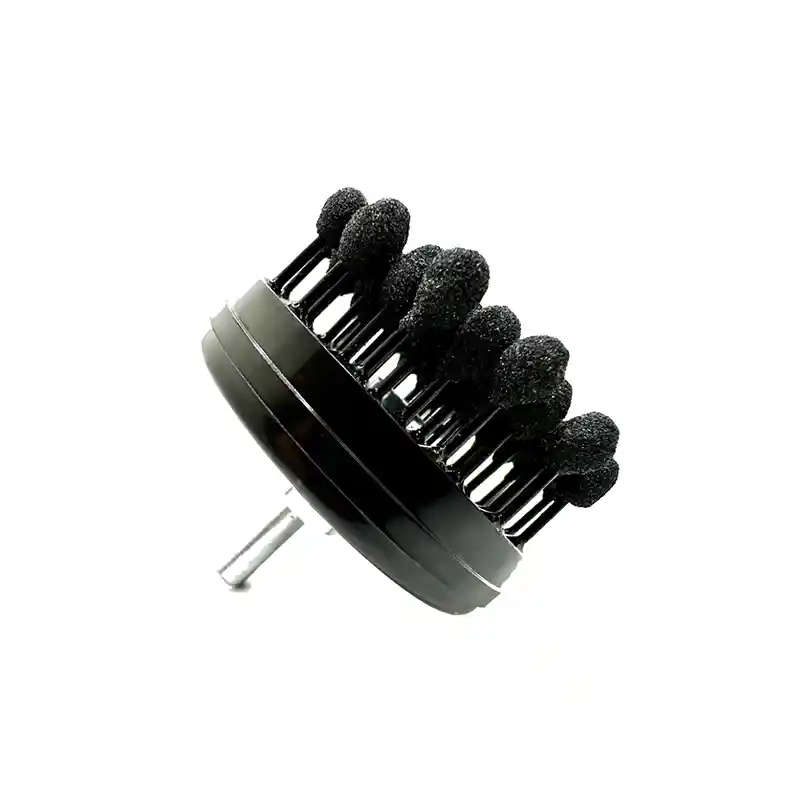
A flexible hone typically uses abrasive globules bonded to flexible nylon strands, while a honing brush uses dense abrasive filaments arranged on a metal core. The flexible hone is easier to use in a hand drill and works for blending and light deburr work. The honing brush gives more control over density, length, and abrasive type, which matters for production finish requirements. In a high cycle series of hardened parts, I prefer the honing brush because the construction is more repeatable.
How do I know when a honing brush is worn out?
Do not wait for visible bristle loss. Track two signs: cycle time drift and the Ra trend across a shift. A worn brush still spins and may look acceptable, but if the same part takes longer to reach the target finish or the Ra moves up before the operator changes pressure, the abrasive edge is gone. Replace when the brush diameter falls below the minimum interference you set at validation, or when cleaning the abrasive no longer recovers the cut. Send your current bore condition and cycle data to [email protected] and we will confirm a practical replacement interval before the next production run.
If you’re interested, check out these related articles:
brushes for steel wire industries cleaning descaling derusting polishing
honing brush treat burrs in barrel parts without affecting accuracy and scale
advantage of hx boiler tube brush
advantage of hx cylindrical nylon brushes


 Whatsapp
 Email
Email