



Drill Brush Attachment Selection for Cleaning and Descaling
A drill brush attachment is a system decision, not an accessory pick. Choosing the right one comes down to three details: bristle material, shank fit, and operating speed. Most failures we see in technical inquiries are not caused by the brush itself. They come from mismatched bristle material, a shank that does not seat properly, or a speed setting that overloads the filaments. Used correctly, a drill brush attachment can remove rust, scale, paint, carbon, and surface deposits quickly without changing the substrate. The selection points below are the ones we use when specifying drill brushes for maintenance teams.
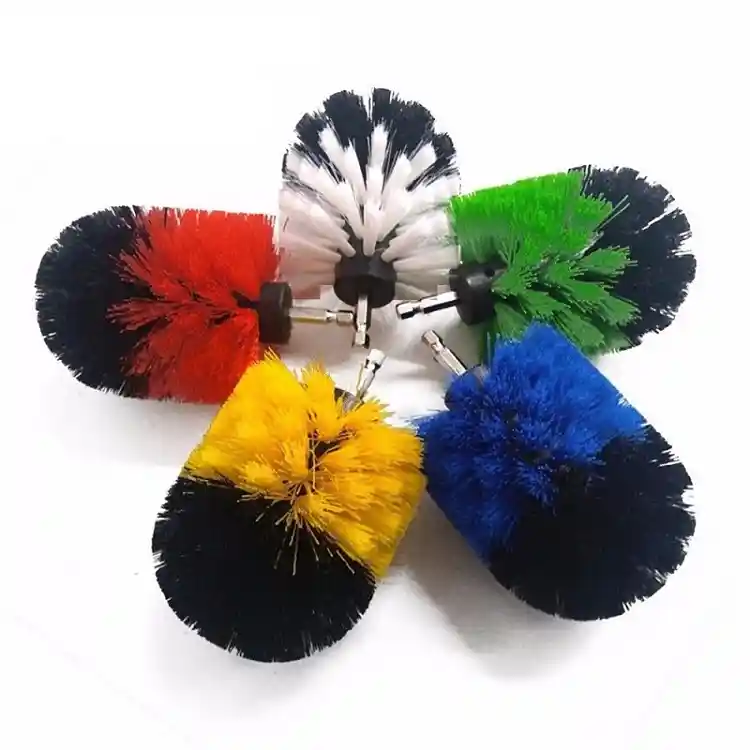
Drill Brush Attachment Capabilities and Limits
A drill brush attachment turns a standard power drill into a rotary surface tool. The brush head does the work while the drill supplies speed and torque. In maintenance work, that works well for spot cleaning, edge blending, thread cleaning, and localized descaling. It is less effective when the surface is large and flat, because hand pressure varies across the pass and leaves an uneven finish.
We treat a drill brush attachment as a hand guided tool, not a replacement for a machine mounted cylindrical brush. The operator controls pressure, angle, and dwell time, which makes brush selection more forgiving but also more dependent on setup. A crimped wire cup can remove light scale from a steel bracket in seconds. The same brush pressed against a stainless steel panel for too long will transfer carbon steel residue and leave a dull gray stain.
The main failure we see is not worn wire. It is a brush that was run too fast or held in one spot until the filament pack lost its shape. Once the outer wire flares, the contact pattern becomes uneven and the brush starts hammering the surface instead of sweeping it.
.jpg)
Bristle Material Selection for Drill Brush Attachments
Bristle material determines whether the brush removes contamination without changing the base metal. For most industrial cleaning and descaling jobs, we specify one of five material families.
| Bristle material | Best suited for | Substrate risk | Typical drill use |
|---|---|---|---|
| Abrasive nylon | Light rust, oxidation, paint prep | Low; leaves a fine satin finish | End, cup, or wheel shapes |
| Crimped steel wire | General rust, paint, and weld cleaning | Medium; light scratch pattern | Radial or cup wheels |
| Knotted steel wire | Heavy rust, mill scale, weld spatter | High; can gouge thin sections | Heavy duty cup or end brushes |
| Brass wire | Soft metals, spark sensitive areas | Low; removes light contamination | Cup or wheel brushes |
| Stainless steel wire | Stainless and aluminum surfaces | Medium; avoids carbon contamination | End or wheel brushes |
Abrasive nylon with silicon carbide grit works well when the goal is descaling without deep scratches. It is also quieter than steel wire and does not throw broken filaments as aggressively. But it removes material more slowly and can load up with paint or grease. Crimped steel wire cuts faster and resists loading. Knotted steel wire removes heavy scale at the cost of surface profile damage, so we limit it to thick sections where a coarse anchor pattern is acceptable or where the surface will be repainted.
Wire grade matters as much as wire type. A 0.3 mm crimped wire filament is more flexible than a 0.5 mm filament, but it will break sooner under side load. For drill brushes used by hand, we usually recommend crimped wire over knotted wire unless the oxide layer is too thick for anything else to move it.
Crimped and knotted wire filaments behave differently under the same drill speed. <the differences between [knotted wire wheel brush](https://www.huixibrush.com/knotted-wire-wheel-brush/) and crimped wire wheel brush> covers why knotted wire cuts more aggressively and why crimped wire runs cooler on thin sheet metal.
.jpg)
Shank Compatibility and Speed Settings That Prevent Damage
A drill brush attachment must seat securely in the drill chuck. Most handheld drill brushes use a 6 mm hex shank, which fits a standard 1/4 inch chuck and resists spinning when the brush contacts the work. Some industrial versions use an 8 mm round shank for heavier heads, but we only recommend round shanks when the drill has a keyed chuck with enough clamping force.
Shank Fit and Chuck Slip
A shank that slips under load turns a cleaning pass into a chatter mark. A hex shank reduces slip, but the shank must also be long enough for the chuck jaws to grip fully. If the brush body sits too close to the chuck, the operator may not have enough clearance to reach corners or recessed surfaces.
Speed and Pressure Windows
Wire drill brushes do not need maximum rpm. For a 50 mm crimped wire cup, we usually keep speed between 4,500 and 6,000 rpm. Smaller heads can run faster, but heat rises quickly. A brush that throws wire in the first few minutes is either over speed, over pressure, or both.
The safe method is to keep the brush moving and let the wire tips do the work. If the operator must lean into the drill to remove scale, the brush is too soft or the speed is too low. We see this often in descaling jobs: too much pressure bends the wire before it can cut, then the bent filaments hammer the surface and break.
Matching Drill Brush Attachments to Cleaning and Descaling Work
The right configuration changes with the substrate. For carbon steel that will be repainted, a knotted steel wire cup removes mill scale and creates a profile for coating adhesion. For stainless steel or aluminum, we specify stainless steel wire or abrasive nylon to avoid carbon contamination and galvanic staining. For food contact surfaces, brass or stainless steel wire is safer, but the brush should be dedicated to the material class so that cross contamination is controlled.
Descaling pipe interiors, deep bores, or narrow grooves with a drill brush can only work when the brush head reaches the surface at the correct angle. A cup brush is often too wide, and an end brush may be too short. Buyers should match brush diameter to the smallest access opening first, then choose filament material.
For repeat production cleaning, standard retail drill brush attachments often vary in filament density and trim length. We specify higher density, controlled trim, and heat resistant hubs when the brush must survive a full shift. Huixi Brush supplies customized drill brush attachments with stem length, filament material, knot pattern, and overall diameter matched to the workpiece.
If your cleaning job involves mixed metals or chloride exposure, confirm filament grade and hub material before finalizing the purchase. Send the contamination type and substrate to [email protected] and we can narrow the specification.
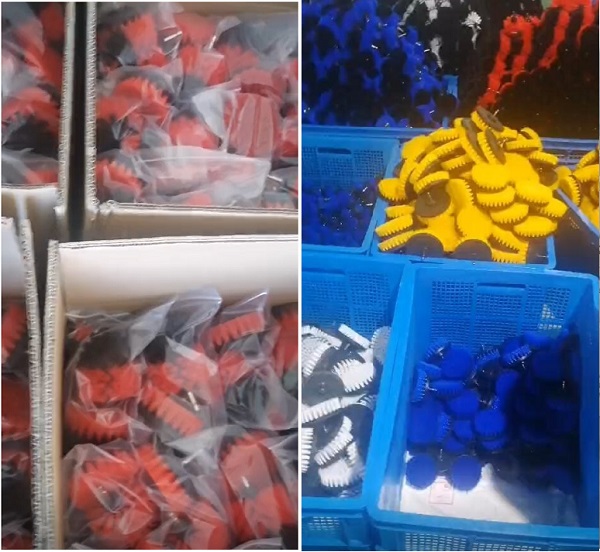
For pipe interiors and long bores, a drill brush attachment may not be the right geometry at all. <descaling spiral brush an innovative tool and generalist in the field of industrial cleaning> covers why twisted spiral brush construction follows the bore contour and clears scale from areas a cup brush cannot reach.
Selection Support Without the Back and Forth
If you are replacing drill brushes too often or seeing scratches after cleaning, the fastest way to correct the specification is to send the substrate material, contamination type, shank size, and current speed. We review the operating window and either confirm the right drill brush attachment or recommend a different brush geometry if the application demands it. Reach us at [email protected] or +86 1580 0932 713.
Common Questions About Drill Brush Attachments
What drill brush attachment size fits a standard drill?
Most maintenance drills accept a 6 mm hex shank, and that is the default we specify unless the buyer tells us otherwise. A hex shank seats in a three-jaw chuck and resists spinning under load. The brush diameter matters for clearance, not chuck fit. For tight bores or narrow channels, the working diameter should be smaller than the smallest opening, with a few millimeters of side clearance. Before ordering, measure the drill chuck capacity and the tightest access point you need to reach.
Can a drill brush attachment remove heavy rust without damaging steel?
A common assumption is that more wire density always removes rust faster. That is not how it works. Heavy rust on thick steel usually calls for a knotted wire cup, but the same brush can gouge thin sheet or fatigue the surface if pressed too hard. We specify heavy rust removal by material thickness, not by maximum aggression. The brush should remove oxidation while leaving the base metal profile intact. If the base metal profile matters, move to a crimped wire or abrasive nylon grade.
What speed should I run a wire drill brush at?
It depends on the brush diameter and filament wire gauge. For a 50 mm wire cup with standard carbon steel wire, we usually keep speed at 4,500 to 6,000 rpm. Smaller brushes can run faster, larger brushes slower. The real check is heat and wire loss. If the brush throws wires within the first few minutes or the cup rim turns blue, speed is too high or pressure is too heavy. Reducing pressure is often a faster fix than changing the brush.
How do I confirm a custom drill brush attachment before production?
For custom brushes, we ask for a drawing or at least one used sample before quoting. In programs we have supported, a used sample tells us how the current brush failed, which narrows filament grade and density faster than a written description. We then confirm the shank, trim length, filament material, and overall diameter before manufacturing. Share your existing brush photo and the failure point with [email protected], and we can confirm whether a custom drill brush attachment is justified.
If you’re interested, check out these related articles:
descaling spiral brush an innovative tool and generalist in the field of industrial cleaning
the differences between inward and outward spiral brush
honing brush treat burrs in barrel parts without affecting accuracy and scale
brass brushes work perfectly for pipe cleaning


 Whatsapp
 Email
Email