



Cylindrical Spiral Brush: Nylon vs Steel Wire for Pipe, Cylinder & Profile Cleaning
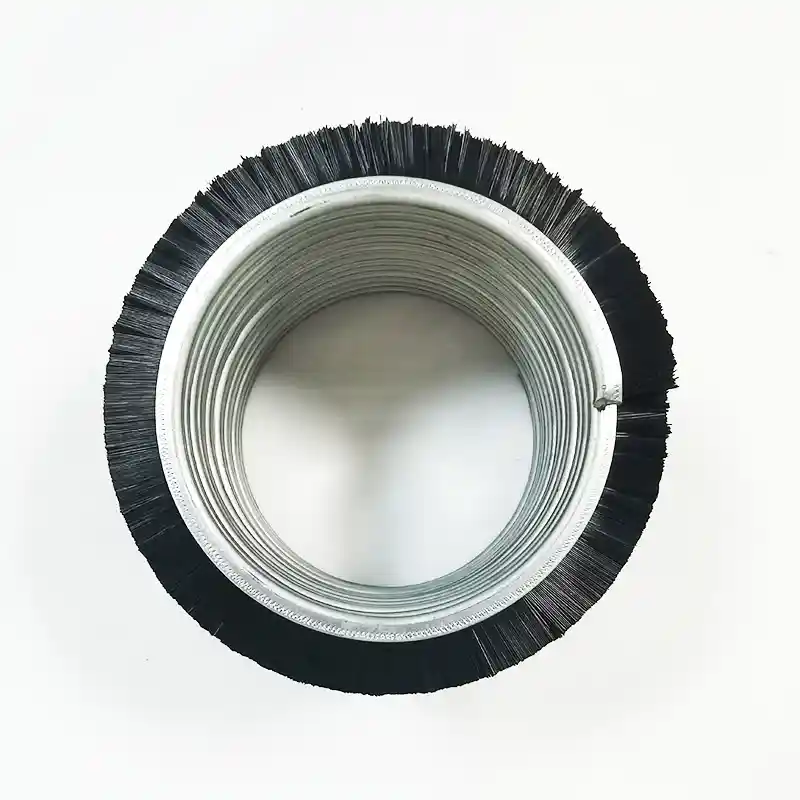
A cylindrical spiral brush looks simple: bristles are twisted between two or more stem wires into a continuous spiral, and the finished strip is mounted on a shaft or fed into a machine. That simple construction is the reason it appears in so many industrial cleaning and surface preparation lines. When a tube, pipe, roller, or continuous profile needs debris removal, light rust cleaning, or a controlled surface pattern, the spiral form keeps the brush self-clearing and flexible in ways that a conventional wheel brush or strip brush cannot easily match.
How a Cylindrical Spiral Brush Works and Where It Fits
A cylindrical spiral brush holds its bristles inside a twisted-wire core rather than gluing or stapling them into a hub. The spiral geometry gives the brush two useful working behaviors. First, debris tends to exit along the spiral channel instead of packing into the bristle face, which keeps the cleaning tip from clogging during continuous operation. Second, the brush can be produced in long lengths with a consistent radial profile, so the same cleaning action can be applied across a long pipe, a wide roller, or an entire profile line without changing tools.
Engineers commonly choose a cylindrical spiral brush for several jobs:
- Cleaning the inner wall of pipes and tubes before coating, plating, or inspection
- Removing light oxide, dust, and process residue from cylinder bores
- Sweeping and light deburring on continuous profiles, extrusion lines, and conveyor-fed parts
- Descaling or surface activation where a uniform scratch pattern is acceptable
The brush can be driven by a shaft, integrated into a fixed brush table, or run as a free-wheeling contact brush inside a production line. The mounting style depends on whether the brush must actively remove material or simply provide consistent rubbing contact.
Nylon vs Steel Wire: Comparing the Two Core Filaments
The most important selection decision for a cylindrical spiral brush is the filament. Nylon and steel wire cover most applications, but they behave differently on the workpiece.
Nylon filament in industrial brushes is usually a 6-series engineering nylon, with 612 nylon as a common grade. Plain nylon is tough and flexible, resists many solvents, and works well for dusting, wiping, and gentle cleaning where the surface must not be scratched. Abrasive nylon is a different material: silicon carbide or aluminum oxide grit is embedded throughout the filament during extrusion, and fresh grit is exposed continuously as the filament wears. That makes an abrasive nylon brush act like a self-renewing abrasive tool rather than simply a cleaning brush [2]. For aluminum, brass, coated metals, and soft alloys where steel wire would mark the surface, abrasive nylon is generally the safer choice.
Steel wire filament can be cut from carbon steel, stainless steel 304, or stainless steel 316. Stainless steel wire is corrosion resistant and is often preferred in food, pharmaceutical, and wet processing environments where carbon steel would leave rust contamination or degrade quickly [1]. Carbon steel wire is more aggressive and usually less expensive, but it is also more likely to fatigue and shed fine wire fragments onto the work surface. Brass filament sits between the two in aggressiveness and is frequently selected for non-sparking cleaning in maintenance settings.

The table below offers a practical comparison for typical cleaning work:
| Property | Plain Nylon | Abrasive Nylon | Stainless Steel Wire |
|---|---|---|---|
| Surface aggression | Low | Medium-high | High |
| Scratch risk on soft metals | Very low | Low | High |
| Self-clearing behavior | Good | Good | Good |
| Moisture and chemical resistance | Good | Good | Excellent |
| Working life under continuous load | Good | Excellent (grit re-exposes) | Good (may fatigue) |
| Common use | Dust, powder, light wiping | Deburring, oxide removal, surface prep | Heavy rust, scale, hard deposits |
This table is a starting reference, not a substitute for a sample test. The right filament depends on the workpiece hardness, the acceptable surface finish, and the production cycle.
Matching Filament to Cleaning Task: A Practical Selection Guide
When a buyer asks “nylon or steel wire?”, the answer usually comes from two questions: what is the base material, and what must be removed from it.
For pipes and cylinders made of stainless steel, aluminum, or coated metal, steel wire may remove scale quickly, but it can also cut the base surface. Abrasive nylon with a medium grit removes most process residue and light oxide without turning a cleaning job into a rework problem. For plain carbon steel pipes with hard mill scale or heavy rust, carbon steel or stainless steel wire is often necessary because nylon grit cannot break through thick, bonded scale economically.

Temperature and chemistry also matter. Nylon is not suitable for continuous exposure above its heat deflection limit, and it can soften in strong solvents. In high-temperature or hot-water cleaning circuits, stainless steel wire generally holds its shape better and carries no thermal softening risk of that kind. For wet food-processing lines, Type 304 or 316 stainless wire is preferred because it resists corrosion and meets common stainless equipment compatibility expectations [1].
Choosing between an inward and an outward spiral also changes how the brush behaves in a tube. <The differences between inward and outward spiral brush> covers the orientation effect on chip clearance and brushing pressure.
Pipe and Tube Internal Cleaning with Cylindrical Spiral Brushes
Internal pipe cleaning is the most common application for cylindrical spiral brushes. The brush is usually selected to be slightly larger than the pipe inner diameter so the bristles maintain contact across the full circumference. For light cleaning, a common starting rule is 10–15% interference on the diameter. For heavier deposit removal, interference can be increased, but the drive system must be checked for power draw and shaft whip first.
Brush length should be matched to the pipe shape. Short tubes are cleaned with one pass, or with a stationary brush while the tube rotates. Long pipe runs are cleaned with a series of brushes on a shaft, or by feeding the pipe through a fixed brush station. For curved pipe, the brush length should be short enough to pass through the bend without kinking the stem wire. A tube cleaning brush built as a spiral follows gentle curves better than a rigid disc or wheel brush because the twisted core flexes along its length.
Nylon filament is preferred when the pipe will be coated or plated after cleaning, because it leaves a cleaner substrate with less embedded foreign matter. Steel wire is preferred for pre-cleaning heavily scaled pipe before a final nylon finishing pass.
For pipe-cleaning work where marking must be kept to a minimum, <Brass brushes work perfectly for pipe cleaning> covers how a softer metallic filament can remove residue without cutting deep into the pipe wall.
Cleaning Cylinder Bores, Rollers and Continuous Profile Lines
The same spiral brush concept scales up to cylinder bores, calender rollers, and continuous profiles. For a horizontal roller or conveyor-defined profile, the brush is often mounted transversely so the part passes under or over the brush face at a controlled line speed.
In cylinder bore cleaning, the brush rotates while the cylinder is held stationary or counter-rotated. The goal is usually a uniform satin finish rather than a polished mirror surface, because that finish improves coating adhesion or oil retention. Abrasive nylon with fine grit is useful here: it removes surface contamination and creates a controlled texture without cutting into the base material.
Continuous profile lines work differently. Extruded aluminum, PVC, or steel profiles pass through a line of brushes arranged to cover the top, sides, and occasionally the bottom surface. Cylindrical spiral brushes in these lines perform light deburring, dust removal, and surface activation before cutting, punching, or coating. The spiral pattern helps move loose particles away from the brush face, which reduces redeposition on the workpiece.

A wire descaling spiral brush is a special case of the cylindrical brush, designed with a tighter spiral and more aggressive filament to break and lift oxide scale. When scale is the primary problem, a dedicated descaling design usually outperforms a general cleaning brush because the filament density, stem wire diameter, and spiral pitch are all set for heavier loading.
In applications where oxide scale is the main target, <Descaling spiral brush: an innovative tool and generalist in the field of industrial cleaning> covers how the spiral geometry handles scale removal across different tubing and rod sizes.
Key Operating Parameters and Sample Testing Before Ordering
Four operating parameters determine whether a cylindrical spiral brush performs well or fails early.
Surface speed. Both nylon and steel wire have practical surface speed ranges. Running too slowly reduces cleaning action; running too fast overheats the nylon or work-hardens and fractures the wire. The manufacturer should confirm the recommended speed for the selected filament diameter and stem wire diameter [3].
Bristle interference. Too little contact means missed spots; too much contact permanently bends the filament and shortens brush life. Interference should be set from actual part diameter measurements, not nominal drawing values.
Filament density. High-density brushes last longer and clean more aggressively, but they also generate more heat and require more drive power. Lower density may be needed for thin-wall parts or heat-sensitive materials.
Stem wire and core design. The stem wire holds the filament in place. For long brushes, a larger stem wire diameter reduces sag and whip. For small-diameter tube brushes, a slimmer stem keeps the brush flexible enough to pass through the bore.
At Huixi Brush, sample testing for cylindrical spiral brushes starts from the customer’s actual part drawing and current defect condition rather than from a catalog table alone. That approach exposes interference and speed problems before production quantities are ordered.
If you are still comparing filament options or are unsure about the interference settings, send the pipe or profile material, inner or outer diameter, and current defect conditions to [email protected]. A real sample test is faster and more reliable than working from a parameter table.
Request a Free Sample or Technical Recommendation
If you are planning a new cleaning line or replacing brushes that wear out too quickly, Huixi Brush can provide a technical recommendation based on your workpiece material, dimensions, and target finish. We supply customized cylindrical spiral brushes, spiral wire brushes, abrasive nylon brushes, and stainless steel wire brushes for OEM and ODM production.
Send your part drawing, material grade, inner or outer diameter, and line speed to [email protected] or call +86 1580 0932 713. We can arrange a free sample for evaluation and recommend the filament, spiral direction, and mounting configuration for your specific application.
Frequently Asked Questions
What is the difference between abrasive nylon and plain nylon bristles?
Plain nylon is a solid polymer filament used for wiping and light cleaning. Abrasive nylon has silicon carbide or aluminum oxide grit embedded throughout the filament. As the filament wears, fresh grit is exposed, so the brush maintains its cutting action over a longer working life.
Can a cylindrical spiral brush replace chemical descaling?
It depends on the deposit. Light oxide, dust, and soft residue can be removed mechanically with a nylon or steel wire spiral brush. Heavy, hard mill scale usually requires pickling, blasting, or a dedicated wire descaling brush followed by chemical treatment—not a brush alone.
What brush diameter should I choose for an internal pipe?
A common starting point is 10–15% larger than the pipe inner diameter for light cleaning. The exact interference depends on the filament type, pipe material, and drive power. A sample test is the most reliable way to confirm the diameter.
How do I know if I should choose stainless steel over carbon steel wire?
If the application involves moisture, food contact, or any requirement to avoid rust contamination, stainless steel 304 or 316 is preferred. Carbon steel wire is more aggressive and lower in cost but can leave rust traces and break into fine fragments.
Do you offer free samples or OEM/ODM customization?
Yes. We support free samples for evaluation and provide OEM/ODM customization for brush diameter, filament material, spiral pitch, shaft length, and mounting configuration. Contact us with your requirements.
References
[1] ASTM International, “Standard Specification for Stainless Steel Spring Wire,” ASTM A313/A313M-18, ASTM International, West Conshohocken, PA, USA, 2018.
[2] J. E. Stout and V. R. Masterson, “Abrasive filament brushes: design, wear behavior and process parameters for surface finishing,” Journal of Manufacturing Processes, vol. 45, pp. 100–108, 2019.
[3] E. Oberg, Machinery’s Handbook, 31st ed. South Norwalk, CT, USA: Industrial Press, 2020.
If you’re interested, check out these related articles:
brass brushes work perfectly for pipe cleaning
main features and applications of hx nylon cylindrical brush


 Whatsapp
 Email