



How to Select a Rope Cleaning Brush: PP vs Nylon Bristles for Grease and Dust Removal
Industrial wire ropes rarely fail from a single dramatic event. More often, grease, dust, compacted debris, and trapped moisture hide broken wires, accelerate corrosion between strands, and make reliable inspection difficult. A correctly selected rope cleaning brush removes that contamination before it becomes a wear or safety problem. In most rope maintenance programs, the brush is not a cosmetic accessory—it works alongside diameter measurement, visual inspection, and lubrication.

Why Rope Cleaning Should Be Part of Inspection
Contaminant films can hide broken wires, pitting, necking, and diameter reduction. ISO 4309 recognizes that external cleaning may be necessary before a rope can be properly examined [1]. In practice, many operators clean ropes before measuring, before applying fresh lubricant, and before taking inspection photographs. Heavy grease can hold abrasive particles against the strand crowns, while dust and scale can create a grinding paste that increases local wear.
A brush with the correct filament stiffness removes these films without cutting into the strand crowns. The goal is not to polish the rope, but to expose the surface condition so the inspector can see what is actually happening.
Grease and dust films hide the early signs of wire breaks and diameter loss. <rope cleaning brush for industrial use a key tool for maintaining safe production> covers how controlled rotary brushing keeps inspection surfaces clear enough for reliable go/no-go decisions.
How a Rope Cleaning Brush Works
A rope cleaning spiral brush uses a helical filament layout to wrap around the rope. The rope passes through the center eye or across the brush face. As the brush rotates, the filaments sweep both the crowns of the outer wires and the valleys between strands. Brushes can be driven, idler-mounted, or fixed, depending on line speed, access, and the amount of contamination.

The important mechanical variables are filament length, filament density, spiral pitch, and interference. Light interference lets the filament tips penetrate between the outer wires without grabbing. Too much interference can bend filaments, generate heat, and smear grease deeper into the rope instead of removing it.
PP vs Nylon Bristles: How the Choice Affects Cleaning
PP stands for polypropylene. Nylon is a tougher, more flexible polymer family. Both are used in rope cleaning brushes, but they respond differently to moisture, chemicals, grease, and flexing.
| Selection factor | PP bristles | Nylon bristles |
|---|---|---|
| Moisture exposure | Typically low moisture uptake; often works well in wet or humid lines | Can absorb some moisture; may soften in continuous wet service |
| Chemical exposure | Often more resistant to many acids, alkalis, and solvents | Good oil and grease resistance; performance varies with strong chemicals |
| Stiffness and scrub | Moderate stiffness; often used for dust, mud, and light grease | Higher toughness and flex fatigue resistance; often preferred for heavy grease and compacted debris |
| Temperature | Commonly used in ambient and moderately warm lines | Can tolerate more continuous flexing; suitability depends on the specific nylon grade |
| Abrasion resistance | Usually strong in wet abrasive conditions | Usually strong in dry abrasive conditions |
| Typical match | Dust, water, chemical exposure, lighter contamination | Grease, oil, hardened dirt, and more aggressive mechanical cleaning |
These are material-family tendencies, not universal rules. Specific PP and nylon grades can be formulated with different stiffness, UV resistance, and heat resistance, so the final choice should be tied to the actual rope line conditions.
Need a shorter selection path? Send the rope diameter, strand construction, line speed, contamination type, and two or three photos of the current mounting to [email protected] or call +86 1580 0932 713. A specific brush recommendation is usually faster than matching dozens of catalog options by trial and error.
Selection Inputs That Matter More Than Bristle Material
Even the best PP or nylon filament will wear quickly if the brush size or mounting is wrong. Standardize these inputs before ordering:
- Actual rope outer diameter, measured at several points rather than taken from a nameplate.
- Rope construction and lay direction, such as 6×36 right regular lay.
- Contamination type: grease, dust, mud, salt, mill scale, or a mixed film.
- Line speed and duty cycle.
- Environment: washdown, humidity, chemical exposure, UV exposure, or high temperature.
- Mounting style: rotating shaft, split housing, fixed plate, or adjustable arm.
The selected brush should not clamp the rope. An adjustable cylindrical spiral brush makes it easier to set the filament tips to light contact as the rope passes through.
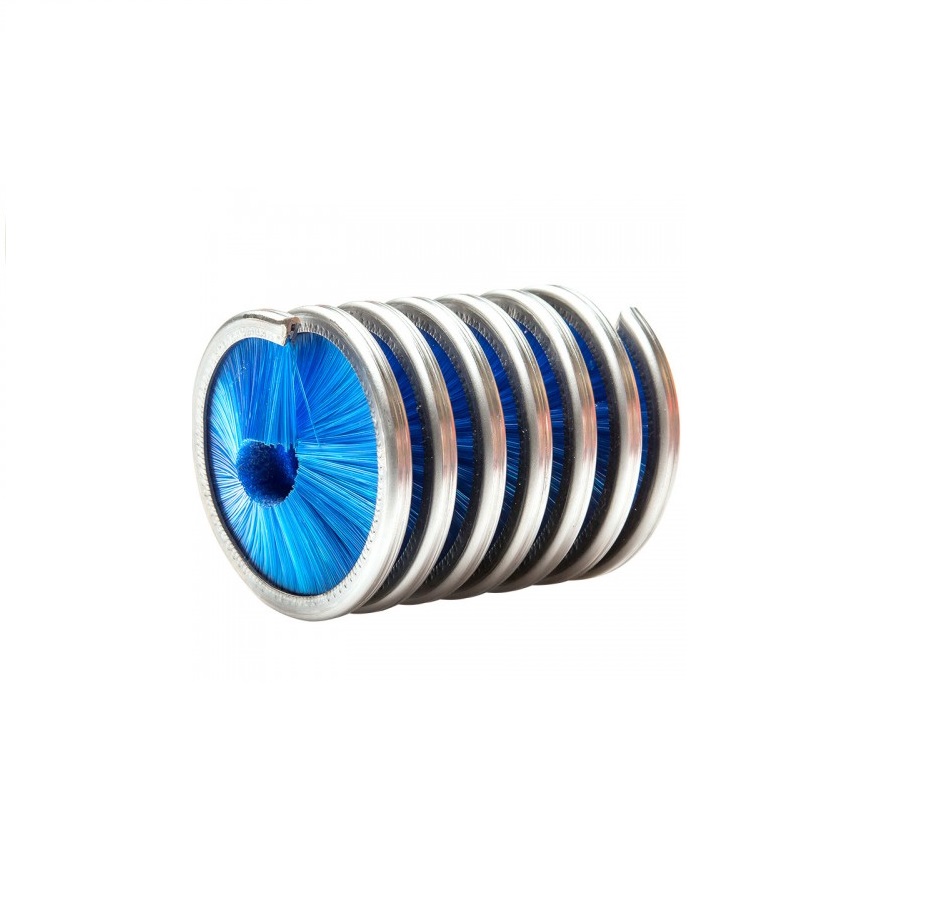
Some rope contamination is closer to scale than to surface dirt, especially on rope that runs through outdoor or high-temperature equipment. <descaling spiral brush an innovative tool and generalist in the field of industrial cleaning> covers spiral filament arrangements for heavier deposits, where brush geometry must do more work than bristle material alone.
Installation and Adjustment
A few installation practices have an oversized effect on brush life and cleaning quality:
- Set clearance by testing on a short rope section or at low speed before full production.
- Use a split housing or quick-release bracket for inspection and replacement.
- Align the brush centerline with the rope path; off-angle mounting causes uneven filament wear.
- Check the preferred rotation direction, because spiral brush geometry can affect debris ejection.
- In wet lines, provide drainage so removed debris does not collect in the bottom of the housing.
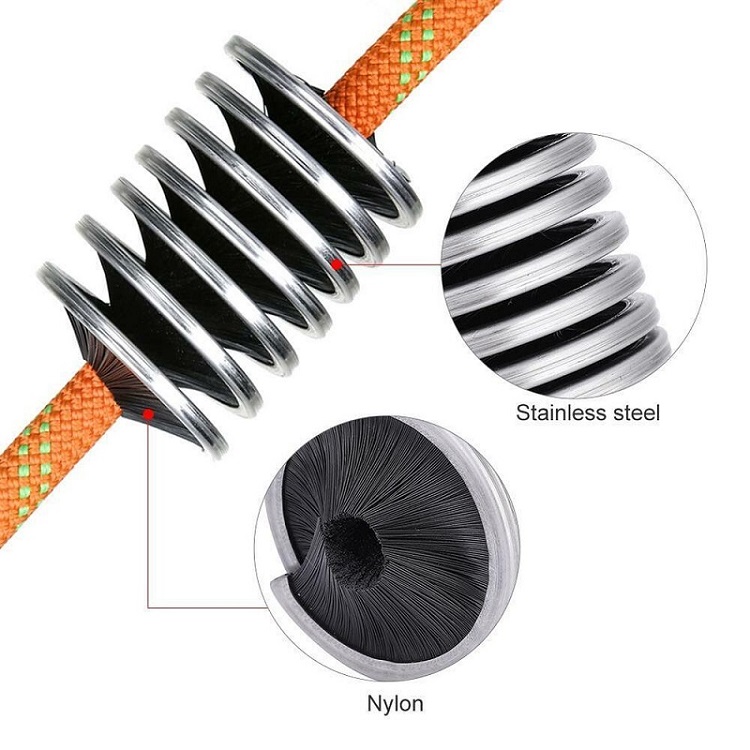
Periodic adjustment is more important than a fixed installed position. As filament tips wear, the brush loses its light interference and may begin riding on the outer wire crowns without reaching the valleys.
Wear Checks and Replacement Signals
Brush replacement cannot be reduced to a single universal interval because rope speed, contamination load, filament grade, and environment all change service life. The Wire Rope Technical Board recommends that cleaning and lubrication be part of the same service sequence, with the rope condition checked after each maintenance step [2].
Replace or reset the brush when:
- Filament tips flatten or lose their set.
- The brush no longer reaches the strand valleys.
- The brush core shows cracks, corrosion, imbalance, or loose filaments.
- Cleaning quality drops even after adjustment.
- The brush wobbles or vibrates at normal operating speed.
Common Mistakes That Shorten Brush Life or Damage Rope
Several mistakes are common across industries:
- Using one brush for several rope diameters.
- Applying heavy pressure to compensate for worn filaments.
- Ignoring chemical compatibility when the wash area uses acids, alkalis, or strong solvents.
- Cleaning only the visible top surface instead of the full rope circumference.
- Selecting filament material before defining contamination type, moisture exposure, and line conditions.
For heavy scale or rust, a polymer-bristle brush may not be the right tool. In those cases, a spiral wire brush can be considered, but it should be matched carefully to avoid surface scoring, especially on galvanized or bright steel ropes.
Stainless wire spiral brushes are sometimes substituted for polymer-bristle brushes on heavily scaled ropes. <where stainless wire spiral brush can be used> covers the application range where metal filaments are better suited.
Get a Rope Cleaning Brush Specification for Your Wire Rope Line
If you are replacing a brush or building a new rope cleaning station, send these details:
- Rope diameter and strand construction
- Contamination type and current cleaning method
- Line speed and available mounting space
- Environment: washdown, chemical, UV, or temperature conditions
- Current brush type and photos
Email [email protected] or call +86 1580 0932 713. Huixi Brush supplies customized rope cleaning spiral brushes, cylindrical spiral brushes, and related industrial cleaning brushes with ODM/OEM support, low MOQ, and free sample service.
FAQ
Can a PP rope cleaning brush remove heavy grease?
PP can remove surface grease in many line conditions, but heavy or hardened grease may require nylon or a two-stage cleaning setup. The correct choice depends on rope diameter, line speed, and whether the grease is fresh or compacted.
Is nylon safe for galvanized wire rope?
In most cases yes, when the brush is set to light contact. Nylon is abrasive enough to clean but usually does not strip zinc the way a steel wire brush can. A visual check after the first few hours of operation is still recommended.
How often should a rope cleaning brush be replaced?
There is no universal interval. Replace the brush when the filament tips lose their shape, the brush no longer reaches the strand valleys, or cleaning quality drops. High-speed, heavily contaminated lines may require more frequent changes than slow, lightly loaded lines.
Can one brush clean multiple rope diameters?
Some adjustable spiral brushes can handle a narrow diameter range. A large diameter difference often produces poor valley cleaning and uneven wear. A dedicated brush size for each rope class, or a carefully adjusted split housing, is usually the safer approach.
Should the brush rotate with or against rope travel?
Both configurations are used. The important condition is controlled relative surface speed and light filament contact. Confirm the preferred direction with the brush supplier, because spiral direction affects how debris is ejected.
References
[1] ISO 4309:2017, Cranes — Wire Ropes — Care and Maintenance, Inspection and Discard, International Organization for Standardization, Geneva, Switzerland, 2017.
[2] Wire Rope Technical Board, Wire Rope User’s Handbook, 4th ed., Alexandria, VA, USA, 2005.
If you’re interested, check out these related articles:
abrasive disc brush an efficient tool for many applications
advantage of hx cylindrical nylon brushes
the differences between knotted wire wheel brush and crimped wire wheel brush
honing brush a magic tool for flexible burr removal


 Whatsapp
 Email