



Cylindrical Spiral Brush for Conveyor and Roller Cleaning
A cylindrical spiral brush is a rotary brush whose bristles are wound in a helix around the core instead of being set in separate tufts. That one geometric difference explains why it holds up on a running conveyor belt or a turning roller: every point on the brush face carries bristles, so the surface meets a continuous contact line rather than a series of patches. The helix also gives the tips a sideways component of motion, which moves loosened debris along the brush face instead of letting it collect under the core. Whether that behaviour turns into reliable cleaning depends on three settings that are decided at the drawing stage and confirmed at installation: winding hand, bristle interference and filament choice.
What Makes a Cylindrical Spiral Brush Different From a Standard Roller Brush
A tufted roller brush carries its bristles in drilled holes. Between tufts there are gaps, and on a fast belt the surface passes under tuft, gap, tuft again. Fine film and dust travel through those gaps, and the result is a striped cleaning pattern that looks acceptable on a white cloth test and then fails on a coated product.
A spiral brush replaces tufts with a continuous strip wound around the core. Three practical consequences follow.
- Contact load spreads along the whole strip, so each filament deflects less for the same working pressure.
- There is no gap between tufts for dust to pass through, so coverage across the brush face is continuous.
- The helical path adds a lateral component to the tip motion, which conveys debris toward the end of the brush instead of holding it in place.
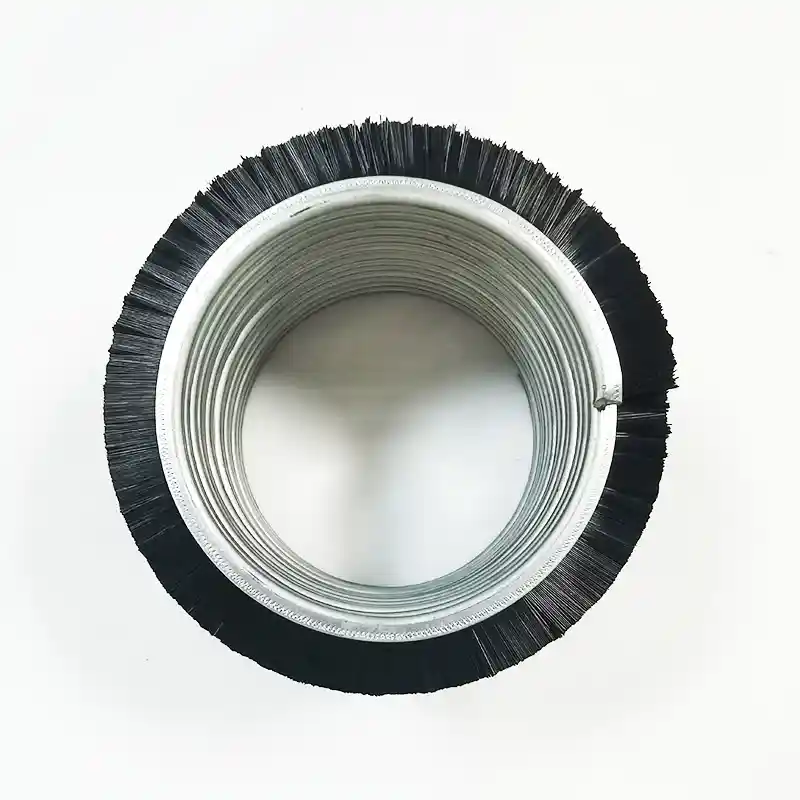
The spiral form is not automatically the right answer for every cleaning point. A narrow job between two close rollers is often cheaper to run with a small wheel brush, and an irregular opening around a machine frame is usually sealed with a strip brush rather than cleaned with a rotating cylinder. The spiral earns its place where the surface is continuous, the line runs at production speed, and carryover into the next process step has a real cost.
How the Helix Moves Debris Instead of Letting It Rebuild
With the brush axis mounted across a belt, each rotation brings a new section of the helix into contact with the surface. Because the strip is wound at an angle, successive filaments touch the belt at positions offset along the axis. The combined motion is a wipe plus a push: the tips lift the material, and the helix angle drives it sideways.
Which side it travels to is settled before the brush is ever mounted. A right hand winding driven in one direction pushes debris one way. Drive the same brush in reverse, or fit the opposite hand, and the material goes the other way. Two arrangements are common. An inward winding gathers debris toward the centre of the belt, where a chute or a suction pick-up can remove it. An outward winding splits the flow toward both edges.
Getting this wrong is easy to miss, because the brush still looks busy and still cleans the middle of the belt. Debris pushed back toward the centre tends to be re-deposited just behind the contact line, so the belt leaves the brush visibly cleaner and dirties again a metre downstream. A short check settles it. Run the line with a small amount of dry marker dust on a clean belt, watch which way the dust tracks, and compare that with the position of the collection point.
The winding direction should follow the discharge point rather than the motor rotation that happens to be available. <the differences between inward and outward spiral brush> covers how inward and outward windings change where debris is discharged.
Where Cylindrical Spiral Brushes Fit on Conveyor and Roller Equipment
Most conveyor and roller cleaning jobs fall into three positions.
Cleaning the return side of a conveyor belt
Material that sticks to the belt after discharge travels back on the return run and drops along the whole length of the structure. A spiral brush mounted on the dirty side of the return belt, downstream of the head pulley, lifts that carryback before it reaches the tail pulley and the snub rollers. The brush does not remove the material by itself; a collection tray, a scraper or an extraction hood has to take what the bristles release. The working action is closer to sweeping than to scrubbing, which is the same principle a road sweeping roller uses to lift grit across a full path in one pass.

Belt construction decides the working pressure more than brush size does. A fabric belt with a vulcanised splice tolerates far less contact than a thick rubber belt, and running the same pressure on both wears the splice first, so the failure starts at the joint rather than in the bristles.
Cleaning rollers and drums on process lines
A roller that carries product also carries whatever the product leaves behind: coating mist, adhesive, dust from a web, scale from hot metal. A spiral brush running parallel to the roller, turning against its surface, keeps that build-up from transferring back onto the product. The brush usually has a smaller diameter than the roller it cleans and sits on a separate drive, so its speed can be set without changing line speed.

Build-up on a roller is a slow problem with a sudden symptom. A coating roller picks up a film, the film hardens, and the defect appears as a repeating mark at the roller circumference rather than as a general quality drop. Brush cleaning works while the deposit is still soft enough for a filament to lift. Once it has cured onto the surface, the same brush polishes the deposit instead of removing it.
In steel and wire processing the same layout handles scale and oxide on rollers, guides and mandrels, where the deposit is harder and the wire section has to do more of the work.
Scale on hot worked steel needs a stiffer section than dust on a coating roller. <brushes for steel wire industries cleaning descaling derusting polishing> covers brush selection across cleaning, descaling, derusting and polishing duties in steel and wire plants.
Keeping the full product width clean
A brush face shorter than the belt leaves two uncleaned margins that grow wider as the helix wears. Face length should match the working width plus a small overhang at each end, with the end plates or cup washers outside the product zone so they cannot mark it. On wide belts the shaft has to be stiff enough to hold contact across the middle. Sag shows up as a heavy stripe in the centre and light contact at the edges, which is often misread as uneven filament.
The brush cleans; it does not contain. Dust thrown off the belt escapes at the frame edges unless the opening is closed, and that is a separate job for a strip brush or a flexible skirt.

Selecting Bristle or Wire for the Material You Are Cleaning
The core, the shaft and the helix decide the geometry. The bristle decides whether the job works. Filament choice is where most mismatched brushes come from, because the same dimensioned drawing can be filled with materials that behave very differently against the same belt.
| Bristle or wire | Works on | Why it behaves that way | Where it stops working |
|---|---|---|---|
| Abrasive nylon | dry dust, light scale and release film on rubber or PVC belts | grit is bonded into the filament, so it cuts lightly without wire breakage risk | wet slurry that loads the grit, heavy rust that packs between filaments |
| Nylon or polypropylene | soft belt surfaces, paper and film dust, washdown areas | flexible tips deflect over surface texture and do not mark it | hard mineral scale, and surfaces hotter than the filament can take |
| Crimped steel wire | rust, loose scale and caked soil on steel rollers | crimped wire spreads contact over more tips and gives a springy action | coated or painted surfaces the wire could scratch, and wet areas where wire corrodes |
| Stainless steel wire | wet, corrosive or stain-sensitive lines | the wire resists corrosion, so broken tips do not leave rust marks downstream | jobs that need a soft non-marking touch rather than an aggressive one |
| Knotted or heavy section wire | thick scale, burrs and hardened deposits on steel rollers | stiffer tufts resist deflection under heavy pressure | thin sheet and coated strip that deform at the same pressure |
In washdown and wet conditions, carbon steel wire is the wrong default even when the deposit is hard, because the wire becomes a contamination source of its own. The cleaning action barely changes; the failure mode does.
Stainless wire changes what happens after a tip breaks, not how the brush cleans. <where stainless wire spiral brush can be used> covers where stainless spiral brushes are applied and what they are chosen to avoid.
Where the roller face is short or the access gap is narrow, a wheel brush in the same filament does a similar job with a smaller footprint, and it can be replaced section by section as it wears.

Setting Rotation Direction, Speed and Bristle Interference
Three settings decide how a spiral brush behaves once it is on the machine.
Interference is the amount the bristles bend against the surface. Just touching is not enough, because a belt is never perfectly flat and the tips lose contact across part of the width. Deep penetration adds load, heat and filament fatigue without removing much more material. A practical method is to set the brush until the tips just kiss the surface, advance slowly by hand until deflection is visible along the full face, then run at low speed and read the clean pattern. Streaks mean too little contact. A hot belt, a climbing motor current or a fine black dust of belt material means too much.
Relative speed sets the cleaning energy. Running the brush against belt travel raises relative speed and cleaning action, at the cost of faster filament wear and more heat in the belt. Running with the belt is gentler and tends to leave a film behind on stubborn deposits. Most conveyor cleaning runs against travel; heat-sensitive belting is where the gentler direction gets reconsidered.
Shaft support matters more as the face gets longer. A long brush held only at the driven end whips, and the wobble shows as uneven contact rather than as an obvious vibration. Both ends should be supported, and the drive should be sized for breakaway torque at start-up, not only for the running load.
Common Failure Modes and What to Check First
| What you see | Likely cause | First check |
|---|---|---|
| Parallel streaks along the belt | insufficient interference, worn tips or a warped belt | contact mark width at three points across the face |
| Debris reappearing downstream of the brush | helix pushing toward the centre with no extraction there, or the wrong hand for the drive direction | dust tracking on a clean belt against the collection point |
| Heavy wear in the middle only | shaft sag on a long face | straight edge along the brush face, and both end bearings |
| Motor current climbing over weeks | product building on the brush, or filaments loaded with deposit | brush condition, guard build-up, drive coupling |
| Belt glazing or black dust | interference too deep, or a wire section on a soft belt | deflection depth first, then filament type |
| Brush face dishing at one end | misalignment between brush axis and belt axis | parallel check across the width |
A dimension drawing tells you core diameter, outer diameter, face length and winding hand. It does not tell you what interference the filaments were designed for, what the filament actually contains beyond a trade name, or whether the brush was balanced for the speed it will run at. Those three points explain most early failures, and they are worth asking about before the order rather than after installation.
What to Send in an RFQ for a Custom Spiral Brush
A spiral brush for a conveyor or a roller is usually a made-to-order part, so the request has to carry the information the factory will actually build from. A drawing helps, but a short dimensional sketch plus the working conditions often settles the choice faster than a full general arrangement.
| Field | What to state | Why it matters |
|---|---|---|
| Mounting | shaft diameter, shaft ends, keyway or pilot, drive side | a brush that does not fit the existing bearing blocks cannot be trialled |
| Dimensions | outer diameter, face length, total length, overhang at each end | face length decides whether the belt edges get cleaned |
| Winding | hand (left or right) and pitch | hand sets which side the debris leaves on |
| Filament | material, diameter, and whether it is abrasive filled | the same drawing with a different filament is a different tool |
| Working conditions | surface being cleaned, belt or roller material, speed, wet or dry, temperature | heat and moisture rule out whole filament families |
| Spares | quantity, expected replacement interval, whether the shaft is reused | reusing the shaft changes the bore and end detail |
Two request lines can look almost identical and produce very different brushes. Reject the line “spiral brush, 200 mm outer diameter, nylon, 1000 mm face”, which names a size and a family but not a brush. Replace it with the mounting and shaft detail, face and total length, winding hand and pitch, filament grade and diameter, whether the filament is abrasive filled, the belt or roller material, the running speed, whether the line is wet, and where the debris is collected.
Get a Spiral Brush Matched to Your Conveyor or Roller
Send the belt or roller diameter, the working width, the material you are removing, the shaft and mounting detail, and the speed the line runs at. Where the filament choice is still open, say whether the line is wet, whether the surface is coated, and how the debris is currently collected. Shanghai Huixi Trading Co., Ltd. builds to those inputs and returns a specification and a drawing for confirmation before production, with ODM and OEM options when the brush has to fit an existing housing.
Email [email protected] or call +86 1580 0932 713. A photo of the mounting point is often more useful than a measured drawing, because it shows the access you actually have for installation and replacement.
FAQ
What is the difference between a cylindrical spiral brush and a tufted roller brush?
A tufted roller holds its bristles in drilled holes, so the working face is a series of dense patches separated by gaps. A spiral brush winds a continuous strip around the core, so the belt meets an unbroken contact line and dust has no channel to pass through. The spiral also gives the tips a lateral component that carries debris to one side, which a straight tufted roller does not do.
Can a spiral brush damage a rubber conveyor belt?
It can, if the interference is too deep or the filament is wrong for the belt. Wire on a soft rubber belt, or a brush pressed far enough to heat the surface, will glaze the rubber and produce black dust. Set the brush to light visible deflection, check the clean pattern, and use nylon or an abrasive nylon on belts that mark easily.
Should the brush turn with the belt or against it?
Against belt travel is the usual choice for conveyor cleaning, because the higher relative speed removes more material per pass. It also wears the filament faster and adds heat. On heat-sensitive belting, or where the surface marks easily, running with travel is gentler. Whichever direction is used, the winding hand has to match the drive so that debris still leaves toward the collection point.
How long does a spiral brush last?
There is no fixed interval, because life depends on interference, grit, running speed and how much abrasive material passes the brush. Track two signals instead: the clean pattern on the belt, and the motor current over time. A widening streak pattern or a slow current rise is the point to inspect, and often the point to re-set rather than replace.
Can one brush clean both a belt and a roller?
Sometimes, but the two duties pull in different directions. Belt cleaning wants a wide face matched to the belt width and a light, sweeping contact. Roller cleaning wants a narrower face, closer control of interference against a hard turning surface, and often a separate drive. A brush sized for the belt is usually too wide and too lightly set for effective roller cleaning.
If you’re interested, check out these related articles:
descaling spiral brush an innovative tool and generalist in the field of industrial cleaning
abrasive disc brush an efficient tool for many applications


 Whatsapp
 Email