



Brush Tables for Conveying, Scrubbing and Scratch Prevention
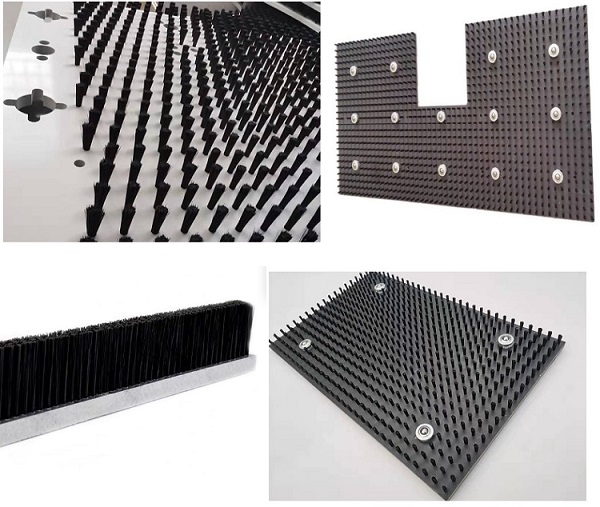
A brush table is not a standard workbench with a few bristle strips bolted onto it. It is a built-to-order station where brush rollers, strip brushes, or spiral brushes carry material across a defined path, scrub the contact surface, and hold the part against transfer forces without scratching it. In quoting these worktables, buyers often wait too long to define bristle material, mounting pitch, and edge contact pressure. Those three decisions determine whether the table moves product cleanly or becomes a source of jams and surface defects.
Brush Table Functions Worth Confirming Before Quoting
A brush table usually performs more than one job, and that is where quotes go wrong. In some lines we see the table used mainly to control transfer, with the brush fill contacting the underside of a moving sheet or profile to keep it tracking straight. In other systems the table is the cleaning stage, where a rotating brush roll removes dust, scale, or coolant residue before the next operation.
Buyers should name the primary function first because it changes bristle selection and drive sizing. A conveying table wants a stable, low aggression fill with enough recovery to hold the part without dragging speed down. A scrubbing table wants a more aggressive fill and a drive rated for higher torque.
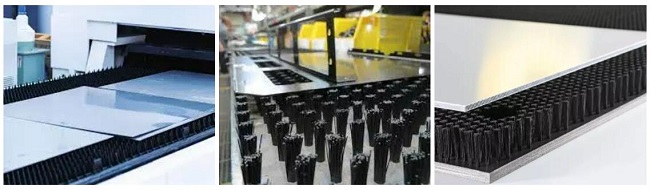
One practical sign that a line needs a brush table rather than a standard roller conveyor is the contact pattern. If standard rollers leave marks, let sheet wander, or fail to remove loose debris, a brush surface spreads the load across thousands of bristle tips and creates a self-sweeping contact.
At Huixi Brush we start every brush table review by asking which function carries the highest penalty if it fails. A conveying failure stops the line. A scrubbing failure creates rework. A scratch failure creates rejected parts. The answer normally moves the quote in a different direction.
Bristle Specifications That Set Brush Table Scrubbing and Conveying Performance
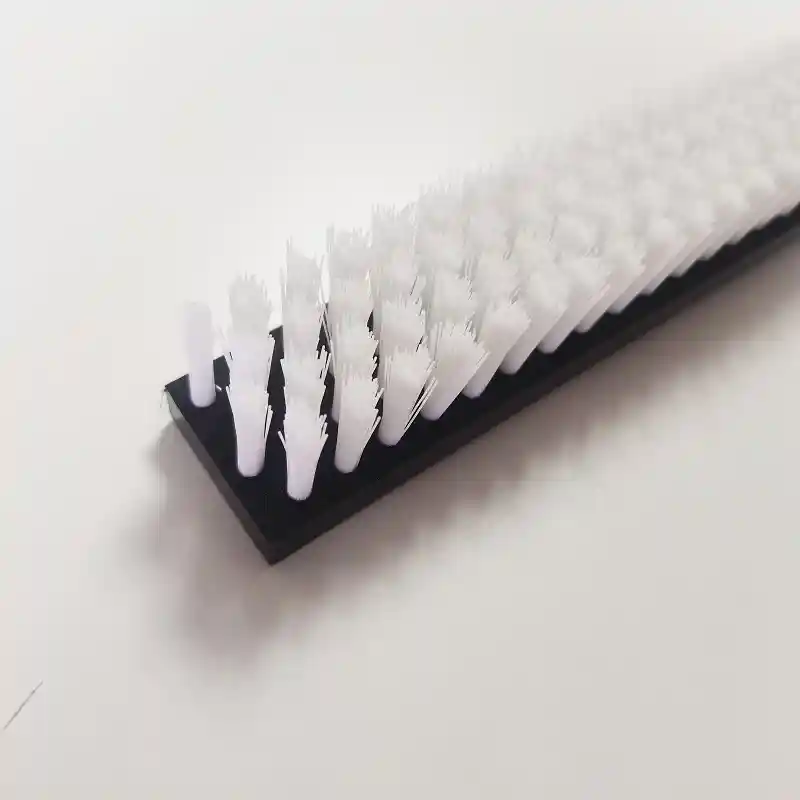
Bristle choice on a brush table is a balance among three variables: filament type, trim length, and fill density. A buyer should specify all three, not just ask for a soft or hard brush. Soft is not a material property. A long nylon filament in an open pattern can feel soft even when the same filament is stiff at a shorter trim length, just as a dense fill of thin nylon can mark a polished panel because many tips strike at once.
For general conveying and anti-scratch contact, nylon PA6 or PA66 is our usual starting point. It recovers well after bending and causes fewer visible contact marks than steel wire on coated or bright sheet. PBT or polyester fills are easier to clean in wet lines and hold shape better under continuous moisture. Abrasive nylon is the wrong default for a transfer table, but it belongs on a brush table that has to dull, deburr, or prepare a surface before coating. Steel wire fills only make sense when the table must remove heavy scale or carry hot parts, because the scratch risk is real and must be designed out through lower interference.
| Brush Fill | Strongest Use on a Brush Table | Main Risk to Check |
|---|---|---|
| Nylon PA6/PA66 | Conveying, light scrubbing, anti-scratch contact | Softens if the line runs hot or dry |
| PBT/PET polyester | Wet lines, washdown, chemical rinse | Stiffer tip feel; confirm scratch behavior |
| Abrasive nylon | Deburring, paint prep, surface dulling | Too aggressive for bright or plated finishes |
| Stainless steel wire | Scale removal, high-temperature transfer | Can scratch soft sheet or coated profiles |
In brush table sections where the fill contacts brushed or plated surfaces, cylindrical nylon brush rolls usually produce fewer contact marks than wire alternatives. <main features and applications of hx nylon cylindrical brush> covers how filament crimp and working speed change the cleaning result on compact automated lines, which is useful when the table must pre-clean without altering surface finish.
For most light scrubbing duties we look for a trim length between 25 mm and 60 mm, but the range is less important than the contact condition. A fill that is too short cannot conform to slight camber or sheet flutter, so the line speed drops and the edges wear. A fill that is too long collapses and leaves material trapped in the bristle row. We ask for part thickness variation before selecting trim length.
Frame, Mounting and Anti-Scratch Contact Requirements for Brush Table Integration
Frame dimensions come before aesthetics. The table must fit between existing roller centers, clear the underside of the conveying equipment, and accept the same drive coupling used elsewhere on the line. We confirm working width, roll diameter, shaft diameter, bearing positions, and bolt spacing before quoting a frame. On a custom brush table the most common rework source is not the brush fill. It is the mounting hole position.
Anti-scratch contact requires two numbers: interference depth and tip pressure. Buyers often describe the brush as soft, but that does not tell the engineer how far the workpiece should push into the fill. A thin, tightly packed nylon fill with only 2 mm of interference can feel firmer than a long stainless wire fill with 8 mm of interference. We ask for the finish tolerance of the moving part, because a polished surface will show a contact mark long before a mill finish or a powder-coated surface does.
If your program involves polished sheet, coated profiles, or powder-coated parts, confirm fill density and interference depth before finalizing the BOM. Send the part material, finish, and line speed to [email protected] and we will check the contact condition.

Custom Brush Table Decisions for Special-Purpose Lines
Most brush tables we quote are not catalog products. The frame length, working width, brush roll segmentation, and drive position change from line to line. Standard sections work when the part width is fixed, the line speed is stable, and the operating environment is dry at room temperature. A special-purpose table becomes the better choice when any of those conditions moves outside a narrow band. High-temperature zones need fill materials rated for continuous heat, and wet or chemical lines need stainless or sealed components.
Customers often add a brush table to a steel wire cleaning line where the brush cover must remove mill scale without snagging round stock. <brushes for steel wire industries cleaning descaling derusting polishing> covers why fill density and rotation direction matter when the brush contacts round stock, and the same logic applies when the table face carries rods or profiles instead of flat sheet.
Another decision point is roll segmentation. For wide tables, we prefer independent brush segments rather than one continuous roll. A single continuous roll can wear at the edges first, and the buyer then replaces the whole roll because the contact face has become uneven. Segments can be changed without pulling the full shaft. That detail matters when the line cannot stay down for long maintenance windows.
Confirming a Brush Table Quote Before Production
A brush table drawing that looks complete can still hide a mismatch in bristle recovery, edge clearance, or roll alignment. We see this most often when a buyer sends only the table size and omits the part material, surface finish, and line speed. At Huixi Brush we check those three inputs before we confirm any special purpose table design, because a table that moves the part is not the same as a table that moves it without damage.
Send your part drawing, production rate, and finish requirement to [email protected] or call +86 1580 0932 713. We will confirm the brush fill, mounting dimensions, and contact condition before tooling starts.
Common Questions About Brush Table Workstations
What is the main difference between a brush table and a standard roller conveyor?
A brush table spreads the moving load across a brush contact face, while a roller conveyor carries the part on a small number of contact points. That difference matters for thin sheet, coated profiles, and parts that tend to wander or scratch. The brush fill also collects loose dust and debris as it rotates, so one station can transfer and clean at the same time. The tradeoff is higher drive torque and more maintenance planning, but we recommend it when roller marks or edge tracking are already known problems.
Can one brush table be used for both conveying and wet scrubbing?
One brush table can do both, but the wet function changes more than the frame. Moisture and detergent narrow the fill choice to polyester or nylon grades that do not soften or trap water, and the bearing arrangement must be sealed or stainless in cleanroom and washdown areas. Drying time between cycles also matters because wet filaments lie differently under load than dry filaments do. If the table is expected to convey and scrub in one pass, we prefer split zones with different fill types rather than forcing one bristle spec to do both jobs.
What information do I need to send for a brush table quotation?
What you need to send depends on how far the line design has progressed. If the frame dimensions are fixed, send the working width, roll center distance, shaft diameter, and bolt pattern. If the part characteristics are still under review, send the material, thickness range, finish tolerance, line speed, and whether the table runs dry or wet. A photo or sketch of the current transfer point is more useful than a catalog number because many brush table failures come from an existing frame constraint, not the brush itself.
How long does a custom brush table take to produce?
In projects we have quoted, production lead time usually hinges on the frame and roll machining rather than the brush fill. Standard strip brush holders with nylon fill can be assembled quickly, while a fully formed steel frame with machined end plates and custom roll segments adds days. Before ordering, share the required installation date and the frame drawing. That way we can confirm which brush table configuration can ship on time without changing your line layout. Send the installation drawing and date to [email protected] and we will confirm the production schedule.
If you’re interested, check out these related articles:
how do you know about deburring brushes
the differences between knotted wire wheel brush and crimped wire wheel brush
where stainless wire spiral brush can be used
descaling spiral brush an innovative tool and generalist in the field of industrial cleaning
abrasive wheel brush a magical tool for industrial surface treatment


 Whatsapp
 Email
Email