



Abrasive Nylon vs Steel Disc Brushes for Metal Edge Blending
Choosing between abrasive nylon and steel disc brushes comes down to how much cutting action a part can tolerate. For metal edge blending and descaling, abrasive nylon discs create a controlled, lower-risk finish on machined edges, while steel wire discs remove rust, scale, and weld residue faster but can alter the base profile. The right choice depends on material hardness, required surface finish, and whether the operator is preparing for coating, assembly, or appearance.
How Abrasive Nylon and Steel Disc Brushes Cut Differently
Abrasive nylon disc brushes use filaments loaded with abrasive grain. The grain is distributed through the nylon, so fresh cutting edges are exposed as the filament wears. Steel disc brushes use carbon steel or stainless steel wire. The wire tips scrape and cut the surface, which removes material quickly but creates more visible texture. Fill density, trim length, and wire diameter control the result. For edge blending, a softer or hollow trim lets the nylon brush wrap around an edge. A short, dense steel trim acts stiffer and removes more base material.
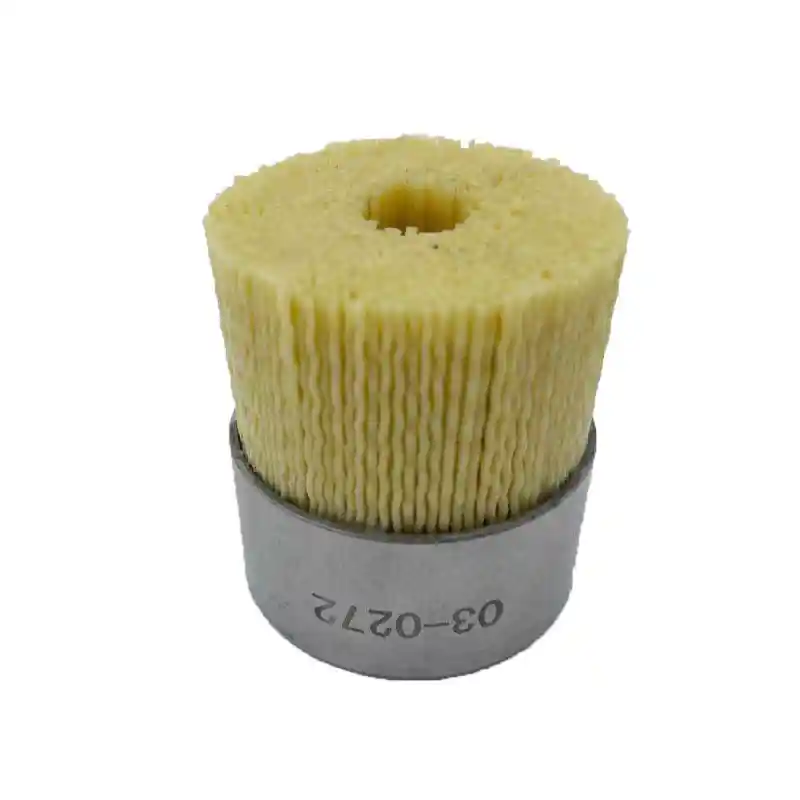
The table below separates the two options by the job they are most likely to support.
| Decision factor | Abrasive nylon disc brush | Steel wire disc brush |
|---|---|---|
| Cutting action | Wears away material with flexible abrasive filaments | Scrapes and cuts with stiff wire tips |
| Edge blending | Creates a controlled edge radius with less burr roll | Removes heavy burrs quickly but can change the profile |
| Descaling | Best on light oxide, flash rust, and final cleanup | Faster on heavy rust and mill scale |
| Finish risk | Lower risk of deep scoring on soft metals | Higher risk without speed and pressure control |
| Contamination risk | Nylon wear debris, little metal transfer | Possible wire fragments, carbon transfer, or flash rust |
| Common fit | Aluminum, soft alloys, coated and close-tolerance parts | Mild steel, weldments, and heavily rusted surfaces |
Edge Blending Performance on Different Metals
Edge blending results differ most on aluminum, stainless steel, and mild steel. Abrasive nylon is usually the safer first choice for aluminum edges because it reduces burr roll without smearing the soft surface. Steel wire can work on aluminum, but it may gouge or transfer carbon if the operator uses too much pressure. On mild steel and stainless steel, steel disc brushes blend edges quickly; stainless wire avoids carbon contamination on stainless parts.
Edge blending decisions also depend on the burr type left by the previous cutting operation. <how do you know about deburring brushes> covers the main deburring brush types and where each style fits.
A disc brush is not the only way to reach an edge. For contoured or recessed edges, a cylindrical brush may follow the part profile more evenly than a flat disc, but a properly selected disc brush still covers most open-edge work.

Descaling Performance and Workpiece Risk
Heavy descaling starts with a thick oxide layer that must be fractured and lifted, not just polished. Steel wire discs are better at that first removal step because the wire tips concentrate force and break up rust and mill scale. The tradeoff is that the same force can thin sharp edges, widen a machined profile, or leave a visible wire pattern. Abrasive nylon discs are safer after the heavy scale is gone; they condition the surface and remove light discoloration without the same edge loss.
Heavy descaling usually starts with aggressive oxide removal and then moves to a cleaning or finishing step. <brushes for steel wire industries cleaning descaling derusting polishing> covers cleaning, descaling, and polishing brush choices for steel processing applications.
For long tube and rod descaling, a spiral brush contacts the full circumference and can be a better fit than a flat disc because it reaches around the part instead of treating one face at a time.

Process Factors: Speed, Tool Life, and Contamination
Speed and pressure affect the two brush types differently. Steel wire fatigues and breaks when run too fast or pressed too hard, so wire condition becomes a safety and quality check. Abrasive nylon wears by shortening and dulling, which changes the edge finish gradually instead of throwing broken wire. That makes abrasive nylon easier to run in automated cells where process consistency matters. Disc construction still matters: a solid hub, balanced fill, and correct arbor prevent vibration. For wider surfaces, a wheel brush provides more face contact than a disc, but it should not be substituted without checking the required edge profile and access.

Selection Checklist for Edge Blending and Descaling
Before choosing, work through the part and process conditions. Confirm the base metal and its sensitivity to scratching. Check the edge condition left by the previous operation. Define the required finish before coating, assembly, or visual inspection. Note the machine arbor, maximum RPM, wet or dry operation, and whether the operator is working by hand or at a fixed station. Then match those conditions to filament type, wire diameter or grit, fill density, trim length, and disc diameter.
Selecting a disc brush also depends on whether the part will run in a hand tool or an automated station. <abrasive disc brush an excellent industrial surface treatment tool> covers abrasive disc brush applications for surface treatment, including edge finishing and cleaning.
In an automated edge blending cell, workpiece support matters as much as the brush. A brush table or dedicated fixture keeps the part stable so the disc hits the edge at the same angle on every piece.

Specify the Right Disc Brush Before You Order
Send the part material, edge condition, current burr or scale problem, target finish before coating or assembly, machine arbor size, maximum speed, and whether the process is manual or automated. Shanghai Huixi Trading Co., Ltd. can use those details to recommend the filament type, density, trim, and disc construction that fit the application instead of quoting a generic brush size.
For a disc brush specification, contact [email protected] or call/WhatsApp +86 1580 0932 713.
FAQ
Which disc brush is safer for aluminum edge blending?
Abrasive nylon is usually the safer starting point. Its flexible filaments cut more gently than steel wire, so they reduce the chance of smearing or gouging a soft aluminum edge. If the part is contaminated with heavy aluminum oxide, a stainless steel wire brush may still be needed, but it should be run at lower pressure and checked on a sample.
Will abrasive nylon remove heavy mill scale?
Not reliably. Abrasive nylon discs handle light scale, flash rust, surface staining, and final edge cleanup. Heavy mill scale on hot-rolled steel usually requires a steel wire brush first because the wire tips can fracture and lift scale faster. Abrasive nylon can follow as a conditioning step before coating.
Do steel disc brushes always leave a rougher finish?
No. The finish depends on wire diameter, trim length, speed, and pressure. A fine stainless steel wire disc run at moderate pressure can produce a uniform satin finish. A coarse carbon steel disc run hard will leave more texture. Ask for a test piece when the finish callout is tight.
What should I include in a disc brush inquiry?
Specify the base material, edge shape, current defect, required finish, maximum RPM or arbor size, wet or dry use, and whether it is manual or automated. Mention whether metal transfer or flash rust is a concern. That detail is more useful than a drawing with only diameter and bore.
If you’re interested, check out these related articles:
advantage of hx cylindrical nylon brushes
abrasive disc brush an efficient tool for many applications
where stainless wire spiral brush can be used
the differences between knotted wire wheel brush and crimped wire wheel brush


 Whatsapp
 Email