



Sanding Brush Roller Selection for Wood Surface Finishing
Sanding brush roller selection should start with the defects on the board, not the grit chart. I have spent fifteen years building custom cylindrical and abrasive brushes for wood processing lines, and the most common failure I see is not insufficient abrasive power. It is a roller that cannot hold the correct contact pattern as filament wears. Buyers specify a roller that should work on paper, then watch edge rounding, uneven gloss, or pitch loading appear within days. This guide works from the board outward: first the contact problem, then the construction variables, then the specification details that determine whether a wood surface finish stays repeatable.
What Should a Sanding Brush Roller Do Before You Compare Suppliers?
The roller has three jobs before abrasive performance matters. It must keep contact pressure stable across the full board width, expose fresh abrasive at a controlled rate, and follow enough of the surface profile to remove defects without cutting sharp edges away. When one of those three functions fails, a line may still produce boards that measure to thickness but fail under stain or under side lighting.
I have seen this on cabinet door lines where operators raise line speed to keep output up. The roller still sands, but only the crown of the brush touches. The result is a bright center band with dull edges, and the board passes because nobody checks gloss under low-angle light. The fix was not a finer grit; it was a denser trim with a different core support. That is why the first comparison task is describing what the roller must do to your board, not picking a number off a supplier chart.

Which Sanding Brush Roller Core and Filament Variables Change Wood Finishing Results?
Two variables decide how a sanding brush roller behaves on wood: filament type and core construction. Filament type controls the way abrasive enters the wood fiber. Core construction controls how much of that filament actually contacts the panel.
How Does Roller Core Design Affect Sanding Consistency?
A solid core can carry a wide roller across a panel, but it will not let the filament flex around raised grain or slight cup. A segmented or flexible core does, provided the filament density stays high enough to prevent flutter. For a flat panel line, a rigid core with independent trim sections usually holds contact better than a fully flexible roller. For contoured cabinet parts, the opposite is often true.
| Variable | What it changes | Buyer action |
|---|---|---|
| Abrasive nylon filament | Surface cut rate and scratch pattern | Confirm grit range against board hardness, not just color |
| Silicon carbide filament | Edge sharpness and stock removal | Use for defect removal on dense or coated wood |
| Aluminum oxide filament | Even finish on mixed species | Request a wear test if boards alternate between hard and soft grain |
| Core design | Contact pressure across the width | State whether parts are flat or contoured |
| Trim density | Gloss level and fuzz removal | Ask for a denser trim where grain lift appears |
Cylindrical brush construction and trim pattern determine how evenly a roller wears. <advantage of hx cylindrical sanding brushes> covers how balanced abrasive filament placement keeps contact pressure stable across a wide roller face.
Why Does Filament Trim Pattern Change Scratch Depth?
Trim pattern controls whether the points of the bristles cut or brush. A flat trim presents many filament tips at once, which levels a surface quickly but can leave a visible scratch pattern if the board moves too fast. A crimped or wavy trim breaks up those lines by varying where each tip touches. For stain-grade panels, a wavy trim with slightly longer filament usually produces a more forgiving finish than a perfectly flat face.
How Should a Sanding Brush Roller Match Specific Wood Defect Patterns?
Matching a sanding brush roller to a defect starts with whether the defect sits below the board surface or on top of it. A scratch sits below the surface and requires stock removal. Fuzz or heat marks sit at the surface and usually require a different filament and trim, not a more aggressive roller.
What Works for Cross-Grain Scratches on Hardwood?
Cross-grain scratches have to be removed by cutting past the depth of the worst scratch. On maple or cherry, a cylindrical sanding brush roller with silicon carbide filament removes scratches faster than aluminum oxide, but it also heats the panel more quickly. The safer path is a slightly slower feed and a roller that is stiff enough to cut the scratch without skipping over it. A higher trim density gives more cutting points, so the same depth clears in fewer passes.
How Should You Handle Pitch, Fuzz, or Heat Discoloration?
Pitch and fuzz do not always need deeper cutting. A filament that clears pitch is not the same as one that removes the underlying wood. For resinous boards, an abrasive nylon filament with an open trim sheds loaded pitch more cleanly. Heat marks, especially near knots or glue lines, come from dwell time and filament pressure. Reducing contact pressure or changing to a more flexible core often works before changing abrasive.
Wood fiber behavior changes when abrasive filament meets dense grain and soft earlywood. <main features and applications of hx nylon cylindrical brush> covers how nylon filament selection shifts results between painted furniture and raw wood surfaces.
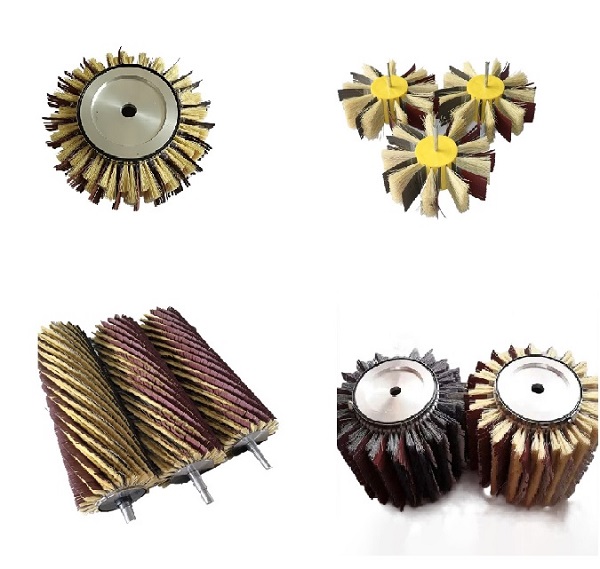
If your program involves mixed wood species or stain applications, it is worth confirming filament aggressiveness and core type before finalizing your bill of materials. Send current roller dimensions and board defect photos to [email protected].
Which Sanding Brush Roller Specifications Should You Lock Before Requesting a Quote?
The fewer specifications a buyer leaves open, the faster a quote turns into the right roller. The details I ask wood processing buyers to confirm are roller face length, overall diameter, core or shaft configuration, filament material and trim length, and maximum line speed. Face length is not the same as machine opening. It should match the widest board or the widest contact area the process intends to sand, not the entire brush body.
-
Face length: actual workpiece contact length, not machine opening
-
Overall diameter: available space plus wear allowance
-
Core/shaft: through shaft, keyed, segmented, or expanding collar
-
Filament: abrasive type, grit, trim length, and density
-
Line speed: meters per minute or parts per hour
.jpg)
Which Failure Modes Should You Watch After the Roller Is Running?
A sanding brush roller usually fails first at the edges, not the center. Edge filament shortens from contact with board corners and hard grain, and the roller starts rounding edges more than it sands the face. If the trim is too dense, pitch can load the center and cause burnishing. Shaft runout from a light core is another common issue; the roller still rotates but cuts unevenly. Checking the contact pattern in the first shift catches these changes before they shift part dimensions or final gloss.
Why Should You Share Wood Surface Requirements Before Finalizing a Sanding Brush Roller Quote?
A purchased sanding brush roller becomes a production variable the moment it is installed. The wrong core costs more in rejected boards and shortened service life than the savings from skipping the sampling step. At Huixi Brush, we ask for the board species, current roller dimensions, line speed, and a photo or description of the defect pattern before confirming a quote. Send those details with your part number to [email protected], or call +86 1580 0932 713 to confirm whether a standard roller or a custom trim will match your wood processing line.
Which Sanding Brush Roller Questions Do Wood Processing Teams Ask Most?
Can one sanding brush roller handle both panel sanding and edge sanding?
Rarely, without changing contact geometry or losing control on one surface. Panel sanding wants a wide, stable face to level the board. Edge sanding needs the roller to follow a narrow corner without breaking down the filament at the point of contact. If the same roller is used for both, it usually wears unevenly and leaves edge rounding. A better answer is one roller trimmed for panel contact and a separate, denser roller configured for edge work. The machine setup then stays repeatable instead of forcing operators to compensate by hand.
Does higher abrasive grit always leave a smoother wood surface?
That is a common misconception, because surface smoothness also depends on trim pattern, filament flex, and contact time. A coarse grit with a wavy trim can leave a more uniform stain result than a finer grit that skips across hard grain. On open-pored wood, too fine a grit can burnish the surface and close the grain before stain goes on. The more reliable target is to match the grit to the deepest scratch or raised fiber that must be removed, then let the trim pattern control the final visual finish.
How do we know whether a sanding brush roller is wearing too quickly?
In programs we have supported, the clearest sign is not lower stock removal alone. It is an uneven contact band: edges cut fine while the center burns, or the crown glosses over while the edges stay dull. If the roller loses trim length within two weeks, share your running conditions and current roller photos with [email protected]. We can confirm whether the wear is expected or the result of filament mismatch, speed, or core support. That confirmation often costs far less than running a second bad batch.
If you’re interested, check out these related articles:
brass brushes work perfectly for pipe cleaning
advantage of hx cylindrical nylon brushes
where stainless wire spiral brush can be used
honing brush a magic tool for flexible burr removal


 Whatsapp
 Email
Email