



Nylon vs Steel Wire Strip Brush: Sealing, Dust Blocking and Edge Cleaning
Industrial strip brushes combine a narrow metal or plastic channel with a continuous row of straight or wavy filament. They are used to fill clearance gaps, block dust, wipe conveyed parts, and remove light burrs from sheet metal, profiles, and enclosure edges. The first selection decision is bristle material. Nylon and steel wire differ in hardness, recovery, corrosion behavior, and edge aggressiveness.
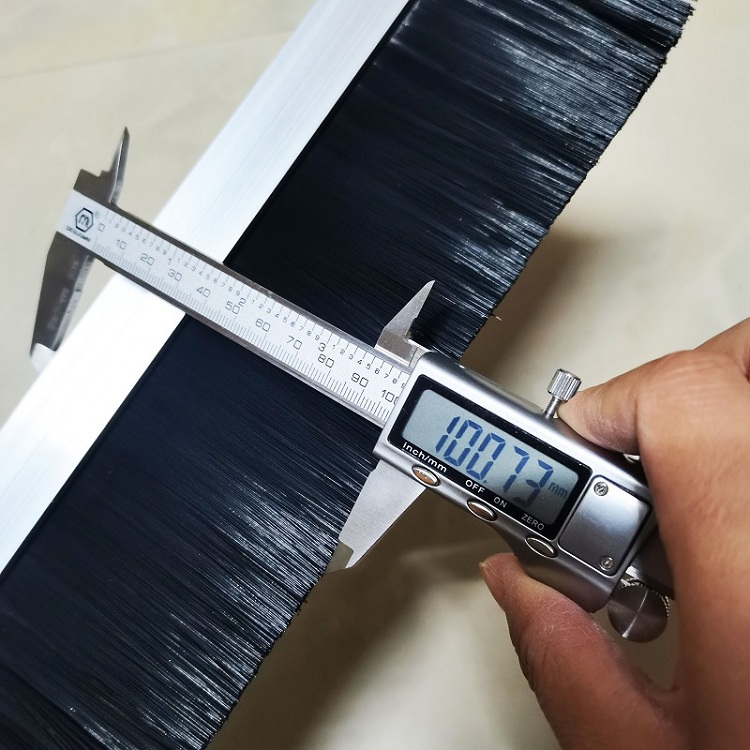
Nylon vs Steel Wire: Service Differences
Nylon strip brush filament, commonly PA6 or PA6.6, is chosen for low-marking contact on painted, powder-coated, anodized, or soft metal surfaces [3]. Nylon recovers well after deflection, does not rust, and works in wet or washdown sealing areas. Its limitation is lower cutting action and a narrower continuous-temperature limit.
Steel wire filament is chosen when the brush must scrape heavy dust, remove scale, or survive sharp metal edges. Carbon steel is low cost; galvanized steel improves corrosion resistance; stainless steel suits humid or mildly corrosive installations. For salt-spray or coastal exposure, the material can be evaluated according to ISO 9227 [1], and the service environment classified under ISO 12944-2 [2] instead of assuming that any stainless grade will survive.
| Service condition | Nylon filament | Steel wire filament |
|---|---|---|
| Edge aggressiveness | Low; protects coated or soft surfaces | Higher; removes rust, scale, or caked dust |
| Wet environment | No rust; temperature limit still applies | Carbon steel may rust; galvanized or stainless preferred |
| Shape recovery | Good after repeated deflection | May bend permanently under high overload |
| Static tendency | Insulating; fine dust may cling | Conductive path may reduce static buildup |
| Cutting/deburring | Minimal unless abrasive nylon is specified | Effective for light mechanical cleaning |
The table is directional. The real selection depends on gap size, contact pressure, speed, and whether the brush must clean or only seal.
How to Select Filament for Sealing, Dust Blocking and Edge Cleaning
For sealing, the brush usually works as a flexible filler rather than a cutting tool. Nylon is common because it does not mark mating surfaces and follows small gap changes. A fine, dense industrial strip brush blocks dust better, while a lower-density or wavy filament pack lets sliding panels move with less resistance.
For dust blocking on equipment cabinets and industrial doors, door seal brush designs often use fine nylon or PP filament. Nylon resists moisture and repeated flexing, which reduces maintenance on machine guards and air-handling panels.
For edge cleaning, the decision shifts. Steel wire is usually the stronger cleaner for sharp edges, oily films, or baked-on dust. On painted, anodized, or polished edges, standard nylon or abrasive nylon brush filament provides light cleaning with lower marking risk.
In sealing applications, filament density and channel retention often matter more than bristle hardness alone. <what you know about brass wire brush strip> covers brass strip brush behavior for softer metallic contact and non-sparking sealing jobs.
Strip Brush Design Details That Affect Performance
The channel, knotting, and filament density control service life more than the bristle material alone. Common metallic channels include aluminum, galvanized steel, and stainless steel; plastic channel is used where electrical isolation or lower weight is required. The filament is packed into a U-channel and secured by a bead or wire, which locks trim length and density.
Trim length changes stiffness. Short trim gives firmer contact, while longer trim conforms to uneven gaps but can lie flat under high pressure. Density is specified as the amount of filament packed per unit length. Low density allows dust leakage; very high density increases actuator load and may trap debris between filaments.
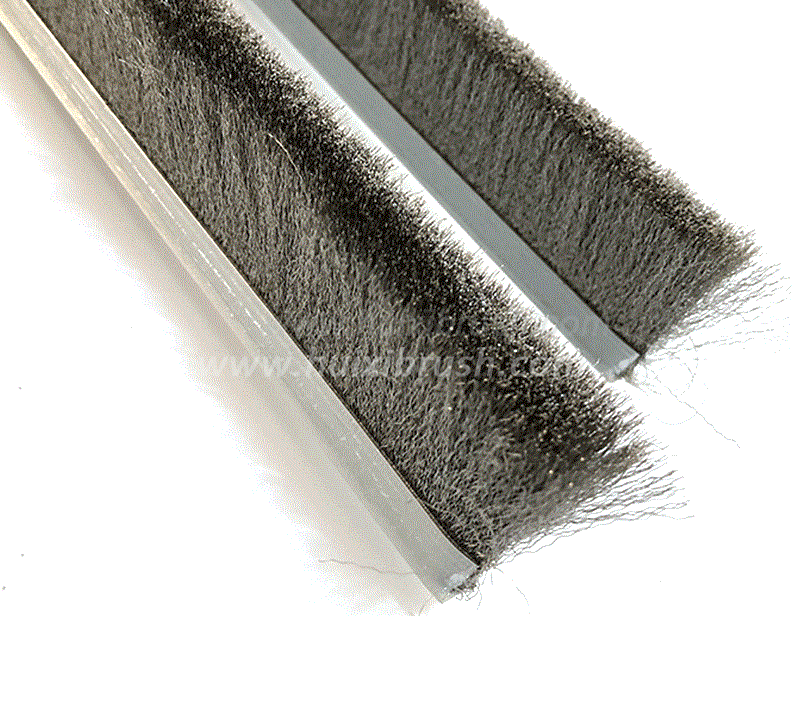
Steel wire strip brushes used near curved or round parts can be paired with rotary alternatives. For pipe inner-wall scale removal, wire descaling spiral brush gives full-circumference contact that a linear strip cannot.
Ready to compare a strip brush drawing? Send gap width, travel speed, edge material, and any washdown or coating constraint to [email protected] with “strip brush selection” in the subject line. Include photos of the contact edge, and we can return a material, backing, and density recommendation before you produce a sample.
Application Mapping: Sealing, Dust Blocking and Edge Cleaning
For static sealing, a dense nylon strip fills the clearance and blocks air, light, and dust around retractable guards, enclosure doors, and conveyor side skirts. For moving sealing, density should be balanced so the brush conforms without jamming the panel or actuator.
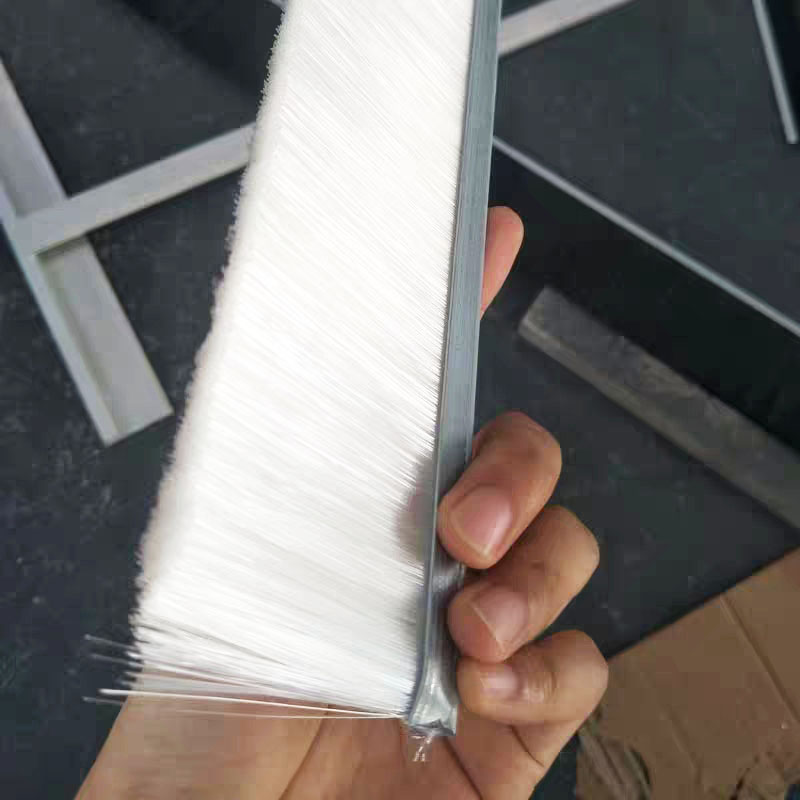
For dust blocking, the brush often works best when mounted on the upstream side of the dust source. On a conveyor transfer point or brush table station, the strip brush contains fines while allowing the belt to move. An industrial strip brush with higher fill and a short trim maintains a tighter seal line at these transfer points.
For edge cleaning, steel wire removes weld scale, rust, and caked deposits. Nylon avoids scratching coated edges and works well with light dust or coolant films. If the task is deburring a round part or continuous profile, a rotary brush may cover the shape more evenly than a flat strip.
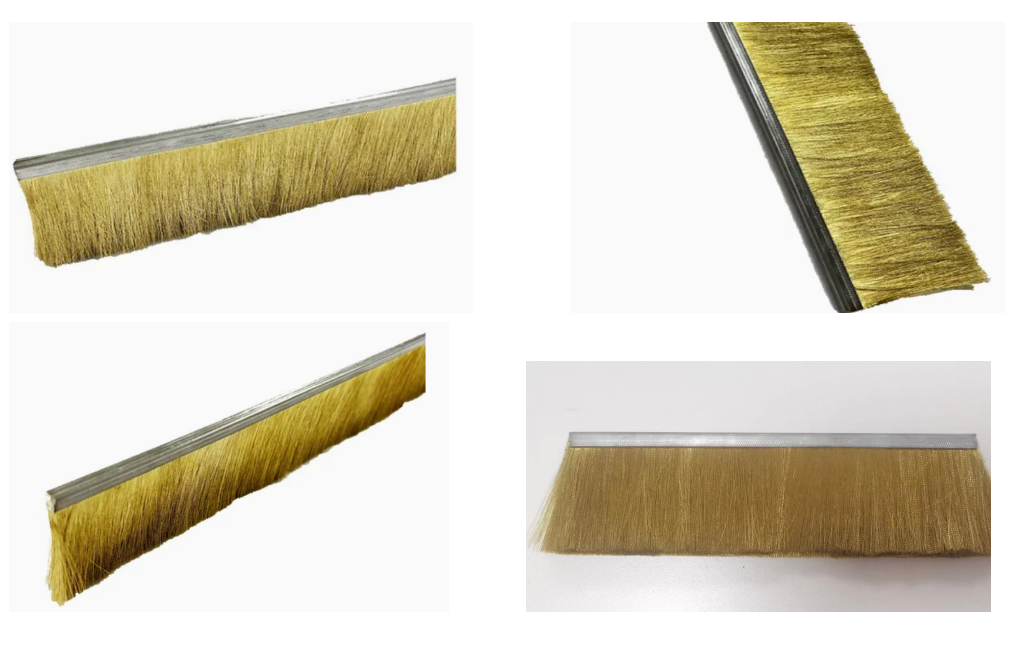
If the edge cleaning task is welded seam dressing or heavy rust removal, a strip brush is rarely the fastest tool. <the differences between knotted wire wheel brush and crimped wire wheel brush> explains knot selection for material removal rate and final surface finish.
For continuous round profiles, spiral brush contact wraps the circumference more evenly than a flat strip. <descaling spiral brush an innovative tool and generalist in the field of industrial cleaning> covers spiral brush choice for tube, rod, and roll cleaning lines.
Common Application Mistakes to Avoid
- Specifying steel wire because it appears stronger, then marking painted, anodized, or polished surfaces.
- Using fine nylon at high speed without checking heat buildup, which can soften tips and reduce sealing pressure.
- Ordering by nominal width only, without allowing for mounting tolerances, thermal expansion, or uneven panel edges.
- Ignoring channel corrosion in humid or washdown zones, where the backing can fail before the filament wears.
- Selecting a very high density pack without checking the actuator or conveyor load.
These failures are usually avoidable with a short engineering review before ordering.
Request a Custom Strip Brush Review
To specify a custom industrial strip brush, prepare the following: channel length, gap width or contact depth, bristle material preference, trim length, density target, and operating conditions.
Send the drawing and application details to [email protected] or call +86 1580 0932 713. Custom production supports aluminum, galvanized steel, and stainless steel channel, plus ODM/OEM length, density, and mounting options.
Frequently Asked Questions
Does a nylon strip brush seal dust as well as a steel wire strip brush?
In most dust blocking applications, a dense nylon strip brush seals as well as steel wire and is less likely to mark coated panels. Steel wire is preferred when the brush must cut through caked dust, oil, or rust rather than only block fine particles.
Can a steel wire strip brush be used on soft aluminum or painted edges?
Steel wire is not usually the first choice for soft aluminum or painted edges because it can scratch or remove the coating. Use fine nylon or abrasive nylon for these surfaces, and reserve steel wire for unpainted steel, cast iron, or surfaces that tolerate mechanical cleaning.
How do I prevent nylon filament from melting at higher speeds?
Keep contact pressure moderate, use a grade suited to the operating temperature, and verify that trim length and density do not create excessive friction. If speed or dry contact is high, request a material review before finalizing the brush.
What backing options are available for industrial strip brushes?
Common metal channels include aluminum, galvanized steel, and stainless steel. Plastic channel is also available for electrical isolation or lower weight. Channel selection should match the mounting environment, especially in humid, washdown, or outdoor locations.
How is brush density specified?
Density is usually quoted as the amount of filament packed per unit length, and it controls the seal line, stiffness, and dust-holding capacity. Provide the gap size and required movement force so the supplier can balance sealing performance against actuator load.
References
[1] ISO 9227:2022, Corrosion tests in artificial atmospheres — Salt spray tests, International Organization for Standardization.
[2] ISO 12944-2:2017, Paints and varnishes — Corrosion protection of steel structures by protective paint systems — Part 2: Classification of environments, International Organization for Standardization.
[3] ASTM D4066, Standard Classification System for Nylon Injection and Extrusion Materials, ASTM International.
If you’re interested, check out these related articles:
abrasive wheel brush a magical tool for industrial surface treatment
wire wheel brush the right assistant for industrial cleaning and polishing


 Whatsapp
 Email