



Nylon vs Stainless Steel Formed Strip Brushes in CNC Sealing
Choosing between nylon and stainless steel formed strip brushes for CNC sealing and conveyor cleaning comes down to contact pressure, contamination type, and the risk of marking or shedding on the workpiece. In most sealing positions, nylon is the safer first choice because it flexes, resists moisture and coolant, and does not scratch aluminum or coated surfaces. Stainless steel earns its place when the strip must cut through oxide, dried coolant, or compacted debris and when springback matters more than surface protection. The right selection is not one material for every station; it is a match between filament behavior and the specific duty.
What Formed Strip Brushes Do in CNC Sealing and Conveyor Cleaning
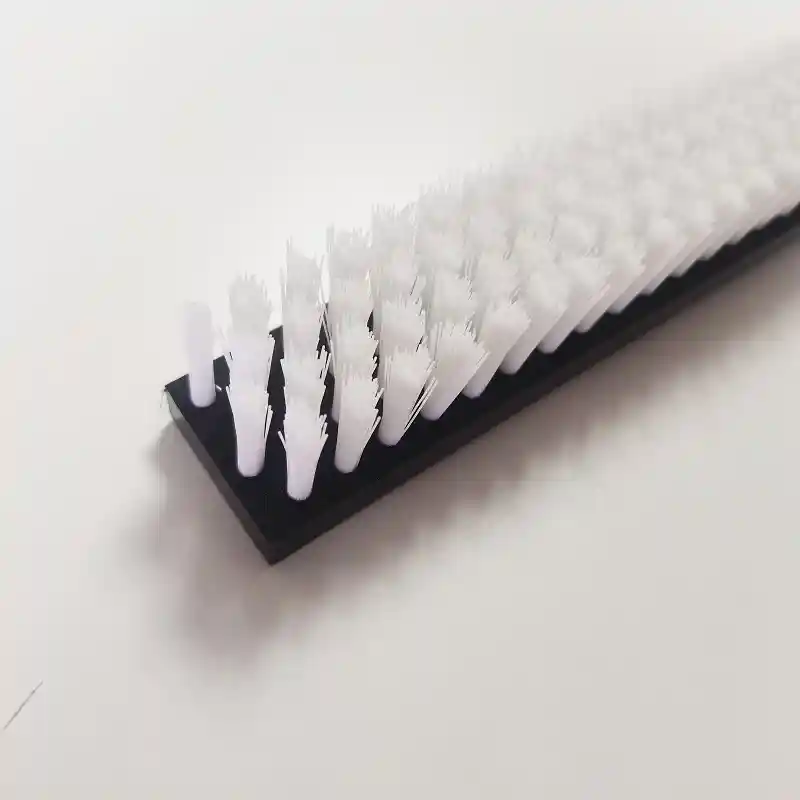
A formed strip brush is a dense filament row held in a metal or plastic channel that has been shaped to follow a machine profile. In CNC sealing, the brush closes gaps around sliding doors, tool changers, guideways, and workholding areas so chips, coolant mist, and dust do not reach sensitive components. In conveyor cleaning, the same strip format wipes parts, removes loose swarf and fluids, or applies light scrubbing as material passes along the line. The useful design decisions include channel profile, mounting method, filament density, trim length, and whether the brush must bend around a radius.

Because the strip is usually close to moving machine elements or finished parts, filament choice directly affects cleaning effectiveness, surface quality, and replacement frequency. A soft filament may deflect too much and allow fine chips to pass. A wire filament may seal aggressively but leave marks on anodized aluminum, painted covers, or precision surfaces.
Nylon Filament Performance in Formed Strip Brushes
Nylon filaments work well when the brush must be non-marring, moisture resistant, and flexible. Straight nylon bends easily to follow a formed channel and recovers well after light compression. It is a practical option for door seals, splash guards, and wiping positions where coolant, oil, or fine dust is present. Abrasive nylon contains embedded grit and adds a light cutting action for oxide films, surface bloom, or minor edge conditioning, but it is more aggressive than straight nylon and must be matched to the acceptable surface finish.
Nylon has limits. Under high contact pressure or heavy swarf, it can compress, take a set, or load with debris. It also softens at elevated temperature, so a sealing position near a hot spindle housing or a continuous high-friction conveyor run needs a filament grade selected for the actual operating temperature.
Nylon filament selection also depends on brush construction. <main features and applications of hx nylon cylindrical brush> covers how nylon brush construction affects cleaning performance and wear life.
Stainless Steel Filament Performance and Limits
Stainless steel wire filaments provide higher stiffness, better springback, and stronger mechanical removal. A formed strip made with stainless wire can clear dried coolant, compacted chips, oxide scale, and oily residue that would flatten nylon. The wire holds its set better in long-stroke or high-cycle sealing positions and tolerates higher temperatures than standard nylon.
The main tradeoff is surface aggression. Stainless wire can scratch aluminum, plastics, coated sheet metal, and soft sealing surfaces. It can also shed broken wire fragments if the trim length is too long, the pressure is too high, or the backing cannot support the filament. For that reason, stainless steel formed strip brushes are usually reserved for robust steel or cast machine components, heavy contamination, and applications where wire straying does not create a quality risk.
Stainless wire selection depends on the brush format and exposure conditions. <where stainless wire spiral brush can be used> covers stainless wire brush applications across industrial cleaning and surface preparation.
Matching Filament to CNC Sealing Duty
The table below separates common sealing conditions into material recommendations.
| Sealing duty | Nylon filament | Stainless steel filament |
|---|---|---|
| Anodized aluminum or painted machine covers | Preferred because it is non-marring | Not recommended unless contact force is very light |
| Dense coolant mist and fine chips | Good with straight or abrasive nylon | Functional but may pass finer particles unless density is high |
| Heavy swarf or dried coolant around workholding | Can compress and load | Preferred for cutting through compacted debris |
| Long stroke and high springback | May take a set over time | Preferred for holding its shape |
| Contact with soft or high-value parts | Preferred to reduce scratching and metallic contamination | Usually unsuitable |
When specifying a sealing strip, measure the real gap width and its variation along the bracket. A brush that is too full in the channel can bind the moving member, while a brush with too little filament density can leave an open leakage path. The material choice should follow the most sensitive surface in the sealing area, not only the heaviest debris load.

Matching Filament to Conveyor Cleaning Duty
Conveyor cleaning can be divided into wiping and removal duty. For finished parts, powder-coated assemblies, or plastic components, nylon strip brushes prevent scratched surfaces while removing light dust, coolant, and loose particles. For castings, steel profiles, welded fabrications, or scale-covered material, stainless steel wire gives the cutting action needed to remove stubborn residue.
The conveyor line also influences replacement behavior. A nylon strip may wear by bending, matting, or losing filament height. A stainless strip may wear by filament fracture, especially when it contacts sharp edges or uneven part surfaces. In many lines, the most practical solution is to combine stations: a stainless steel strip for aggressive removal, followed by a nylon strip for final wiping and surface protection.

Conveyor cleaning often overlaps with descaling and derusting work. <brushes for steel wire industries cleaning descaling derusting polishing> covers brush selection for cleaning, descaling, derusting and polishing in steel wire processing.

Specification Checklist for OEM and Maintenance Buyers
Before ordering formed strip brushes, confirm the following details:
- Channel profile, overall length, and bend radius
- Filament material and diameter
- Filament density and trim length
- Mounting method and bracket spacing
- Workpiece material and surface finish
- Coolant, oil, or chemical exposure
- Operating temperature and duty cycle
- Current failure mode: bending, breakage, loading, or leakage
A maintenance team should record whether the old brush lost height, flattened, broke, or stopped sealing. That observation points to the required material change more reliably than choosing a filament by habit. For a new CNC sealing station, a sample strip or a dimensioned profile drawing is the fastest way to verify fit.
Request a Formed Strip Brush Recommendation
Send the channel profile or machine drawing, workpiece material, coolant type, and the current sealing or cleaning problem you need to correct. A useful inquiry includes filament material, density, trim length, and mounting detail. Contact Shanghai Huixi Trading Co., Ltd. at [email protected] or +86 1580 0932 713 for a selection review.
FAQ
Which filament lasts longer in CNC sealing, nylon or stainless steel?
It depends on the duty. For dry deflection sealing with light chip contact, nylon often lasts because it flexes without permanent bend. For abrasive swarf or repetitive high-pressure contact, stainless steel retains height longer but may damage adjacent surfaces. Compare the failed brushes to identify the dominant wear mode.
Will stainless steel formed strip brushes scratch aluminum CNC fixtures?
They can if the wire tips contact the surface under load. For aluminum fixtures, anodized covers, or painted panels, nylon is usually the safer choice. If stainless wire is required for debris removal, use a shorter trim length, lower contact force, or a finer wire diameter and test on a non-critical area first.
Can nylon strip brushes handle coolant and oil in CNC machines?
Yes, nylon generally resists common coolants, water-based fluids, and light oils. The exception is high-temperature or aggressive solvent exposure, which can soften or degrade the filament. Confirm the filament grade against the machine’s coolant chemistry and peak operating temperature.
What should I send for a formed strip brush quotation?
Send a dimensioned profile or sketch, the channel size, filament material, filament diameter and density, trim length, mounting method, workpiece material, and the failure you are trying to correct. Clear photos of the current brush and mounting slot are also useful for confirming fit.
If you’re interested, check out these related articles:
abrasive disc brush an excellent industrial surface treatment tool
descaling spiral brush an innovative tool and generalist in the field of industrial cleaning
wire wheel brush the right assistant for industrial cleaning and polishing
what you know about brass wire brush strip
honing brush treat burrs in barrel parts without affecting accuracy and scale


 Whatsapp
 Email