



Knotted Stainless Wire vs Crimped Wire for Weld Spatter Removal
Knotted stainless wire wheels remove heavy weld spatter and mill scale faster than crimped wire wheels because the twisted knots create a concentrated impact instead of a flexible brushing sweep. The advantage is real when the main target is thick, bonded contamination on a surface that can accept a coarser finish. It is not a universal rule for every cleaning job. The better wheel depends on the base material, the required finish, and how the operator controls speed and pressure. This article compares the two wire wheel constructions, explains where knotted stainless wire delivers the strongest result, and lists the application details to confirm before ordering.
How Knotted and Crimped Wire Wheels Remove Surface Contamination
Crimped wire wheels are built from individual wire filaments that are crimped into small waves and secured around a hub. The wave shape lets each filament flex as it strikes the surface, so the wheel cuts with moderate pressure and tends to leave a smoother, more uniform finish. That behavior works well for light rust, thin paint, loose dirt, and surface blending where the goal is to avoid deep scratches.
Knotted wire wheels take a different approach. Wires are grouped into dense twisted knots that stand off from the hub and hit the workpiece with a harder, more localized impact. The knot acts more like a small impact tool than a soft brush. For heavy weld spatter and mill scale, that concentrated force is what breaks the bond between the contamination and the base metal.
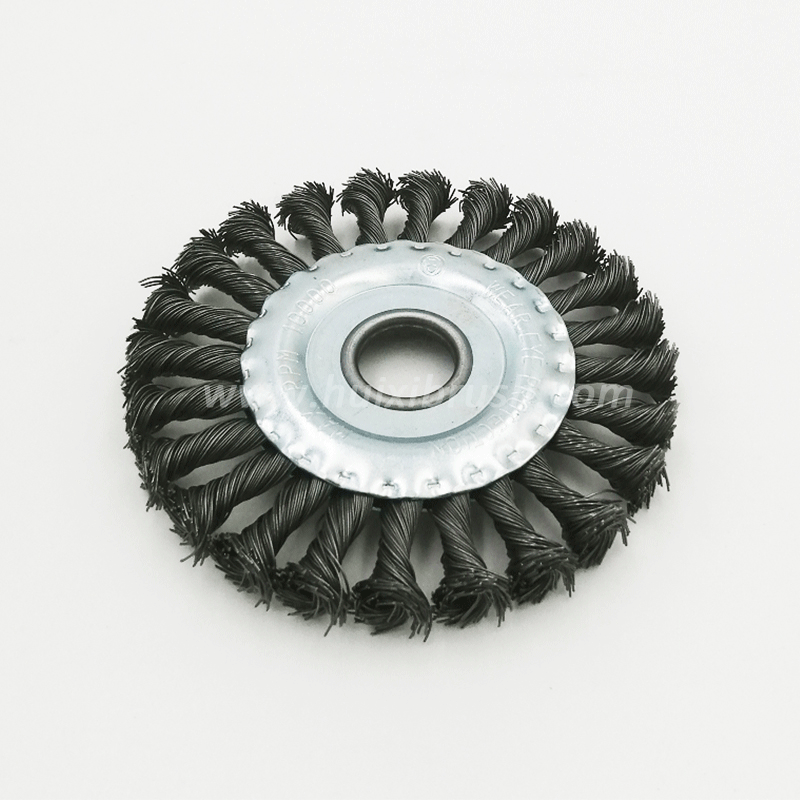
The finish also changes. A crimped wheel deflects and follows the surface, which makes it more forgiving on thin sheet and machined features. A knotted wheel removes more material and leaves a coarser pattern. On a weldment or structural part with heavy spatter and scale, that tradeoff is usually acceptable because the first requirement is complete removal before inspection, painting, or further processing.
The choice between a knot and a crimped filament changes how the wheel impacts the surface. <the differences between knotted wire wheel brush and crimped wire wheel brush> covers how the two constructions behave in cleaning and surface preparation.
Why Knotted Stainless Wire Wins on Heavy Weld Spatter and Scale
Weld spatter and mill scale are not simply loose dirt. They are tightly bonded, often brittle layers that resist a flexible filament. A crimped wire filament can bend around a high spot and glide over the projection. A knotted wire bundle concentrates force on a smaller area, cracks the spatter or scale loose, and keeps working through uneven weld profiles. That is the main reason knotted construction is preferred for heavy removal rather than fine finishing.
Stainless wire adds another practical benefit for corrosion-sensitive work. A carbon steel wire wheel can leave small carbon steel particles embedded in a stainless surface, and those particles may later rust or become a contamination issue. Stainless wire reduces that risk and is often specified for stainless steel fabrication, food-grade equipment, and parts that must stay free of carbon pickup. The stainless wire does not make the wheel gentle; it changes the contamination risk, not the impact pattern.
| Application condition | Knotted stainless wire wheel | Crimped wire wheel |
|---|---|---|
| Heavy weld spatter | Concentrated impact breaks projections loose | Softer flex can skip over hard spatter |
| Thick mill scale | Strong cleaning on bonded oxide scale | Better for light rust or thin oxide |
| Surface finish | Coarser pattern; may need a finishing pass | Finer, more uniform finish |
| Base metal removal risk | Higher if pressure or speed is excessive | Lower and easier to control |
| Contamination-sensitive materials | Stainless wire reduces carbon pickup | Stainless crimped version available but less aggressive |
| Edge and weld seam access | Knots clean uneven profiles effectively | Filaments flex around contours |
For circular or profile parts, the same knot principle can be carried into other brush forms. A cylindrical brush can cover rollers and long shafts, while a spiral brush reaches inside bores or wraps around tube surfaces. A wheel brush remains the most common choice for localized weld seams and flat areas around joints.

When Crimped Wire Makes More Sense
Crimped wire is the better starting point when the surface is thin, dimensionally sensitive, or already close to the required finish. The flexing filaments remove light rust, thin paint, dust, and light oxide without gouging the base material as easily. For sheet metal cabinets, machined surfaces, visible architectural parts, or parts being prepared for a smooth coating, the finer finish is often more important than maximum removal speed.
Crimped wire also works well when the operator is cleaning around threads, holes, and delicate edges. The filaments can conform to small features and clean without changing the geometry. If the workpiece has both heavy spatter and critical machined areas, it may be better to use a knotted wheel on the heavy weld zones and a separate crimped wheel or non-woven product on the finished areas.
Long cylindrical workpieces and internal bores often require a different brush form. A spiral brush can follow the length of a shaft or enter a tube, while a knotted wheel is mainly effective on external faces and edges.

Key Wheel Specifications to Confirm Before Ordering
Choosing the correct knotted stainless wire wheel requires more than selecting the diameter. The following details determine whether the wheel removes the scale efficiently and runs safely on the available tool.
- Wire gauge: heavier wire increases impact and removal rate; thinner wire leaves a finer finish but wears faster on hard scale.
- Knot style and density: a denser, more tightly twisted knot is more aggressive, while a lower-density knot can be more compliant.
- Trim length: a shorter trim exposes less free wire and cuts more aggressively; a longer trim is more flexible.
- Wheel diameter and arbor size: the wheel must fit the grinder or machine and match the tool’s speed range.
- Maximum safe RPM: verify that the tool speed does not exceed the wheel rating.
- Wire material: choose stainless wire when carbon contamination or corrosion resistance matters; carbon steel wire is often more economical for mild steel components.
Once these variables are matched, the wheel decision becomes repeatable. A wire wheel that is correctly specified removes weld spatter without forcing the operator to use excessive pressure or accept early wire loss.
The same wheel diameter can behave differently when the wire pattern changes, so the application condition matters more than the wheel category. <wire wheel brush the right assistant for industrial cleaning and polishing> covers wire wheel brush selection for industrial cleaning and polishing.
How to Avoid Workpiece Damage and Short Wheel Life
Knotted wire wheels are aggressive, so controlling the contact angle and pressure is the main way to protect the workpiece. Pressing harder does not always remove scale faster; it can flatten the knots, generate excess heat, and increase the risk of gouging. Use the contact area recommended for the wheel and let the knot impact do the work.
Inspect the wheel before mounting. Look for broken knots, flattened wire bundles, cracks in the hub, or uneven wear. A damaged wheel can vibrate and may throw wire fragments, so it should be replaced rather than run at lower speed. Keep guards in place and use appropriate eye and face protection.
For stainless steel and other sensitive materials, keep the stainless wire wheel dedicated to compatible work. If the same wheel has been used on carbon steel, it can carry carbon particles into a later stainless operation. Dedicated wheels or a documented cleaning procedure reduce cross-contamination.
Matching the Wheel to the Job and Surface Finish Requirement
Start with the contamination and the accepted finish. If the main problem is heavy weld spatter, thick mill scale, or oxide on a structural part, and a coarse pre-paint or pre-inspection texture is acceptable, a knotted stainless wire wheel is the faster route. If the part is thin, dimensionally critical, or intended for a visible finish, choose a crimped wire wheel or plan a two-step process: knotted wire for gross removal, followed by a finer brush or non-woven wheel for blending.
For production lines, the brush form is just as important as the wire construction. Disc brushes can cover larger flat areas, strip brushes can seal and clean edges, and cylindrical or spiral brushes can run on shafts, profiles, and rollers.

Huixi Brush supplies knotted and crimped stainless wire wheels in different diameters, arbor sizes, and wire gauges, and can match the wheel to the tool and the base material. For long edge or conveyor applications, a strip brush can also be integrated where a wheel brush would not fit.

Send the Application Details for a Matched Stainless Wire Wheel
Tell us the base material, weld type, scale condition, required finish, tool model, arbor size, and target speed. Huixi Brush can recommend a knotted or crimped stainless wire wheel and arrange a sample for approval. Contact Liu Jian at [email protected] or +86 1580 0932 713.
FAQ
Can I use a knotted stainless wire wheel on carbon steel?
Yes. The knotted stainless wheel will remove scale and spatter from carbon steel, but stainless wire may cost more than a carbon steel wheel and is usually reserved for work where carbon pickup or rust staining is a concern. For ordinary carbon steel, a carbon steel knotted wheel may be more economical.
Will a knotted wire wheel remove too much base metal?
It can if it is pressed too hard, run at an unsuitable angle, or used on a thin section. Keep the pressure light enough for the knots to strike the contamination, and check the surface after a short test area. If the part is tightly dimensioned, use a crimped wheel or a finer second step.
Why choose stainless wire instead of carbon steel for stainless steel parts?
Carbon steel wire can leave small iron particles on the stainless surface. Those particles may corrode later and create visible staining or contamination. Stainless wire reduces that risk, provided the wheel is dedicated to stainless work and is not shared with carbon steel parts.
Can crimped wire remove heavy weld spatter?
It can remove some spatter, but it is slower and may not break hard projections efficiently. The flexible filaments tend to deflect around high spots, so the operator may need more passes and higher pressure. For heavy weld spatter or thick scale, knotted wire is the more productive starting point.
What causes a knotted wheel to shed wires?
Common causes are running above the wheel’s speed rating, using a damaged or unbalanced wheel, or forcing it into a sharp edge. Check the tool RPM, inspect the wheel for broken knots, and replace damaged wheels before further use.
If you’re interested, check out these related articles:
abrasive disc brush an excellent industrial surface treatment tool
the differences between knotted wire wheel brush and crimped wire wheel brush
brass brushes work perfectly for pipe cleaning
descaling spiral brush an innovative tool and generalist in the field of industrial cleaning


 Whatsapp
 Email