



Steel Wire vs Nylon End Brushes: How to Choose the Right Tool for Precision Deburring of Small Holes and Threaded Cavities
Small holes, threaded cavities, counterbores, and intersecting bores are among the most difficult deburring features to finish consistently. They are hard to reach, easy to damage, and difficult to inspect without magnification. A shank-mounted end brush can solve many of these problems, but only when the fill material and brush geometry match the actual burr type, workpiece material, and required edge condition.
In this guide, we compare the two most common end brush fill materials for precision deburring: steel wire and abrasive nylon. The best choice depends on how the burr was formed, the hardness of the workpiece, the acceptable edge radius, and the risk of changing a critical thread or bore.

What Makes End Brushes Useful for Tight-Cavity Deburring
An end brush has filaments arranged radially at the end of a shank. Unlike cup brushes or large wheel brushes that work best on open surfaces, an end brush can enter a bore and reach a blind hole, thread start, or internal shoulder. Pointed, tapered, flat-end, and cup-style end brush geometries each cover a different feature shape.
Instead of cutting with a defined edge, an end brush removes material through repeated contact. That makes the process forgiving on complex geometry, but also sensitive to fill type, trim length, speed, and pressure. Steel wire removes material mainly by impact and cutting. Abrasive nylon removes material by micro-abrasion and tends to produce a smaller, more controlled edge break.
Burr control in small holes and threaded cavities depends on more than brush diameter.
Burr control in small holes and threaded cavities depends on more than brush diameter. <how do you know about deburring brushes> covers how deburring brush design, fill type, and operating parameters work together to control edge quality.
Steel Wire End Brushes: High Penetration, Higher Risk
Steel wire end brushes are usually made from carbon steel or stainless steel wire. They are most effective for heavy burrs, compressed chips, heat scale, light rust, and sharp machined edges in ferrous or harder nonferrous workpieces. Because steel wire is stiff, it can enter a small opening and apply strong local force.
For steel and cast iron parts, a steel wire end brush can remove a visible burr quickly. However, the same stiffness can scratch an adjacent surface, cut into a thread crest, or create a larger edge radius than the print allows. On aluminum, brass, zinc, or plated parts, carbon steel wire can leave transfer marks or surface contamination. Broken wire is also a foreign-matter risk in hydraulic manifolds, valve bodies, fuel-system parts, and other cleanliness-critical assemblies [1].

When steel wire is selected, keep tool pressure low. Excessive pressure increases the chance of digging into a thread root or generating a new rolled edge. Use the shortest practical trim length for tight bores, and inspect the brush for broken or flattened wires before the next run. In many cases, steel wire works best as the first pass for stubborn material, followed by a less aggressive finishing step.
Nylon End Brushes: Controlled Removal, Better Surface Protection
Abrasive nylon end brush filaments are made from nylon loaded with abrasive grain, most commonly silicon carbide or aluminum oxide. The result is a conformable abrasive tool that works more like a flexible grinding medium than a wire impact tool. It removes light burrs and sharp edges while producing a more uniform edge condition.
Because the filaments flex, they tend to follow thread profiles and irregular cavities without digging in as aggressively as steel wire. That makes nylon end brushes useful where dimensional accuracy, surface finish, and controlled edge radius are more important than high material removal. They are often selected for threaded components, cross-drilled holes, precision hydraulic parts, fluid-handling parts, and softer workpiece materials. Abrasive nylon does not rust and does not leave carbon steel fragments in the part [2].
The main limitation is removal rate. Nylon is not the first choice for large, tough, or heavily compressed burrs. It also wears faster in deep or blind cavities where the filaments cannot fully flex. Use nylon end brushes for light burr removal, secondary deburring, or final edge conditioning after a more aggressive operation.
Abrasive nylon is valuable when dimensional accuracy must be preserved while removing light burrs.
Abrasive nylon is useful when dimensional accuracy must be preserved while removing light burrs. <honing brush treat burrs in barrel parts without affecting accuracy and scale> covers brush-based burr removal on barrel parts without degrading size or scale.
Steel Wire vs Nylon: Direct Comparison
| Factor | Steel Wire End Brush | Nylon End Brush |
|---|---|---|
| Primary removal mechanism | Impact and cutting | Abrasive micro-cutting and flex |
| Best burr type | Heavy, rolled, large, oxidized | Light, thin, sharp, secondary |
| Workpiece compatibility | Best for ferrous and harder metals | Broad; safer on softer or finished surfaces |
| Edge condition | More aggressive; larger edge radius risk | More controlled; smaller edge break |
| Thread safety | Risk of crest or root damage | Lower risk with controlled pressure |
| Contamination risk | Carbon steel wires may rust; wire particles possible | No rust; lower metal contamination |
| Tool life in deburring | Long when not overloaded | Wears faster in narrow or deep features |
| Typical process role | Primary heavy removal | Finishing and light precision conditioning |
Process Settings and Feature-Based Selection
Speed, pressure, and dwell affect the result as much as fill material. In precision deburring, lower RPM and controlled feed often produce a better edge condition than maximum speed. High speed can melt nylon filaments or over-press steel wire tips. Use repeated light passes rather than high force, and keep the machine guarding and maximum speed limits in place [3].
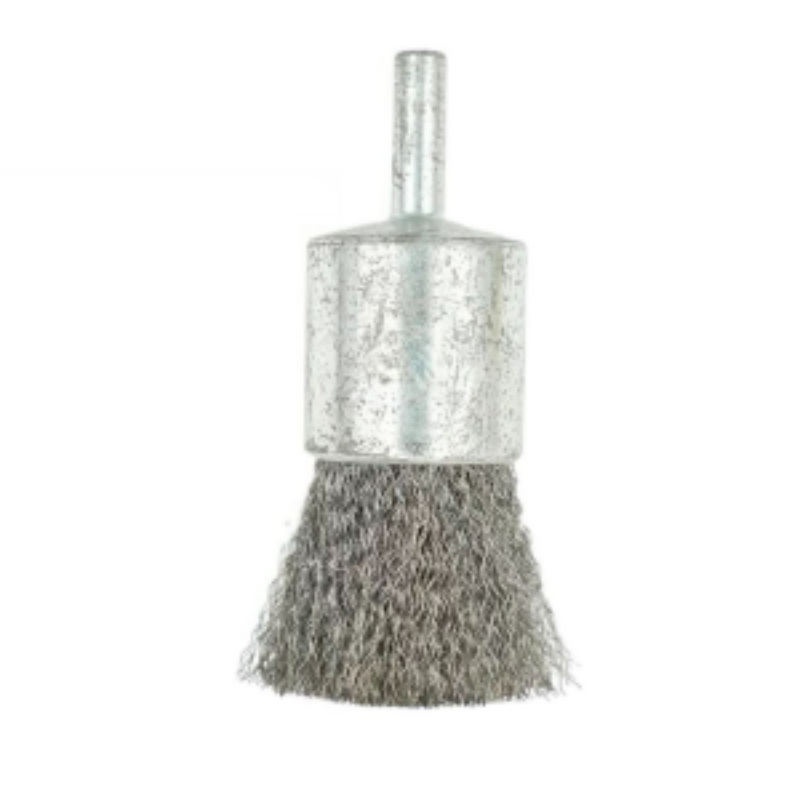
A practical trial setup is to run the same threaded cavity with a steel wire end brush at low RPM for the largest burr, then make a second pass with an abrasive nylon end brush to refine the edge. Compare the result with plug or thread gauges and inspect the edge under magnification. This separates heavy removal from final conditioning and reduces the chance of oversizing a hole.
The feature also controls brush selection. Small through holes generally need a brush diameter below the bore size with enough trim length to reach the exit edge. Blind holes need a flat-end or pointed brush that can contact the bottom without wedging. Threaded cavities are often safer with nylon because the filament can follow the thread form; steel wire should be reserved for heavy burrs where thread damage is acceptable or can be rechecked. Cross holes and port intersections should be deburred from each accessible side, and plated or soft parts usually benefit from abrasive nylon rather than carbon steel wire.
Need help narrowing down the shortlist? Tell us your hole diameter, thread size, material, and current deburring problem at [email protected]. Our engineers can recommend a steel wire or nylon end brush trial set and send samples against a drawing before you commit.
How to Avoid Common Failure Modes
Oversized holes are usually caused by an oversized brush, too much dwell, or excessive pressure. Use a smaller diameter, shorter trim length, and lighter engagement. Thread damage often comes from over-stiff wire or incorrect rotation; switch to a softer fill, lower RPM, or a controlled toolpath. Broken wire contamination can be reduced by using the correct wire grade, lowering pressure, and inspecting the brush before production. Nylon melting or rapid wear is typically a speed and pressure problem; reduce RPM, shorten dwell, and use air or coolant where the process allows. Inconsistent edge quality usually means the brush is wearing unevenly or recutting removed material; check the brush condition and maintain a consistent feed path.
Plan Your End Brush Trial with Huixi Brush
We supply end brushes in custom filament type, wire diameter, abrasive grit, trim length, and shank size. To specify a practical test set, include the following information:
- Workpiece material and hardness
- Hole or thread size and type
- Burr location, thickness, and inspection requirement
- Rotary tool or CNC spindle speed and shank diameter
- Required edge condition and surface finish
Send your part drawing, material spec, and current deburring issue to [email protected] or call +86 1580 0932 713. Browse the end brush category for standard shank, filament, and diameter options, and our team can adjust the brush after your first trial.
Frequently Asked Questions
Are steel wire end brushes safe for stainless steel threads?
Steel wire can remove heavy burrs on stainless steel, but it may scratch or alter the thread surface. Use stainless steel wire fill to avoid carbon steel contamination, keep RPM low, and follow with a nylon finishing pass if thread fit is critical.
How do I prevent an end brush from enlarging a small hole?
Select a brush smaller than the hole, use a short trim length, keep the tool moving, and limit dwell time. A nylon brush is generally easier to control than steel wire when bore diameter must remain stable.
Can nylon end brushes remove machined burrs or only polish edges?
Abrasive nylon can remove light to moderate machined burrs and refine sharp edges. It is not the best choice for large or heavy burrs; use steel wire or another aggressive deburring step first, then finish with nylon.
What shank size should I specify?
Specify the shank diameter to match the collet of the rotary tool or CNC spindle. Send the tool model or collet size to your brush supplier so the shank is machined correctly.
How do I choose between stainless steel wire and carbon steel wire?
Choose stainless steel wire when rust or carbon contamination is a concern, or when processing stainless steel, aluminum, or fluid-contact parts. Carbon steel wire is generally less expensive and can be used where light surface rust is acceptable and cleaning removes any residual particles.
References
[1] ANSI B165.1-2017, Power Brushes – Safety Requirements.
[2] Gillespie, L. K., Deburring and Edge Finishing Handbook, Society of Manufacturing Engineers, 1999.
[3] ISO 12100:2010, Safety of machinery — General principles for design — Risk assessment and risk reduction.
If you’re interested, check out these related articles:
wire wheel brush the right assistant for industrial cleaning and polishing
the differences between inward and outward spiral brush
advantage of hx boiler tube brush
descaling spiral brush an innovative tool and generalist in the field of industrial cleaning


 Whatsapp
 Email
Email