



Nylon vs Steel Disc Brush for Metal Deburring & Surface Finishing
Disc brushes remove burrs, blend edges, clean oxide, and prepare metal surfaces in automated and manual stations. The first decision is not diameter or machine type; it is filament material. Nylon and steel disc brushes both remove material, but they behave differently on the same workpiece. Filament behavior is consistent across rotary brush formats: the same comparison applies to abrasive nylon brush and wire wheel brush applications.
How Nylon and Steel Disc Brushes Work
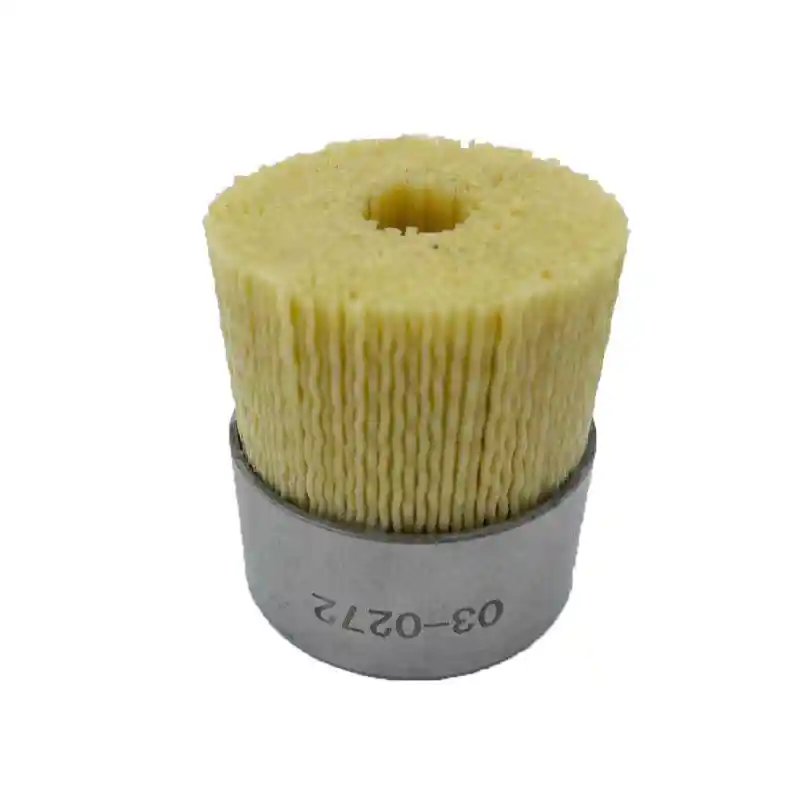
Abrasive Nylon Disc Brush
Abrasive nylon disc brushes use heat-stabilized nylon filaments, commonly nylon 6/12 or nylon 6, with abrasive grain embedded during filament production [1]. Aluminum oxide and silicon carbide are the most common grains. The nylon carries the abrasive to the part surface and flexes under load, so the brush deburrs without cutting deeply into the base material.
This type is a good starting point for CNC-machined edges, fine punched holes, light oxidation, and cosmetic finishing. It is also suitable for mixed-metal lines because it is less likely to contaminate stainless steel or aluminum parts with carbon steel particles.
Steel Wire Disc Brush
Steel wire disc brushes use carbon steel or stainless steel wire for aggressive material removal [2]. The wire can be crimped or knotted. Crimped wire is more flexible and better for light-to-medium cleaning. Knotted wire is stiffer and better for heavy rust, scale, weld slag, and thick surface contamination.
Steel brushes remove material faster than nylon brushes, but they also create a coarser surface and change edge geometry more quickly. On coating lines, steel brushing is often only one step; the prepared surface is then checked against the relevant visual cleanliness standard before coating [3].

Nylon vs Steel Disc Brush: Application Selection
| Application | Better filament | Reason |
|---|---|---|
| Edge deburring after machining | Abrasive nylon | Controlled edge rounding, less geometry change |
| Light oxide and tarnish removal | Abrasive nylon | Fine grain produces a satin finish |
| Thick rust and mill scale removal | Steel wire | High-impact cutting action |
| Weld cleaning and slag removal | Steel wire | Stiff knotted wire breaks heavy deposits |
| Final cosmetic finishing | Abrasive nylon | Softer contact, more uniform grain |
| Pre-paint surface preparation | Steel wire | Faster removal, but requires cleanliness verification |
Disc brushes have to balance material removal, edge break, and surface finish in automated lines. <Abrasive disc brush: an efficient tool for many applications> covers common disc brush configurations for deburring, blending, and surface treatment. <Abrasive disc brush: an excellent industrial surface treatment tool> adds practical guidance on surface finishing performance, while <Main features and applications of HX nylon cylindrical brush> explains abrasive nylon behavior in rotary brush formats.
Specification Factors Beyond Filament Type
Filament choice is important, but the full brush specification determines whether the tool performs in production.
- Diameter and arbor: The brush must fit the machine spindle, adapter, or quick-change fixture.
- Trim length: Shorter trim gives more stiffness and more aggressive contact; longer trim increases flexibility and surface conformity.
- Filament diameter and density: Thicker and denser fill cuts more aggressively; thinner and lower-density fill is softer.
- Grit type and size: Finer grit creates a finer surface finish; coarser grit increases stock removal.
- Crimp or knot type: For steel brushes, crimp affects flexibility, while knot type affects impact.
- Maximum RPM: Brushes must be rated for the machine speed to prevent filament loss or imbalance.
- Wear compensation: Automated lines often need adjustable feed pressure or part positioning as the brush face wears.

Matching the Brush to the Deburring Cell
Start with abrasive nylon when the burr is small, the part tolerance is tight, or the customer requires a uniform cosmetic finish. Start with steel wire when the main task is fast removal of rust, scale, or a heavy attached burr. Many lines run more than one station: a steel brush for rough cleaning, followed by an abrasive nylon brush for final edge treatment and surface finish.
For parts with both heavy contamination and fine finish requirements, a single brush type usually is not the lowest-cost solution. A two-step process may take less time than forcing one brush to do both jobs. An automated deburring line with mixed aluminum and steel housings can also use abrasive nylon to reduce the risk of carbon steel transfer onto aluminum surfaces.
If you are comparing nylon and steel fill for a current workpiece, send the part drawing or a clear photo to [email protected]. Our application engineers can recommend filament type, trim length, grit, density, and a test sequence for your existing machine.
Request a Disc Brush Recommendation
Send your workpiece drawing, burr location and size, target edge condition, machine type, and current line speed to [email protected] or call/WhatsApp +86 1580 0932 713. Huixi Brush supplies customized disc brushes with technical drawing support, ODM/OEM service, low MOQ, free sample testing for qualified applications, and fast delivery.
Frequently Asked Questions
How do I know whether a burr needs nylon or steel?
A light, thin burr from precision machining is usually better suited to abrasive nylon. A heavy attached burr, deep rust, or scale usually requires steel wire. When dimension control and surface finish matter more than removal speed, choose nylon.
Can one disc brush both deburr and finish?
Abrasive nylon can handle light deburring and create a satin finish in one station. Steel wire removes material quickly but often needs a secondary nylon or non-woven step for a final cosmetic surface.
Are steel disc brushes safe for stainless steel parts?
Stainless steel wire brushes are used for stainless parts to avoid carbon steel contamination. A carbon steel brush used on stainless can leave particles that later rust. Dedicated brushes for stainless and aluminum help prevent cross-contamination.
What information should be included in a disc brush inquiry?
Include workpiece material, drawing or photo, burr size and location, current brush type, machine speed, target edge radius or surface finish, annual volume, and whether the process is wet or dry.
References
[1] ASTM D6779, Standard Classification for Polyamide (PA) Molding and Extrusion Materials. West Conshohocken, PA, USA: ASTM International.
[2] ISO 16120-1:2017, Non-alloy steel wire rod for conversion to wire — Part 1: General requirements. Geneva, Switzerland: International Organization for Standardization.
[3] ISO 8501-1:2007, Preparation of steel substrates before application of paints and related products — Visual assessment of surface cleanliness. Geneva, Switzerland: International Organization for Standardization.
If you’re interested, check out these related articles:
advantage of hx cylindrical nylon brushes
main features and applications of hx nylon cylindrical brush
rope cleaning brush for industrial use a key tool for maintaining safe production


 Whatsapp
 Email
Email