



Abrasive Nylon Honing Brush vs Steel Wire: Engine Bore Honing Guide
Finishing an engine inner hole or cylinder bore is a balancing act. The tool must remove torn material and edge burrs, improve the plateau surface, and still keep bore size, roundness, and surface texture inside the print. A brush that cuts too hard can scratch, open up, or contaminate the bore. A brush that cuts too little can leave the surface unfinished. Abrasive nylon honing brushes have become a practical alternative to steel wire for many of these jobs, especially in cast iron, aluminum, and hardened steel bores.
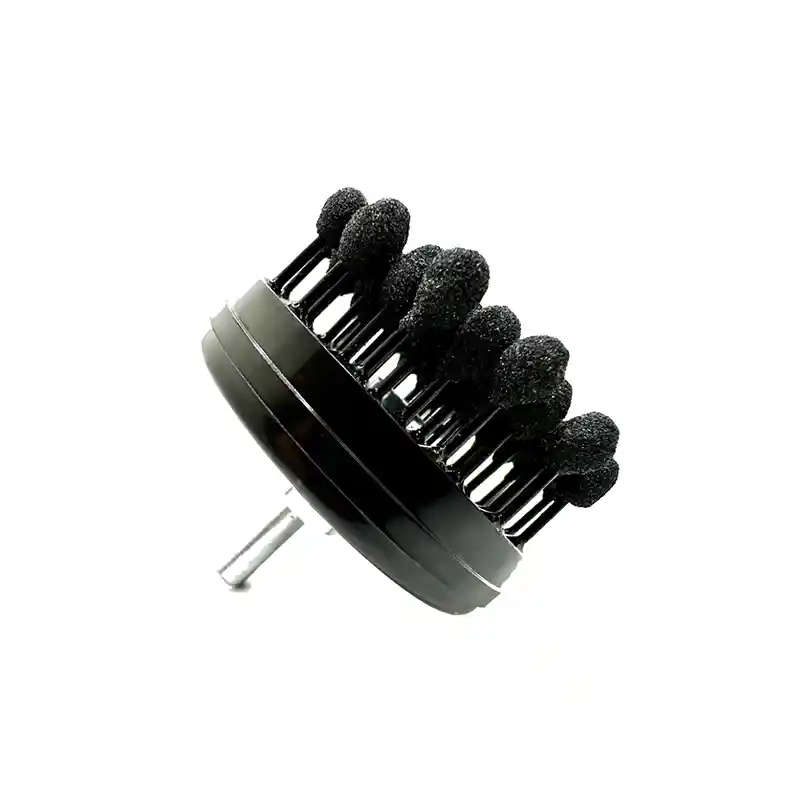
Why Bores Respond Differently to Nylon vs Steel Wire
Steel wire works mainly by scraping. The wire tips are stiff, and each tip acts like a small cutter. That can be useful, but in a controlled bore it often leaves directional scratches and sharp peaks. If a wire breaks during rotation, steel debris may remain in the oil circuit, bearing area, or assembly cavity.
Abrasive nylon works differently. The nylon carrier flexes and returns to position, while the abrasive grains on the filament surface perform a more controlled micro-machining action. This helps the brush follow the bore rather than fight it. Surface texture parameters used to judge this work are defined in ISO 21920-2 [1]; in practice, an engine drawing usually specifies Ra, Rz, cross-hatch angle, or a bearing-area ratio rather than simply calling for a “smooth” finish.
Contamination risk is another practical difference. Steel wire can introduce ferrous contamination and may rust when used with water-based coolant or stored in a humid shop. Abrasive nylon is non-metallic, so it does not leave rust bloom or magnetic steel debris in the bore.
Abrasive nylon filaments cut with a flexible carrier, so the tool follows the bore and reaches cross-hole edges without the scoring action of a stiff steel wire. <honing brush a magic tool for flexible burr removal> covers how brush action removes edge burrs without overcutting.
What Abrasive Nylon Honing Brushes Do Well
Abrasive nylon honing brushes are strongest when the bore size is already established and the remaining work is edge conditioning, burr removal, or surface refinement.
Cross-hole deburring. Engine blocks, crankshaft bores, hydraulic valve bodies, and compressor cylinders often contain oil holes or intersecting cross-drills. A flexible nylon brush can flare into those openings and remove the edge burr without changing the main bore diameter. This is one of the most common reasons shops switch from manual deburring to a mounted nylon brush.
Plateau finishing. After rigid honing creates the basic cross-hatch, an abrasive nylon brush can remove remaining peaks and produce a more uniform bearing surface. The process does not replace the honing stone when material removal is required, but it can improve the functional surface when the bore is already close to size.
Lower geometry risk. Because the filaments flex, the brush is less likely to open the bore or create a bell-mouth condition. That is valuable when the part is expensive, when print limits are tight, or when rework would be costly. Abrasive nylon is also well suited to soft metals such as aluminum, where aggressive steel wire can tear the surface [2].
Selecting the right abrasive filament is not only about grit. Brush geometry, filament diameter, and fill density determine how uniformly the bore is covered. <how do you know about deburring brushes> covers deburring brush selection criteria in more detail.

Where Steel Wire Still Has a Place
Steel wire brushes are not obsolete. They remain effective when the priority is fast removal of thick scale, heavy rust, carbon deposits, or weld-type contamination from a rugged bore. If the part has loose surface-finish limits and will be re-inspected after cleaning, steel wire may be the lower-cost choice.
The main risk appears in precision bores. Steel wire can alter roundness, leave irregular scratches, and produce ferrous debris that is difficult to remove completely. For an engine cylinder bore, those risks are usually unacceptable unless the bore will be re-honed afterward.
Key Selection Factors for Engine Inner Holes and Cylinder Bores
| Factor | Abrasive Nylon Honing Brush | Steel Wire Brush |
|---|---|---|
| Typical role | Edge break, cross-hole deburring, plateau finishing | Heavy contamination removal, coarse surface cleaning |
| Cutting action | Flexible filaments with abrasive grains | Hard wire tips scrape and score |
| Bore geometry risk | Lower when fill and pressure are controlled | Higher with long dwell or heavy pressure |
| Contamination risk | Non-metallic, no rust bloom | Ferrous debris and potential rust contamination |
| Best fit | Precision bores, aluminum, cast iron, hardened steel after sizing | Rough bores, heavy deposits, salvage or pre-cleaning |
Many shops ask what information is needed to choose the right bore brush. The practical inputs are bore diameter, bore length, material hardness, required surface finish, current operation, and production quantity. That data determines filament type, grit, brush diameter, fill density, and whether abrasive nylon or steel wire is the safer first test.
For standard product families, start with the abrasive nylon brush and deburring brush pages. For bore-cleaning combinations, tube cleaning brush options are also relevant when the bore is long or the main task is internal cleaning. If you are not sure which family fits the drawing, send the bore size, target Ra/Rz, material, and cycle time target to [email protected].
Process Notes for Repeatable Finish
Control the interference. The brush must exert enough pressure to do useful work, but excessive interference raises torque, heat, and bore-pressure variation. Start with a controlled fit and adjust based on measured finish and brush wear.
Avoid dwell. Let the brush pass through the bore without stopping in one place. Dwell can create bands, overheating, or uneven material removal.
Use the right abrasive. Aluminum-oxide and silicon-carbide grains are common in abrasive nylon filaments. The correct choice depends on workpiece hardness and the required surface texture. Finer grits generally produce a lower Ra value, but the final result also depends on filament diameter, speed, coolant, and the prior surface [2].
Clean and inspect after processing. Remove released abrasive particles and any loosened material before assembly. Measure the bore with the same instruments and surface-texture definitions used on the drawing, following ISO 21920-2 or ASME B46.1 where those standards are referenced [1][3].
Do not assume wire replacement is a direct drop-in. When moving from steel wire to abrasive nylon, the cycle time, brush life, and part finish will differ. Run a small batch first, measure the result, and adjust the process before releasing the line.
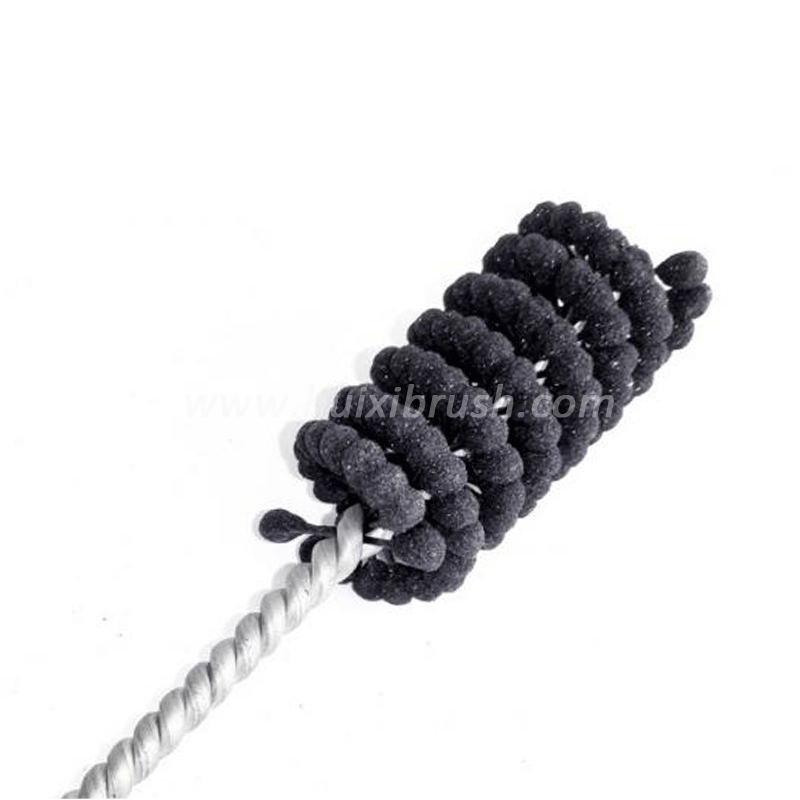
When dimensional accuracy is the priority, tool pressure and grit selection must be controlled so burr removal does not change bore scale. <honing brush treat burrs in barrel parts without affecting accuracy and scale> explains setup choices for accuracy-sensitive barrel parts.
Get a Bore-Specific Recommendation
Send the bore diameter, bore length, workpiece material, target finish, current operation, and annual quantity to [email protected]. A Huixi Brush application engineer can evaluate whether an abrasive nylon honing brush, a steel wire brush, or a staged process will be more reliable for your part. For immediate needs, call +86 1580 0932 713.
FAQ
Is an abrasive nylon honing brush a replacement for rigid honing stones?
No. If the part needs heavy stock removal or correction of bore geometry, rigid honing is still required. Abrasive nylon brushes are strongest for edge conditioning, cross-hole deburring, and plateau finishing after the bore has been sized.
Can one brush work for multiple bore diameters?
A given brush size covers a narrow interference range. If the bore size range is too wide, using two brush sizes is safer than forcing one brush to cover both extremes.
Does steel wire always damage an engine bore?
No. Steel wire may be acceptable in rugged parts with loose finish limits, especially for heavy contamination removal. It is not the first choice when ferrous debris, roundness change, or surface scoring would create a functional problem.
What finish can abrasive nylon achieve?
The final Ra/Rz depends on grit, filament diameter, fill density, speed, coolant, cycle time, and the prior surface. Use the surface-texture definitions and measurement methods in ISO 21920-2 or ASME B46.1, and confirm the result on the actual part [1][3].
How can I prevent overheating in a cylinder bore?
Use coolant or oil mist where appropriate, reduce dwell, and avoid excessive brush interference. Check bore temperature and measured finish on trial parts before entering full production.
References
[1] ISO 21920-2:2021, Geometrical product specifications (GPS) — Surface texture: Profile, International Organization for Standardization.
[2] E. Oberg, H. Jones, H. Ryffel, and C. McCauley, Machinery’s Handbook, 31st ed. Industrial Press, 2020.
[3] ASME B46.1-2019, Surface Texture (Surface Roughness, Waviness, and Lay), American Society of Mechanical Engineers.
If you’re interested, check out these related articles:
the differences between inward and outward spiral brush
descaling spiral brush an innovative tool and generalist in the field of industrial cleaning
honing brush treat burrs in barrel parts without affecting accuracy and scale
honing brush a magic tool for flexible burr removal


 Whatsapp
 Email
Email